



 Chat with AI
Exam 18: Thermodynamics

Exam 1: Introduction153 Questions
Exam 2: Atoms, Molecules, and Ions141 Questions
Exam 3: Stoichiometry168 Questions
Exam 4: Reactions in Aqueous Solution156 Questions
Exam 5: Gases109 Questions
Exam 6: Energy Relationships in Chemical Reactions105 Questions
Exam 7: The Electronic Structure of Atoms115 Questions
Exam 8: The Periodic Table119 Questions
Exam 9: Chemical Bonding I: the Covalent Bond118 Questions
Exam 10: Chemical Bonding Ii: Molecular Geometry and Hybridization of Atomic Orbitals120 Questions
Exam 11: Introduction to Organic Chemistry57 Questions
Exam 12: Intermolecular Forces and Liquids and Solids138 Questions
Exam 13: Physical Properties of Solutions109 Questions
Exam 14: Chemical Kinetics114 Questions
Exam 15: Chemical Equilibrium99 Questions
Exam 16: Acids and Bases163 Questions
Exam 17: Acid-Base Equilibria and Solubility Equilibria92 Questions
Exam 18: Thermodynamics112 Questions
Exam 19: Redox Reactions and Electrochemistry138 Questions
Exam 20: The Chemistry of Coordination Compounds76 Questions
Exam 21: Nuclear Chemistry112 Questions
Exam 22: Organic Polymerssynthetic and Natural42 Questions
Select questions type


For the reaction H2(g)+ S(s) H2S(g), H° = -20.2 kJ/mol and S° = +43.1 J/K·mol. Which of these statements is true?
(Multiple Choice)
4.8/5  (89)
(89) Kw for the auto-ionization of water, H2O(l) H+(aq)+ OH- (aq), is 1.0 * 10-14. What are the signs (+/-)of S° and H° for the reaction at 25°C?
(Multiple Choice)
4.9/5 (69)
(69) Which one of the following reactions would you expect to have the lowest S°?
(Multiple Choice)
4.8/5 (73)
(73) For the reaction CuS(s)+ H2(g) H2S(g)+ Cu(s),
G°f (CuS)= -53.6 kJ/mol
G°f (H2S)= -33.6 kJ/mol
H°f (CuS)= -53.1 kJ/mol
H°f (H2S)= -20.6 kJ/mol
Calculate the value of the equilibrium constant (Kp)for this reaction at 298 K.
(Essay)
4.9/5 (92)
(92) Using the thermodynamic data provided below, calculate Ksp for ZnS(s)at 25°. 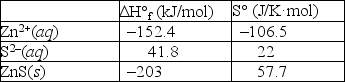
(Essay)
4.9/5 (97)
(97) Predict the sign of S for the process N2(g, 10 atm) N2(g, 1atm).
(Short Answer)
5.0/5 (103)
(103) Sulfur can be separated from lead in the mineral galena, PbS(s), by "roasting" the ore in the presence of oxygen as shown in the following reaction:
2PbS(s)+ 3O2(g) 2PbO(s)+ 2SO2(g)
Determine G for the above reaction at 850°C. 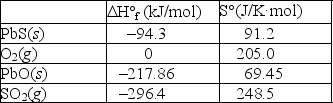
(Short Answer)
4.9/5 (77)
(77) Given the following data, estimate the boiling point of carbon disulfide, CS2, assuming that S° and H° are temperature-independent. 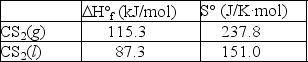
(Short Answer)
4.8/5 (82)
(82) In the gas phase, formic acid forms a dimmer, 2HCOOH(g) (HCOOH)2(g). For this reaction, H° = -60.1 kJ/mol and G° = -13.9 kJ/mol at 25°C. Find the equilibrium constant (Kp)for this reaction at 75 °C.
(Multiple Choice)
4.9/5 (74)
(74) Using the thermodynamic data provided below, calculate Ka1 for H2CO3(aq)at 25°. 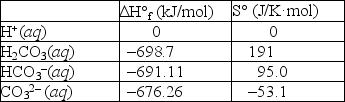
(Essay)
4.7/5 (91)
(91) For the reaction SbCl5(g) SbCl3(g)+ Cl2(g),
G°f (SbCl5)= -334.34 kJ/mol
G°f (SbCl3)= -301.25 kJ/mol
H°f (SbCl5)= -394.34 kJ/mol
H°f (SbCl3)= -313.80 kJ/mol
Calculate the value of the equilibrium constant (Kp)for this reaction at 298 K.
(Essay)
4.8/5 (86)
(86) The heat of vaporization of water is 2.27 kJ/g. What is Svap per mole at the normal boiling point?
(Short Answer)
4.7/5 (83)
(83) Ozone (O3)in the atmosphere can reaction with nitric oxide (NO): O3(g)+ NO(g) NO2(g)+ O2(g).
Calculate the G° for this reaction at 25°C. ( H° = -199 kJ/mol, S° = -4.1 J/K·mol)
(Multiple Choice)
4.9/5 (84)
(84) At 1500°C the equilibrium constant for the reaction CO(g)+ 2H2(g) CH3OH(g)has the value Kp = 1.4 * 10-7. Calculate G° for this reaction at 1500°C.
(Multiple Choice)
4.7/5 (89)
(89) Determine the equilibrium constant Kp at 25°C for the reaction N2(g)+ 3H2(g) 2NH3(g) [ G°f (NH3(g))= -16.6 kJ/mol].
(Multiple Choice)
4.8/5 (83)
(83) Consider the gas phase reaction shown below.
CH4(g)+ CF4(g) CH3F(g)+ CHF3(g)
Will the standard entropy increase, decrease, or remain if the reaction proceeds from reactants to products, as written? Explain your reasoning.
(Essay)
4.9/5 (77)
(77) In the gas phase, methyl isocyanate (CH3NC)isomerizes to acetonitrile (CH3CN), H3C-N C (g) H3C-C N (g)
With H° = -89.5 kJ/mol and G° = -73.8 kJ/mol at 25°C. Find the equilibrium constant for this reaction at 100°C.
(Multiple Choice)
4.8/5 (77)
(77) 
Filters
- Essay(0)
- Multiple Choice(0)
- Short Answer(0)
- True False(0)
- Matching(0)