



 Chat with AI
Exam 20: The Chemistry of Coordination Compounds

Exam 1: Introduction153 Questions
Exam 2: Atoms, Molecules, and Ions141 Questions
Exam 3: Stoichiometry168 Questions
Exam 4: Reactions in Aqueous Solution156 Questions
Exam 5: Gases109 Questions
Exam 6: Energy Relationships in Chemical Reactions105 Questions
Exam 7: The Electronic Structure of Atoms115 Questions
Exam 8: The Periodic Table119 Questions
Exam 9: Chemical Bonding I: the Covalent Bond118 Questions
Exam 10: Chemical Bonding Ii: Molecular Geometry and Hybridization of Atomic Orbitals120 Questions
Exam 11: Introduction to Organic Chemistry57 Questions
Exam 12: Intermolecular Forces and Liquids and Solids138 Questions
Exam 13: Physical Properties of Solutions109 Questions
Exam 14: Chemical Kinetics114 Questions
Exam 15: Chemical Equilibrium99 Questions
Exam 16: Acids and Bases163 Questions
Exam 17: Acid-Base Equilibria and Solubility Equilibria92 Questions
Exam 18: Thermodynamics112 Questions
Exam 19: Redox Reactions and Electrochemistry138 Questions
Exam 20: The Chemistry of Coordination Compounds76 Questions
Exam 21: Nuclear Chemistry112 Questions
Exam 22: Organic Polymerssynthetic and Natural42 Questions
Select questions type


The oxidation number of Co in [Co(NH3)4Cl2]Cl is +1.

Free
(True/False)
4.9/5  (78)
(78) Correct Answer: Verified
False
In the complex ion [Fe(CN)6]4-, the oxidation number of Fe is
Free
(Multiple Choice)
4.9/5 (80)
(80) Correct Answer:Verified
VerifiedB
In the complex ion [Cr(C2O4)2(H2O)2]-, the oxidation number of Cr is
Free
(Multiple Choice)
4.8/5 (81)
(81) Correct Answer:Verified
VerifiedC
Give (a)the oxidation number of the metal, (b)the number of d electrons, (c)the coordination number, (d)the charge of the complex ion, and (e)the number and type of ligands for the coordination compound shown below. 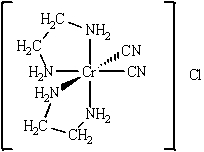
(Essay)
4.9/5 (71)
(71) In the following pair of complex ions, choose the one that absorbs light at a longer wavelength.
(Multiple Choice)
4.9/5 (76)
(76) Which of these electron energy level patterns would absorb light with the shortest wavelength? 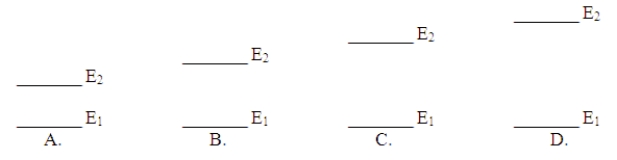
(Multiple Choice)
4.8/5 (83)
(83) In the following pair of complex ions, choose the one that absorbs light at a shorter wavelength.
(Multiple Choice)
4.9/5 (96)
(96) The correct formula for the dichlorobis(ethylenediamine)chromium(III)ion is
(Multiple Choice)
4.8/5 (88)
(88) How many geometric isomers are possible for the complex [CrF3Br3]3-? Draw these isomers.
(Essay)
4.9/5 (66)
(66) Two well-known complex ions containing Ni are [Ni(H2O)6]2+, which is green, and [Ni(en)3]2+, which is purple. Which one of these statements is true?
(Multiple Choice)
4.9/5 (79)
(79) How many unpaired electrons does the manganese ion have in [Mn(CN)6]4- ?
(Multiple Choice)
4.9/5 (86)
(86) The correct formula for the dibromobis(oxalato)cobaltate(III)ion is [Co(C2O4)Br2]3+.
(True/False)
4.9/5 (75)
(75) How would you expect the molecule 1,10-phenanthroline (shown below)to function as a ligand? 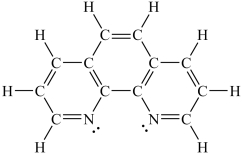
(Multiple Choice)
4.8/5 (82)
(82) Predict the number of unpaired electrons in the [Fe(CN)6]4- ion.
(Short Answer)
4.8/5 (87)
(87) A complex with the composition [MA2B2]X2 is found to have no geometrical isomers. Both A and B are monodentate ligands. The structure of the complex is
(Multiple Choice)
4.8/5 (81)
(81) A molecule or ion that provides an electron pair for coordinate covalent bond formation is called a Lewis ________.
(Short Answer)
4.8/5 (72)
(72) In the complex ion [ML6]n+, Mn+ has five d electrons and L is a strong field ligand. According to crystal field theory, the magnetic properties of the complex ion correspond to how many unpaired electrons?
(Multiple Choice)
4.8/5 (76)
(76) A molecule or atom that accepts an electron pair to form a coordinate covalent bond is called a Lewis _______.
(Short Answer)
4.8/5 (78)
(78) 
Filters
- Essay(0)
- Multiple Choice(0)
- Short Answer(0)
- True False(0)
- Matching(0)