



 Chat with AI
Exam 18: Thermodynamics

Exam 1: Introduction153 Questions
Exam 2: Atoms, Molecules, and Ions141 Questions
Exam 3: Stoichiometry168 Questions
Exam 4: Reactions in Aqueous Solution156 Questions
Exam 5: Gases109 Questions
Exam 6: Energy Relationships in Chemical Reactions105 Questions
Exam 7: The Electronic Structure of Atoms115 Questions
Exam 8: The Periodic Table119 Questions
Exam 9: Chemical Bonding I: the Covalent Bond118 Questions
Exam 10: Chemical Bonding Ii: Molecular Geometry and Hybridization of Atomic Orbitals120 Questions
Exam 11: Introduction to Organic Chemistry57 Questions
Exam 12: Intermolecular Forces and Liquids and Solids138 Questions
Exam 13: Physical Properties of Solutions109 Questions
Exam 14: Chemical Kinetics114 Questions
Exam 15: Chemical Equilibrium99 Questions
Exam 16: Acids and Bases163 Questions
Exam 17: Acid-Base Equilibria and Solubility Equilibria92 Questions
Exam 18: Thermodynamics112 Questions
Exam 19: Redox Reactions and Electrochemistry138 Questions
Exam 20: The Chemistry of Coordination Compounds76 Questions
Exam 21: Nuclear Chemistry112 Questions
Exam 22: Organic Polymerssynthetic and Natural42 Questions
Select questions type


Find the temperature at which Kp = 4.00 for the reaction N2O4(g) 2NO2(g). [Given: at 25°C, for NO2(g), H°f = 33.85 kJ/mol, S° = 240.46 J/mol·K; for N2O4(g), H°f = 9.66 kJ/mol, S° = 304.3 J/mol·K; assume that H° and S° are independent of temperature.]

Free
(Multiple Choice)
4.7/5  (65)
(65) Correct Answer: Verified
D
The entropy change S° for the reaction NH4Cl(s) NH3(g)+ HCl(g)will be negative.
Free
(True/False)
4.9/5 (84)
(84) Correct Answer:Verified
VerifiedFalse
Which of these species has the highest entropy (S°)at 25°C?
Free
(Multiple Choice)
4.9/5 (77)
(77) Correct Answer:Verified
VerifiedB
Is the reaction SiO2(s)+ Pb(s) PbO2(s)+ Si(s)spontaneous?
G°f (PbO2)= -217 kJ/mol
G°f (SiO2)= -856 kJ/mol
(Short Answer)
4.8/5 (90)
(90) Predict the normal boiling point of triethylborane (C6H15B)using the following data: 
(Multiple Choice)
4.8/5 (77)
(77) For the reaction H2O2(g) H2O(g)+ 1/2O2(g), H° = -106 kJ/mol and S° = 58 J/K·mol at 25°C. Is H2O2(g)stable with respect to dissociation into water vapor and oxygen gas at 25°C?
(Short Answer)
4.9/5 (64)
(64) Which species will have the lowest absolute entropy at 25°C?
(Multiple Choice)
4.8/5 (79)
(79) The following reaction is spontaneous under standard state conditions at 25°C:
AgCl(s) Ag+(aq)+ Cl-(aq)( G° = 55 kJ/mol)
(True/False)
5.0/5 (86)
(86) For the reaction 3H2(g)+ N2(g) 2NH3(g), Kc = 9.0 at 350°C. In what direction does the reaction proceed when 1.0 mol NH3, 5.0 mol N2, and 5.0 mol H2 are mixed in a 2.5 L reactor?
(Short Answer)
4.8/5 (79)
(79) How does the entropy change when a molecular solid is dissolved in water?
(Short Answer)
4.8/5 (73)
(73) The free energy of formation of nitric oxide, NO, at 1000 K (roughly the temperature in an automobile engine during ignition)is about 78 kJ/mol. Calculate the equilibrium constant Kp for the reaction N2(g)+ O2(g) 2NO(g)at this temperature.
(Essay)
4.8/5 (92)
(92) Which of these species would you expect to have the lowest standard entropy (S°)?
(Multiple Choice)
4.8/5 (73)
(73) Calculate G° for the reaction 3NO2(g)+ H2O(l) 2HNO3(l)+ NO(g). 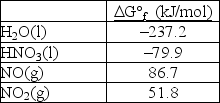
(Multiple Choice)
4.9/5 (78)
(78) Which of these species would you expect to have the highest standard entropy (S°)?
(Multiple Choice)
4.9/5 (74)
(74) The element oxygen was prepared by Joseph Priestley in 1774 by heating mercury(II)oxide: HgO(s) Hg(l)+ 1/2O2(g), H° = 90.84 kJ/mol.
Estimate the temperature at which this reaction will become spontaneous under standard state conditions.
S°(Hg)= 76.02 J/K·mol
S°(O2)= 205.0 J/K·mol
S°(HgO)= 70.29 J/K·mol
(Multiple Choice)
4.9/5 (77)
(77) 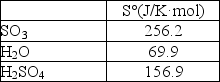
Find the temperature at which the reaction N2O4(g) 2NO2(g)will be in equilibrium when both gases are present at partial pressures of 1.00 atm. 
(Multiple Choice)
4.7/5 (72)
(72) Using the thermodynamic data provided below, calculate the standard change in entropy when one mole of sodium sulfate is dissolved in water? 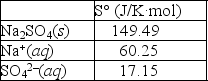 Will the solubility of sodium nitrate increase or decrease if the temperature of the system is increased?
 (Essay)
4.7/5 (86)
(86) 
Filters
- Essay(0)
- Multiple Choice(0)
- Short Answer(0)
- True False(0)
- Matching(0)