



 Chat with AI
Exam 18: Thermodynamics

Exam 1: Introduction153 Questions
Exam 2: Atoms, Molecules, and Ions141 Questions
Exam 3: Stoichiometry168 Questions
Exam 4: Reactions in Aqueous Solution156 Questions
Exam 5: Gases109 Questions
Exam 6: Energy Relationships in Chemical Reactions105 Questions
Exam 7: The Electronic Structure of Atoms115 Questions
Exam 8: The Periodic Table119 Questions
Exam 9: Chemical Bonding I: the Covalent Bond118 Questions
Exam 10: Chemical Bonding Ii: Molecular Geometry and Hybridization of Atomic Orbitals120 Questions
Exam 11: Introduction to Organic Chemistry57 Questions
Exam 12: Intermolecular Forces and Liquids and Solids138 Questions
Exam 13: Physical Properties of Solutions109 Questions
Exam 14: Chemical Kinetics114 Questions
Exam 15: Chemical Equilibrium99 Questions
Exam 16: Acids and Bases163 Questions
Exam 17: Acid-Base Equilibria and Solubility Equilibria92 Questions
Exam 18: Thermodynamics112 Questions
Exam 19: Redox Reactions and Electrochemistry138 Questions
Exam 20: The Chemistry of Coordination Compounds76 Questions
Exam 21: Nuclear Chemistry112 Questions
Exam 22: Organic Polymerssynthetic and Natural42 Questions
Select questions type


Using the thermodynamic data provided below, calculate the standard change in entropy when one mole of sodium nitrate is dissolved in water? 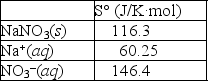 Will the solubility of sodium nitrate increase or decrease if the temperature of the system is increased?
 (Essay)
4.8/5  (88)
(88) The standard free energy of formation of gaseous hydrogen iodide is 1.30 kJ/mol at 25°C. Find Kp for the reaction H2(g)+ I2(s) 2HI(g)at this temperature.
(Multiple Choice)
4.7/5 (92)
(92) Choose the substance with the higher entropy per mole at a given temperature: CO2(g)or CO2(aq).
(Short Answer)
4.9/5 (90)
(90) The reaction rates of many spontaneous reactions are actually very slow. Which of these statements is the best explanation for this observation?
(Multiple Choice)
4.8/5 (75)
(75) Nitrosyl chloride (NOCl)decomposes at elevated temperatures according to the equation 2NOCl(g) 2NO(g)+ Cl2(g). Calculate Kp for this reaction at 227°C. ( H° = 81.2 kJ/mol, S° = 128 J/K·mol)
(Multiple Choice)
4.7/5 (93)
(93) Which of these species has the highest entropy (S°)at 25°C?
(Multiple Choice)
4.8/5 (74)
(74) Sodium carbonate can be made by heating sodium bicarbonate: 2NaHCO3(s) Na2CO3(s)+ CO2(g)+ H2O(g)
Given that H° = 128.9 kJ/mol and G° = 33.1 kJ/mol at 25°C, above what minimum temperature will the reaction become spontaneous under standard state conditions?
(Multiple Choice)
4.9/5 (87)
(87) Aluminum forms a layer of aluminum oxide when exposed to air which protects the bulk metal from further corrosion. 4Al(s)+ 3O2(g) 2Al2O3(s)
Using the thermodynamic data provided below, calculate S° for this reaction. 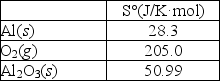
(Multiple Choice)
4.9/5 (74)
(74) Consider the reaction CO(g)+ 2H2(g) CH3OH(l)at 25°C.
G°f (CO)= -137.3 kJ/mol
G°f (CH3OH)= -166.3 kJ/mol
H°f (CO)= -110.5 kJ/mol
H°f (CH3OH)= -238.7 kJ/mol
S°(CO)= 197.9 J/K·mol
S°(CH3OH)= 126.8 J/K·mol
Calculate S°(H2(g)).
(Short Answer)
4.9/5 (88)
(88) Calculate the free energy of formation of NaBr(s)given the following information:
NaBr(s) Na(s)+ 1/2Br2(l), G° = 349 kJ/mol
(Short Answer)
4.9/5 (63)
(63) Which species will have the greatest absolute entropy at 25°C?
(Multiple Choice)
4.9/5 (73)
(73) A sample of solid naphthalene is introduced into an evacuated flask. Use the data below to calculate the equilibrium vapor pressure of naphthalene (C10H8)in the flask at 35°C. 
(Multiple Choice)
4.9/5 (77)
(77) Calculate G° for the combustion of ethanol vapor, C2H5OH(g), at 750°C in oxygen to form carbon dioxide and water vapor. The following data is valid at 25°C: 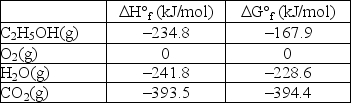
(Multiple Choice)
4.8/5 (89)
(89) Aluminum forms a layer of aluminum oxide when exposed to air which protects the bulk metal from further corrosion. 4Al(s)+ 3O2(g) 2Al2O3(s)
Calculate G° for this reaction, given that G°f of aluminum oxide is -1576.4 kJ/mol.
(Multiple Choice)
4.8/5 (63)
(63) For the reaction SbCl5(g) SbCl3(g)+ Cl2(g),
G°f (SbCl5)= -334.34 kJ/mol
G°f (SbCl3)= -301.25 kJ/mol
H°f (SbCl5)= -394.34 kJ/mol
H°f (SbCl3)= -313.80 kJ/mol
Calculate the value of the equilibrium constant (Kp)at 800 K and 1 atm pressure.
(Essay)
4.9/5 (78)
(78) The entropy change on vaporization ( Svap)of a compound or element is
(Multiple Choice)
4.9/5 (68)
(68) Predict the sign of S for the process Ni(s, 50°C) Ni(s, 25°C).
(Short Answer)
4.8/5 (83)
(83) Choose the substance with the higher entropy per mole at a given temperature: 1 mole of N2(g)in a 22.4 L container or 1 mole of N2(g)in a 2.24 L container.
(Essay)
4.9/5 (69)
(69) 
Filters
- Essay(0)
- Multiple Choice(0)
- Short Answer(0)
- True False(0)
- Matching(0)