



 Chat with AI
Exam 18: Thermodynamics

Exam 1: Introduction153 Questions
Exam 2: Atoms, Molecules, and Ions141 Questions
Exam 3: Stoichiometry168 Questions
Exam 4: Reactions in Aqueous Solution156 Questions
Exam 5: Gases109 Questions
Exam 6: Energy Relationships in Chemical Reactions105 Questions
Exam 7: The Electronic Structure of Atoms115 Questions
Exam 8: The Periodic Table119 Questions
Exam 9: Chemical Bonding I: the Covalent Bond118 Questions
Exam 10: Chemical Bonding Ii: Molecular Geometry and Hybridization of Atomic Orbitals120 Questions
Exam 11: Introduction to Organic Chemistry57 Questions
Exam 12: Intermolecular Forces and Liquids and Solids138 Questions
Exam 13: Physical Properties of Solutions109 Questions
Exam 14: Chemical Kinetics114 Questions
Exam 15: Chemical Equilibrium99 Questions
Exam 16: Acids and Bases163 Questions
Exam 17: Acid-Base Equilibria and Solubility Equilibria92 Questions
Exam 18: Thermodynamics112 Questions
Exam 19: Redox Reactions and Electrochemistry138 Questions
Exam 20: The Chemistry of Coordination Compounds76 Questions
Exam 21: Nuclear Chemistry112 Questions
Exam 22: Organic Polymerssynthetic and Natural42 Questions
Select questions type


Hvap for ethanol is 38.7 kJ/mol at its boiling point (78°C). What is Ssurr when 1.00 mole of ethanol is boiled?
(Short Answer)
4.8/5  (74)
(74) For the reaction H2O2(g) H2O(g)+ 1/2O2(g), H° = -106 kJ/mol and S° = 58 J/K·mol at 25°C. Calculate G° for this reaction at this temperature.
(Short Answer)
4.9/5 (88)
(88) Hydrogen peroxide (H2O2)decomposes according to the equation H2O2(l) H2O(l)+ 1/2O2(g).
Calculate Kp for this reaction at 25°C. ( H° = -98.2 kJ/mol, S° = 70.1 J/K·mol)
(Multiple Choice)
4.8/5 (77)
(77) For the reaction 2C(graphite)+ H2(g) C2H2(g), G°= +209.2 kJ/mol at 25°C. If P(H2)= 100. atm, and P(C2H2)= 0.10 atm, calculate G for this reaction.
(Multiple Choice)
4.9/5 (81)
(81) For the reaction CuS(s)+ H2(g) H2S(g)+ Cu(s),
G°f (CuS)= -53.6 kJ/mol
G°f (H2S)= -33.6 kJ/mol
H°f (CuS)= -53.1 kJ/mol
H°f (H2S)= -20.6 kJ/mol
Calculate G at 798 K and 1 atm pressure (assume S° and H° do not change with temperature).
(Short Answer)
4.8/5 (80)
(80) Calculate S° for the reaction SO2(s)+ NO2(g) SO3(g)+ NO(g). 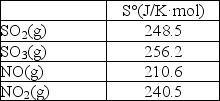
(Multiple Choice)
4.8/5 (81)
(81) Calculate S° at 25°C for the reduction of PbO(s), 2PbO(s)+ C(s) 2Pb(s)+ CO2(g)given these absolute entropies: 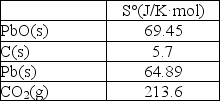
(Multiple Choice)
4.7/5 (81)
(81) Which one of the following reactions would you expect to have highest S°?
(Multiple Choice)
4.8/5 (76)
(76) For the reaction 3H2(g)+ N2(g) 2NH3(g), Kc = 9.0 at 350°C. Calculate G° at 350°C.
(Short Answer)
4.9/5 (71)
(71) Determine the equilibrium constant (Kp)at 25°C for the reaction CO(g)+ H2O(g) CO2(g)+ H2(g) G° = -28.5 kJ/mol.
(Multiple Choice)
4.9/5 (69)
(69) Using the thermodynamic data provided below, calculate Ka for HCN(aq)at 25°. 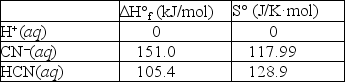
(Essay)
4.7/5 (76)
(76) Given the following data, calculate the boiling point of HCOOH (formic acid). 
(Short Answer)
4.9/5 (73)
(73) Using the thermodynamic data provided below, determine the temperature in °C at which the decomposition of solid calcium carbonate to form solid calcium oxide and oxygen becomes spontaneous. 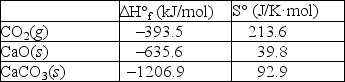
(Short Answer)
4.8/5 (69)
(69) Calculate Kp at 298 K for the reaction SO2(g)+ NO2(g) SO3(g)+ NO(g). 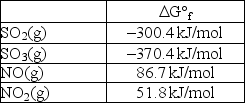
(Multiple Choice)
4.9/5 (76)
(76) The equilibrium constant at 427°C for the reaction N2(g)+ 3H2(g) 2NH3(g)is Kp = 9.4 * 10-5. Calculate the value of G° for the reaction under these conditions.
(Multiple Choice)
4.9/5 (75)
(75) Find the temperature at which Kp = 42.0 for the reaction H2(g)+ I2(g) 2HI(g). [Given: at 25°C, for H2(g), H°f = 0, S° = 131.0 J/mol·K; for I2(g), H°f = 62.26 kJ/mol, S° = 260.6 J/mol·K; for HI(g), H°f = 25.9 kJ/mol, S° = 206.3 J/mol·K; assume that H° and S° are independent of temperature.]
(Multiple Choice)
4.9/5 (82)
(82) Given the following data, estimate the boiling point of bromine, Br2, assuming that S° and H° are temperature-independent. 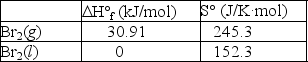
(Short Answer)
4.8/5 (85)
(85) 
Filters
- Essay(0)
- Multiple Choice(0)
- Short Answer(0)
- True False(0)
- Matching(0)