



 Chat with AI
Exam 14: Chemical Kinetics

Exam 1: Introduction153 Questions
Exam 2: Atoms, Molecules, and Ions141 Questions
Exam 3: Stoichiometry168 Questions
Exam 4: Reactions in Aqueous Solution156 Questions
Exam 5: Gases109 Questions
Exam 6: Energy Relationships in Chemical Reactions105 Questions
Exam 7: The Electronic Structure of Atoms115 Questions
Exam 8: The Periodic Table119 Questions
Exam 9: Chemical Bonding I: the Covalent Bond118 Questions
Exam 10: Chemical Bonding Ii: Molecular Geometry and Hybridization of Atomic Orbitals120 Questions
Exam 11: Introduction to Organic Chemistry57 Questions
Exam 12: Intermolecular Forces and Liquids and Solids138 Questions
Exam 13: Physical Properties of Solutions109 Questions
Exam 14: Chemical Kinetics114 Questions
Exam 15: Chemical Equilibrium99 Questions
Exam 16: Acids and Bases163 Questions
Exam 17: Acid-Base Equilibria and Solubility Equilibria92 Questions
Exam 18: Thermodynamics112 Questions
Exam 19: Redox Reactions and Electrochemistry138 Questions
Exam 20: The Chemistry of Coordination Compounds76 Questions
Exam 21: Nuclear Chemistry112 Questions
Exam 22: Organic Polymerssynthetic and Natural42 Questions
Select questions type


The first-order reaction SO2Cl2 SO2 + Cl2 is 10% complete in 80. min. How long would it take for the reaction to be 95% complete?

Free
(Multiple Choice)
4.8/5  (80)
(80) Correct Answer: Verified
D
The reaction A + 2B products has been found to have the rate law, rate = k[A] [B]2. While holding the concentration of A constant, the concentration of B is increased from x to 3x. Predict by what factor the rate of reaction increases.
Free
(Multiple Choice)
4.8/5 (73)
(73) Correct Answer:Verified
VerifiedC
The following initial rate data apply to the reaction below. F2(g)+ 2Cl2O(g) 2FClO2(g)+ Cl2(g)  Which of the following is the rate law (rate equation)for this reaction?
 Free
(Multiple Choice)
4.8/5 (81)
(81) Correct Answer:Verified
VerifiedC
The oxidation of iodide ions by arsenic acid in acidic aqueous solution occurs according to the net reaction H3AsO4 + 3I - + 2 H3O + H3AsO3 + I3- + H2O. The experimental rate law for this reaction is
Rate = k [H3AsO4] [I-] [H3O+].
According to the rate law for the reaction, an increase in the concentration of hydronium ion has what effect on this reaction?
(Essay)
4.7/5 (85)
(85) Ammonium ion (NH4+)reacts with nitrite ion (NO2-)to yield nitrogen gas and liquid water. The following initial rates of reaction have been measured for the given reactant concentrations.  Which of the following is the rate law (rate equation)for this reaction?
 (Multiple Choice)
4.8/5 (80)
(80) Nitric oxide reacts with chlorine to form nitrosyl chloride, NOCl. Use the following data to determine the rate equation for the reaction. NO + 1/2Cl2 NOCl 
(Multiple Choice)
4.8/5 (72)
(72) The isomerization of cyclopropane to form propene is a first-order reaction. 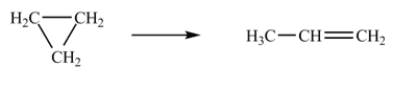 At 760 K, 85% of a sample of cyclopropane changes to propene in 79.0 min. Determine the rate constant for this reaction at 760 K.
 (Multiple Choice)
4.8/5 (75)
(75) The activation energy for the following first-order reaction is 102 kJ/mol. N2O5(g) 2NO2(g)+ 1/2O2(g)
The value of the rate constant (k)is 1.35 * 10-4 s-1 at 35°C. What is the value of k at 0°C?
(Multiple Choice)
4.9/5 (86)
(86) At 25°C, the second-order reaction NOCl(g) NO(g)+ 1/2Cl2(g) is 50% complete after 5.82 hours when the initial concentration of NOCl is 4.46 mol/L. How long will it take for the reaction to be 75% complete?
(Multiple Choice)
4.8/5 (76)
(76) Which one of the following units would not be an acceptable way to express reaction rate?
(Multiple Choice)
4.8/5 (78)
(78) The gas phase reaction of nitrogen dioxide and carbon monoxide was found by experiment to be second-order with respect to NO2, and zeroth-order with respect to CO below 25°C. NO2 + CO NO + CO2
Which one of the following mechanisms is consistent with the observed reaction order?
(Multiple Choice)
4.9/5 (69)
(69) With respect to the figure below, which choice correctly identifies all the numbered positions? 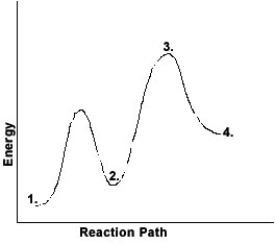

(Multiple Choice)
4.7/5 (88)
(88) For the chemical reaction A B + C, a plot of [A]t versus time is found to give a straight line with a negative slope. What is the order of reaction with respect to A?
(Multiple Choice)
4.9/5 (83)
(83) The rate law predicted by the following two-step mechanism is rate = k[A][B].
A C + B slow
A + B C + E fast
(True/False)
4.9/5 (82)
(82) For the reaction C6H14(g) C6H6(g)+ 4H2(g), P(H2)/ t was found to be 2.5 * 10-2 atm/s, where P(H2)is the change in pressure of hydrogen. Determine P(C6H14)/ t for this reaction at the same time.
(Multiple Choice)
4.9/5 (81)
(81) A certain first-order reaction A B is 25% complete in 42 min at 25°C. What is the half-life of the reaction?
(Multiple Choice)
4.8/5 (70)
(70) For what order reaction does the half-life get longer as the initial concentration increases?
(Multiple Choice)
4.8/5 (82)
(82) The reaction A + 2B products was found to follow the rate law: rate = k[A]2[B]. Predict by what factor the rate of reaction will increase when the concentration of A is doubled, the concentration of B is tripled, and the temperature remains constant.
(Multiple Choice)
4.8/5 (85)
(85) A first-order reaction has a rate constant of 3.00 * 10-3 s-1. The time required for the reaction to be 75.0% complete is
(Multiple Choice)
4.9/5 (78)
(78) 
Filters
- Essay(0)
- Multiple Choice(0)
- Short Answer(0)
- True False(0)
- Matching(0)