



 Chat with AI
Exam 14: Chemical Kinetics

Exam 1: Introduction153 Questions
Exam 2: Atoms, Molecules, and Ions141 Questions
Exam 3: Stoichiometry168 Questions
Exam 4: Reactions in Aqueous Solution156 Questions
Exam 5: Gases109 Questions
Exam 6: Energy Relationships in Chemical Reactions105 Questions
Exam 7: The Electronic Structure of Atoms115 Questions
Exam 8: The Periodic Table119 Questions
Exam 9: Chemical Bonding I: the Covalent Bond118 Questions
Exam 10: Chemical Bonding Ii: Molecular Geometry and Hybridization of Atomic Orbitals120 Questions
Exam 11: Introduction to Organic Chemistry57 Questions
Exam 12: Intermolecular Forces and Liquids and Solids138 Questions
Exam 13: Physical Properties of Solutions109 Questions
Exam 14: Chemical Kinetics114 Questions
Exam 15: Chemical Equilibrium99 Questions
Exam 16: Acids and Bases163 Questions
Exam 17: Acid-Base Equilibria and Solubility Equilibria92 Questions
Exam 18: Thermodynamics112 Questions
Exam 19: Redox Reactions and Electrochemistry138 Questions
Exam 20: The Chemistry of Coordination Compounds76 Questions
Exam 21: Nuclear Chemistry112 Questions
Exam 22: Organic Polymerssynthetic and Natural42 Questions
Select questions type


The rate constant for a certain first-order reaction is 0.40/min. What is the initial rate in mole/L·min, if the initial concentration of the compound involved is 0.50 mol/L?
(Short Answer)
5.0/5  (74)
(74) The isomerization of cyclopropane follows first order kinetics. The rate constant at 700 K is 6.20 * 10-4 min-1, and the half-life at 760 K is 29.0 min. Calculate the activation energy for this reaction.
(Multiple Choice)
4.9/5 (85)
(85) The reaction A + 2B products has the rate law, rate = k[A][B]3. If the concentration of B is doubled while that of A is unchanged, by what factor will the rate of reaction increase?
(Multiple Choice)
4.8/5 (79)
(79) The isomerization of methyl isocyanide, CH3NC CH3CN, follows first-order kinetics. The half-lives were found to be 161 min at 199°C and 12.5 min at 230°C. Calculate the activation energy for this reaction.
(Multiple Choice)
4.9/5 (81)
(81) A certain reaction A products is second order in A. If this reaction is 10.% complete after 20. s, how long would it take for the reaction to be 90.% complete?
(Multiple Choice)
4.9/5 (89)
(89) For the hypothetical reaction A + 3B 2C, the rate should be expressed as
(Multiple Choice)
4.8/5 (78)
(78) The activation energy for the reaction CH3CO CH3 + CO is 71 kJ/mol. How many times greater is the rate constant for this reaction at 170°C than at 150°C?
(Multiple Choice)
4.9/5 (80)
(80) An increase in the temperature of the reactants causes an increase in the rate of reaction. The best explanation for this behavior is that as the temperature increases,
(Multiple Choice)
4.9/5 (79)
(79) Peroxodisulfate ion can oxidize iodide ions to iodine according to the balanced equation S2O82- + 2I - 2SO42- + I2.
The reaction is catalyzed by certain chemical species. Identify the catalyst in the following mechanism:
Step 1: Fe3+ + 2I - Fe2+ + I2
Step 2: S2O82- + Fe2+ 2SO42- + Fe3+
(Multiple Choice)
4.8/5 (87)
(87) In which of the forms listed below would 0.5 g aluminum react the fastest with gaseous chlorine at 25°C?
(Multiple Choice)
4.8/5 (64)
(64) Nitric acid is formed by the gas-phase hydrolysis of N2O5. Draw an energy profile curve for the reaction N2O5 + H2O 2HNO3 given that Ea(forward)= 15 kJ and Ea(reverse)= 51 kJ/mol. Label the activation energies of the forward and reverse reactions and label H for the reaction.
(Essay)
4.8/5 (85)
(85) For the hypothetical reaction A + 3B 2C, the rate of appearance of C given by ( [C]/ t)may also be expressed as
(Multiple Choice)
4.9/5 (95)
(95) For the reaction X + Y Z, the reaction rate is found to depend only upon the concentration of X. A plot of 1/X verses time gives a straight line. 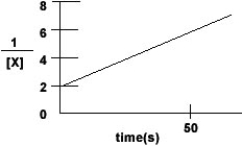 What is the rate law for this reaction?
 (Multiple Choice)
4.8/5 (81)
(81) A city's water supply is contaminated with a toxin at a concentration of 0.63 mg/L. Fortunately, this toxin decomposes to a safe mixture of products by first-order kinetics with a rate constant of 0.27 day-1. How long will it take for half of the toxin to decompose?
(Multiple Choice)
4.9/5 (95)
(95) The rate constant of a first-order reaction, A products, can be determined from a graph of ln[A] versus t.
(True/False)
4.7/5 (78)
(78) The first-order decomposition of SO2Cl2 to sulfur dioxide gas and chlorine gas at 320°C has a half-life of 8.75 hr. If one begins with 600. mmHg of pure SO2Cl2 in a 5.00-L flask at 320°C, how long does it take for the total pressure in the flask to rise to 1.000 atm?
(Multiple Choice)
4.9/5 (87)
(87) It takes 42.0 min for the concentration of a reactant in a first-order reaction to drop from 0.45 M to 0.32 M at 25°C. How long will it take for the reaction to be 90% complete?
(Multiple Choice)
4.7/5 (79)
(79) For the overall chemical reaction shown below, which one of the following statements can be rightly assumed? 2H2S(g)+ O2(g) 2S(s)+ 2H2O(l)
(Multiple Choice)
4.9/5 (81)
(81) At 25°C the rate constant for the first-order decomposition of a pesticide solution is 6.40 * 10-3 min-1. If the starting concentration of pesticide is 0.0314 M, what concentration will remain after 62.0 min at 25°C?
(Multiple Choice)
4.8/5 (92)
(92) 
Filters
- Essay(0)
- Multiple Choice(0)
- Short Answer(0)
- True False(0)
- Matching(0)