



 Chat with AI
Exam 14: Chemical Kinetics

Exam 1: Introduction153 Questions
Exam 2: Atoms, Molecules, and Ions141 Questions
Exam 3: Stoichiometry168 Questions
Exam 4: Reactions in Aqueous Solution156 Questions
Exam 5: Gases109 Questions
Exam 6: Energy Relationships in Chemical Reactions105 Questions
Exam 7: The Electronic Structure of Atoms115 Questions
Exam 8: The Periodic Table119 Questions
Exam 9: Chemical Bonding I: the Covalent Bond118 Questions
Exam 10: Chemical Bonding Ii: Molecular Geometry and Hybridization of Atomic Orbitals120 Questions
Exam 11: Introduction to Organic Chemistry57 Questions
Exam 12: Intermolecular Forces and Liquids and Solids138 Questions
Exam 13: Physical Properties of Solutions109 Questions
Exam 14: Chemical Kinetics114 Questions
Exam 15: Chemical Equilibrium99 Questions
Exam 16: Acids and Bases163 Questions
Exam 17: Acid-Base Equilibria and Solubility Equilibria92 Questions
Exam 18: Thermodynamics112 Questions
Exam 19: Redox Reactions and Electrochemistry138 Questions
Exam 20: The Chemistry of Coordination Compounds76 Questions
Exam 21: Nuclear Chemistry112 Questions
Exam 22: Organic Polymerssynthetic and Natural42 Questions
Select questions type


For the first-order reaction, A products, if half of the initial concentration of A reacts in 20 min, then the remaining half will completely react in the next 20 min.
(True/False)
4.7/5  (87)
(87) Nitrous oxide (N2O)decomposes at 600°C according to the balanced equation 2N2O(g) 2N2(g)+ O2(g)
A reaction mechanism involving three steps is shown below. Identify all of the catalysts in the following mechanism.
Cl2(g) 2Cl(g)
N2O(g)+ Cl(g) N2(g)+ ClO(g)(occurs twice)
ClO(g)+ ClO(g) Cl2(g)+ O2(g)
(Multiple Choice)
5.0/5 (94)
(94) Use the following data to determine the rate law for the reaction shown below. 2NO + H2 N2O + H2O 
(Multiple Choice)
4.9/5 (89)
(89) The oxidation of iodide ions by arsenic acid in acidic aqueous solution occurs according to the net reaction H3AsO4 + 3I - + 2 H3O + H3AsO3 + I3- + H2O. The experimental rate law for this reaction is rate = k [H3AsO4] [I-] [H3O+]. What is the order of the reaction with respect to I-?
(Short Answer)
4.9/5 (92)
(92) The activation energy for a certain reaction is 113 kJ/mol. By what factor (how many times)will the rate constant increase when the temperature is raised from 310 K to 325 K?
(Short Answer)
4.9/5 (76)
(76) The first-order decomposition of phosphene to phosphorus and hydrogen 4PH3(g) P4(g)+ 6H2(g)has a half-life of 35.0 s at 680°C. Starting with 520 mmHg of pure phosphene in an 8.00-L flask at 680°C, how long will it take for the total pressure in the flask to rise to 1.000 atm?
(Multiple Choice)
4.8/5 (110)
(110) When acetaldehyde at a pressure of 364 mmHg is introduced into an evacuated 500. mL flask at 518°C, the half-life for the second-order decomposition process, CH3CHO CH4 + CO, is 410. s. What will the total pressure in the flask be after 1.00 hour?
(Multiple Choice)
4.9/5 (92)
(92) Nitric acid is formed by the gas-phase hydrolysis of N2O5. For the reaction N2O5 + H2O 2HNO3, Ea(forward)= 15 kJ/mol and Ea(reverse)= 51 kJ/mol. Calculate Hrxn.
(Short Answer)
4.9/5 (84)
(84) The rate law for the reaction 2NO2 + O3 N2O5 + O2 is rate = k[NO2][O3]. Which one of the following mechanisms is consistent with this rate law?
(Multiple Choice)
4.9/5 (87)
(87) For the reaction whose rate law is rate = k[X], a plot of which of the following is a straight line?
(Multiple Choice)
4.9/5 (84)
(84) A certain reaction A products is second order in A. If this reaction is 85% complete in 12 minutes, how long would it take for the reaction to be 15% complete?
(Multiple Choice)
4.9/5 (83)
(83) Calculate the activation energy, in kJ/mol, for the redox reaction Sn2+ + 2Co3+ Sn4+ + 2Co2+. 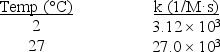
(Multiple Choice)
4.9/5 (89)
(89) The data below were determined for the reaction shown below. S2O82- + 3I - (aq) 2SO42- + I3-  The rate law for this reaction must be:
 (Multiple Choice)
4.8/5 (73)
(73) Use the table of data shown below to calculate the average rate of the reaction A B between 10 s and 20 s. 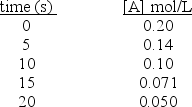
(Essay)
4.9/5 (75)
(75) At 25°C, by what factor is the reaction rate increased by a catalyst that reduces the activation energy of the reaction by 1.00 kJ/mol?
(Multiple Choice)
4.8/5 (80)
(80) Hydrogen peroxide decomposes to water and oxygen gas, and the activation energy for this process is 42 kJ/mol. The hydrogen peroxide formed in biological processes is harmful to tissue, but the enzyme catalase catalyzes the decomposition hydrogen peroxide by lowering the activation energy to 7.0 kJ/mol. Assuming the frequency factor is the same for both processes and independent of temperature, calculate the temperature required for the uncatalyzed decomposition to proceed at the same rate as the enzyme-catalyzed decomposition at 37°C (normal human body temperature). Is this a reasonable temperature for a biological organism?
(Short Answer)
4.8/5 (77)
(77) At a particular temperature the first-order gas-phase reaction N2O5 2NO2 + 1/2O2 has a half-life for the disappearance of dinitrogen pentoxide of 5130 s. Suppose 0.450 atm of N2O5 is introduced into an evacuated 2.00 L flask. What will be the total gas pressure inside the flask after 3.00 hours?
(Multiple Choice)
4.9/5 (79)
(79) For the reaction X2 + Y + Z XY + XZ, it is found that the rate equation is rate = k [X2][Y]. Why does the concentration of Z have no effect on the rate?
(Multiple Choice)
4.8/5 (92)
(92) 
Filters
- Essay(0)
- Multiple Choice(0)
- Short Answer(0)
- True False(0)
- Matching(0)