



 Chat with AI
Exam 14: Chemical Kinetics

Exam 1: Introduction153 Questions
Exam 2: Atoms, Molecules, and Ions141 Questions
Exam 3: Stoichiometry168 Questions
Exam 4: Reactions in Aqueous Solution156 Questions
Exam 5: Gases109 Questions
Exam 6: Energy Relationships in Chemical Reactions105 Questions
Exam 7: The Electronic Structure of Atoms115 Questions
Exam 8: The Periodic Table119 Questions
Exam 9: Chemical Bonding I: the Covalent Bond118 Questions
Exam 10: Chemical Bonding Ii: Molecular Geometry and Hybridization of Atomic Orbitals120 Questions
Exam 11: Introduction to Organic Chemistry57 Questions
Exam 12: Intermolecular Forces and Liquids and Solids138 Questions
Exam 13: Physical Properties of Solutions109 Questions
Exam 14: Chemical Kinetics114 Questions
Exam 15: Chemical Equilibrium99 Questions
Exam 16: Acids and Bases163 Questions
Exam 17: Acid-Base Equilibria and Solubility Equilibria92 Questions
Exam 18: Thermodynamics112 Questions
Exam 19: Redox Reactions and Electrochemistry138 Questions
Exam 20: The Chemistry of Coordination Compounds76 Questions
Exam 21: Nuclear Chemistry112 Questions
Exam 22: Organic Polymerssynthetic and Natural42 Questions
Select questions type


The isomerization of cyclopropane to form propene is a first-order reaction. 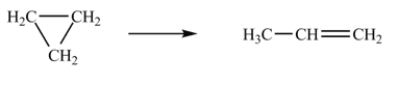 At 760 K, 15% of a sample of cyclopropane changes to propene in 6.8 min. What is the half-life of cyclopropane at 760 K?
 (Multiple Choice)
4.7/5  (71)
(71) Chlorine dioxide reacts in basic water to form chlorite and chlorate according to the following chemical equation: 2ClO2(aq)+ 2OH-(aq) ClO2-(aq)+ ClO3-(aq)+ H2O(l)
Under a certain set of conditions, the initial rate of disappearance of chlorine dioxide was determined to be 2.30 * 10-1 M/s. What is the initial rate of appearance of chlorite ion under those same conditions?
(Multiple Choice)
4.9/5 (90)
(90) If Ea for a certain biological reaction is 50. kJ/mol, by what factor (how many times)will the rate of this reaction increase when body temperature increases from 37°C (normal)to 40°C (fever)?
(Multiple Choice)
4.9/5 (78)
(78) For the first-order reaction 2N2O5 2N2O4 + O2 at a particular temperature, the half-life of N2O5 is 0.90 hr. What fraction of the initial concentration of N2O5 will remain after 2.4 hours?
(Short Answer)
4.9/5 (73)
(73) The activation energy of a certain uncatalyzed reaction is 64 kJ/mol. In the presence of a catalyst, the Ea is 55 kJ/mol. How many times faster is the catalyzed than the uncatalyzed reaction at 400°C? Assume that the frequency factor remains the same.
(Multiple Choice)
4.8/5 (95)
(95) The reaction C4H10 C2H6 + C2H4 has an activation energy (Ea)of 350 kJ/mol, and the Ea of the reverse reaction is 260 kJ/mol. Estimate H, in kJ/mol, for the reaction as written above.
(Multiple Choice)
4.8/5 (77)
(77) The activation energy for the following reaction is 60. kJ/mol. Sn2+ + 2Co3+ Sn4+ + 2Co2+
By what factor (how many times)will the rate constant increase when the temperature is raised from 10°C to 28°C?
(Multiple Choice)
4.7/5 (82)
(82) A certain first-order reaction A B is 25% complete in 42 min at 25°C. What is its rate constant?
(Multiple Choice)
4.8/5 (76)
(76) For the reaction BrO3- + 5Br-+ 6H+ 3Br2 + 3H2O at a particular time, - [BrO3-]/ t = 1.5 * 10-2 M/s. What is - [Br-]/ t at the same instant?
(Multiple Choice)
4.7/5 (83)
(83) Sucrose, C12H22O11, reacts slowly with water in the presence of an acid to form two other sugars, glucose and fructose, both of which have the same molecular formulas, but different structures.
C12H22O11 + H2O C6H12O6 (glucose)+ C6H12O6 (fructose)
The reaction is first order and has a rate constant of 6.2 * 10-5/s at 35°C when the H+ concentration is 0.10 M. Suppose that the initial concentration of sucrose in the solution is 0.40 M. What will the sucrose concentration be after 2.0 hours?
(Short Answer)
4.8/5 (73)
(73) A city's water supply is contaminated with a toxin at a concentration of 0.63 mg/L. For the water to be safe for drinking, the concentration of this toxin must be below 1.5 * 10-3 mg/L. Fortunately, this toxin decomposes to a safe mixture of products by first-order kinetics with a rate constant of 0.27 day-1. How long will it take for the water to be safe to drink?
(Multiple Choice)
4.9/5 (74)
(74) Benzoyl chloride, C6H5COCl, reacts with water to form benzoic acid, C6H5COOH, and hydrochloric acid. This first-order reaction is 25% complete after 26 s. How much longer would one have to wait in order to obtain 99% conversion of benzoyl chloride to benzoic acid?
(Multiple Choice)
4.9/5 (72)
(72) The reaction A + 2B products was found to have the rate law, rate = k[A] [B]2. Predict by what factor the rate of reaction will increase when the concentration of A is doubled and the concentration of B is also doubled.
(Multiple Choice)
4.7/5 (71)
(71) The rate law for the reaction H2O2 + 2H+ + 2I - I2 + 2H2O is rate = k[H2O2][I -]. The following mechanism has been suggested. H2O2 + I - HOI + OH - slow
OH - + H+ H2O fast
HOI + H+ + I - I2 + H2O fast
Identify all intermediates included in this mechanism.
(Multiple Choice)
4.7/5 (79)
(79) Given that Ea for a certain biological reaction is 48 kJ/mol and that the rate constant is 2.5 * 10-2 s-1 at 15°C, what is the rate constant at 37°C?
(Multiple Choice)
4.8/5 (84)
(84) Chlorine dioxide reacts in basic water to form chlorite and chlorate according to the following chemical equation: 2ClO2(aq)+ 2OH-(aq) ClO2-(aq)+ ClO3-(aq)+ H2O(l)
A kinetic study of this reaction under a certain set of conditions yielded the data below. 
(Multiple Choice)
4.9/5 (89)
(89) At a certain temperature, the data below were collected for the reaction below.
2ICl + H2 I2 + 2HCl.
Determine the rate law for the reaction. 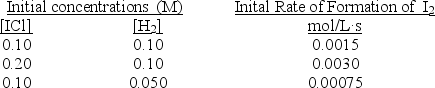
(Short Answer)
4.9/5 (74)
(74) Nitric oxide gas (NO)reacts with chlorine gas according to the chemical equation given below. NO +  Cl2 NOCl
The following initial rates of reaction have been measured for the given reagent concentrations.
 Which of the following is the rate law (rate equation)for this reaction?
Cl2 NOCl
The following initial rates of reaction have been measured for the given reagent concentrations. Which of the following is the rate law (rate equation)for this reaction? (Multiple Choice)
4.9/5 (83)
(83) Substitute natural gas can be synthesized by passing carbon monoxide and hydrogen over Ni or Co at 400°C.  This process is an example of homogeneous catalysis.
 (True/False)
4.9/5 (95)
(95) An experimental drug, D, is known to decompose in the blood stream. Tripling the concentration of the drug increases the decomposition rate by a factor of nine. Write the rate law for decomposition of D and give the units of the rate constant.
(Essay)
4.8/5 (77)
(77) 
Filters
- Essay(0)
- Multiple Choice(0)
- Short Answer(0)
- True False(0)
- Matching(0)