



 Chat with AI
Exam 9: Chemical Bonding I: the Covalent Bond

Exam 1: Introduction153 Questions
Exam 2: Atoms, Molecules, and Ions141 Questions
Exam 3: Stoichiometry168 Questions
Exam 4: Reactions in Aqueous Solution156 Questions
Exam 5: Gases109 Questions
Exam 6: Energy Relationships in Chemical Reactions105 Questions
Exam 7: The Electronic Structure of Atoms115 Questions
Exam 8: The Periodic Table119 Questions
Exam 9: Chemical Bonding I: the Covalent Bond118 Questions
Exam 10: Chemical Bonding Ii: Molecular Geometry and Hybridization of Atomic Orbitals120 Questions
Exam 11: Introduction to Organic Chemistry57 Questions
Exam 12: Intermolecular Forces and Liquids and Solids138 Questions
Exam 13: Physical Properties of Solutions109 Questions
Exam 14: Chemical Kinetics114 Questions
Exam 15: Chemical Equilibrium99 Questions
Exam 16: Acids and Bases163 Questions
Exam 17: Acid-Base Equilibria and Solubility Equilibria92 Questions
Exam 18: Thermodynamics112 Questions
Exam 19: Redox Reactions and Electrochemistry138 Questions
Exam 20: The Chemistry of Coordination Compounds76 Questions
Exam 21: Nuclear Chemistry112 Questions
Exam 22: Organic Polymerssynthetic and Natural42 Questions
Select questions type


Use bond energies to estimate the enthalpy of formation of HBr(g). BE(H-H)= 436 kJ/mol
BE(Br-Br)= 192 kJ/mol
BE(H-Br)= 366 kJ/mol

Free
(Multiple Choice)
4.7/5  (79)
(79) Correct Answer: Verified
B
Write a Lewis structure for SO3 that expands the octet to minimize formal charge and if necessary places negative formal charges on the most electronegative atom(s).
Free
(Essay)
4.9/5 (79)
(79) Correct Answer:Verified
Verified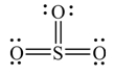
The bond in which of the following pairs of atoms would be the least polar (i.e., lowest percent ionic character)?
Free
(Multiple Choice)
4.7/5 (76)
(76) Correct Answer:Verified
VerifiedB
The formal charge on the sulfur atom in the resonance structure of sulfur dioxide which has one single bond and one double bond is
(Multiple Choice)
4.8/5 (69)
(69) Which of the following ionic solids would have the largest lattice energy?
(Multiple Choice)
4.8/5 (91)
(91) What is total number of lone pairs in the best Lewis structure for SOF4 that exceeds the octet rule (S is the central atom)?
(Multiple Choice)
4.9/5 (65)
(65) What is the formal charge on sulfur in the best Lewis structure for the SCN- (thiocyanate)ion?
(Multiple Choice)
4.9/5 (94)
(94) Write the Lewis structure for the product that forms when boron trifluoride combines with ammonia.
(Essay)
4.7/5 (66)
(66) Which of the following solids would have the lowest melting point?
(Multiple Choice)
4.9/5 (76)
(76) A polar covalent bond would form in which one of the following pairs of atoms?
(Multiple Choice)
4.8/5 (80)
(80) What is the formal charge on the singly bonded oxygens in the Lewis structure for the carbonate ion?
(Multiple Choice)
4.8/5 (85)
(85) Write a Lewis structure for the chlorite ion, ClO2-, that expands the octet to minimize formal charge and if necessary places negative formal charges on the most electronegative atom(s).
(Essay)
4.9/5 (70)
(70) Which of the following solids would have the highest melting point?
(Multiple Choice)
4.8/5 (71)
(71) Which one of the following is most likely to be a covalent compound?
(Multiple Choice)
4.8/5 (83)
(83) Which one of the following is most likely to be a covalent compound?
(Multiple Choice)
4.9/5 (88)
(88) Write a Lewis structure for the phosphate ion, PO43-, that obeys the octet rule, showing all non-zero formal charges, and give the total number of resonance structures for PO43- that obey the octet rule.
(Essay)
4.9/5 (81)
(81) Use bond energies to estimate the enthalpy change for the reaction of one mole of CH4 with chlorine gas to give CH3Cl and hydrogen chloride. BE(C-H)= 414 kJ/mol
BE(C-Cl)= 326 kJ/mol
BE(H-Cl)= 432 kJ/mol
BE(Cl-Cl)= 243 kJ/mol
(Multiple Choice)
4.9/5 (86)
(86) What type of chemical bond holds the atoms together within a water molecule?
(Multiple Choice)
4.9/5 (65)
(65) The covalent bond with the greatest polarity would form in which of the atom pairs below?
(Multiple Choice)
4.9/5 (80)
(80) 
Filters
- Essay(0)
- Multiple Choice(0)
- Short Answer(0)
- True False(0)
- Matching(0)