



 Chat with AI
Exam 9: Chemical Bonding I: the Covalent Bond

Exam 1: Introduction153 Questions
Exam 2: Atoms, Molecules, and Ions141 Questions
Exam 3: Stoichiometry168 Questions
Exam 4: Reactions in Aqueous Solution156 Questions
Exam 5: Gases109 Questions
Exam 6: Energy Relationships in Chemical Reactions105 Questions
Exam 7: The Electronic Structure of Atoms115 Questions
Exam 8: The Periodic Table119 Questions
Exam 9: Chemical Bonding I: the Covalent Bond118 Questions
Exam 10: Chemical Bonding Ii: Molecular Geometry and Hybridization of Atomic Orbitals120 Questions
Exam 11: Introduction to Organic Chemistry57 Questions
Exam 12: Intermolecular Forces and Liquids and Solids138 Questions
Exam 13: Physical Properties of Solutions109 Questions
Exam 14: Chemical Kinetics114 Questions
Exam 15: Chemical Equilibrium99 Questions
Exam 16: Acids and Bases163 Questions
Exam 17: Acid-Base Equilibria and Solubility Equilibria92 Questions
Exam 18: Thermodynamics112 Questions
Exam 19: Redox Reactions and Electrochemistry138 Questions
Exam 20: The Chemistry of Coordination Compounds76 Questions
Exam 21: Nuclear Chemistry112 Questions
Exam 22: Organic Polymerssynthetic and Natural42 Questions
Select questions type


How many covalent bonds will be drawn to phosphorous in PO43- for the dot structure that expands the octet to minimize formal charge and if necessary places negative formal charges on the most electronegative atom(s)?
(Multiple Choice)
4.9/5  (75)
(75) Which of the elements listed below has the greatest electronegativity?
(Multiple Choice)
4.8/5 (73)
(73) Calculate the energy change for the reaction K(g)+ I(g) K+(g)+ I - (g)
Given the following ionization energy (IE)and electron affinity (EA)values. 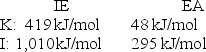
(Multiple Choice)
4.8/5 (72)
(72) Use the Born-Haber cycle to calculate the standard enthalpy of formation ( H  )for LiCl(s)given the following data: H(sublimation)Li = 155.2 kJ/mol
I1 (Li)= 520 kJ/mol
Bond energy (Cl-Cl)= 242.7 kJ/mol
EA (Cl)= 349 kJ/mol
Lattice energy (LiCl(s))= 828 kJ/mol
)for LiCl(s)given the following data: H(sublimation)Li = 155.2 kJ/mol
I1 (Li)= 520 kJ/mol
Bond energy (Cl-Cl)= 242.7 kJ/mol
EA (Cl)= 349 kJ/mol
Lattice energy (LiCl(s))= 828 kJ/mol (Multiple Choice)
4.8/5 (78)
(78) Which of the elements listed below is the least electronegative?
(Multiple Choice)
4.8/5 (94)
(94) Which of the following pairs of elements would be most likely to form an ionic compound?
(Multiple Choice)
4.9/5 (89)
(89) Which one of the following compounds does not follow the octet rule?
(Multiple Choice)
4.7/5 (85)
(85) How many covalent bonds will be drawn to bromine in BrO3- for the dot structure that expands the octet to minimize formal charge and if necessary places negative formal charges on the most electronegative atom(s)?
(Multiple Choice)
4.8/5 (74)
(74) Which of the bonds below would have the greatest polarity (i.e., highest percent ionic character)?
(Multiple Choice)
4.9/5 (76)
(76) Of the species NO2, NO, and N2, only NO2 is an exception to the octet rule.
(True/False)
4.9/5 (82)
(82) Which one of these polar covalent bonds would have the greatest percent ionic character?
(Multiple Choice)
4.7/5 (85)
(85) Which one of the following is most likely to be a covalent compound?
(Multiple Choice)
4.8/5 (79)
(79) Which of the following ionic solids would have the largest lattice energy?
(Multiple Choice)
4.8/5 (80)
(80) Use the Born-Haber cycle to calculate the lattice energy of KCl(s)given the following data: H(sublimation)K = 79.2 kJ/mol
I1 (K)= 418.7 kJ/mol
Bond energy (Cl-Cl)= 242.8 kJ/mol
EA (Cl)= 348 kJ/mol
H  (KCl(s))= -435.7 kJ/mol
 (Multiple Choice)
4.9/5 (63)
(63) The bond in which of the following pairs of atoms would have the greatest percent ionic character (i.e., most polar)?
(Multiple Choice)
4.9/5 (85)
(85) Estimate the enthalpy change for the combustion of one mole of acetylene, C2H2, to form carbon dioxide and water vapor. BE(C-H)= 456 kJ/mol
BE(C C)= 962 kJ/mol
BE(O=O)= 499 kJ/mol
BE(C=O)= 802 kJ/mol
BE(O-H)= 462 kJ/mol
(Multiple Choice)
5.0/5 (77)
(77) Write a Lewis structure for the chlorate ion, ClO3-, that obeys the octet rule, showing all non-zero formal charges, and give the total number of resonance structures for ClO3- that obey the octet rule.
(Essay)
4.7/5 (80)
(80) The number of resonance structures for the sulfur dioxide molecule that satisfy the octet rule is
(Multiple Choice)
4.7/5 (90)
(90) 
Filters
- Essay(0)
- Multiple Choice(0)
- Short Answer(0)
- True False(0)
- Matching(0)