



 Chat with AI
Exam 19: Redox Reactions and Electrochemistry

Exam 1: Introduction153 Questions
Exam 2: Atoms, Molecules, and Ions141 Questions
Exam 3: Stoichiometry168 Questions
Exam 4: Reactions in Aqueous Solution156 Questions
Exam 5: Gases109 Questions
Exam 6: Energy Relationships in Chemical Reactions105 Questions
Exam 7: The Electronic Structure of Atoms115 Questions
Exam 8: The Periodic Table119 Questions
Exam 9: Chemical Bonding I: the Covalent Bond118 Questions
Exam 10: Chemical Bonding Ii: Molecular Geometry and Hybridization of Atomic Orbitals120 Questions
Exam 11: Introduction to Organic Chemistry57 Questions
Exam 12: Intermolecular Forces and Liquids and Solids138 Questions
Exam 13: Physical Properties of Solutions109 Questions
Exam 14: Chemical Kinetics114 Questions
Exam 15: Chemical Equilibrium99 Questions
Exam 16: Acids and Bases163 Questions
Exam 17: Acid-Base Equilibria and Solubility Equilibria92 Questions
Exam 18: Thermodynamics112 Questions
Exam 19: Redox Reactions and Electrochemistry138 Questions
Exam 20: The Chemistry of Coordination Compounds76 Questions
Exam 21: Nuclear Chemistry112 Questions
Exam 22: Organic Polymerssynthetic and Natural42 Questions
Select questions type


Complete and balance the following redox equation. When properly balanced using the smallest whole-number coefficients, the coefficient of S is H2S + HNO3 S + NO (acidic solution)

Free
(Multiple Choice)
4.9/5  (68)
(68) Correct Answer: Verified
C
Calculate the cell emf for the following reaction at 25°C: 2Ag+(0.010 M)+ H2(1 atm) 2Ag(s)+ 2H+(pH = 10.0)
Free
(Multiple Choice)
4.8/5 (91)
(91) Correct Answer:Verified
VerifiedB
Consider an electrochemical cell constructed from the following half cells, linked by a KCl salt bridge. - a Fe electrode in 1.0 M FeCl2 solution
- a Ni electrode in 1.0 M Ni(NO3 )2 solution
When the cell is running spontaneously, which choice includes only true statements and no false ones?
Free
(Multiple Choice)
4.7/5 (90)
(90) Correct Answer:Verified
VerifiedB
Which one of the following reagents is capable of transforming Cu(s)to Cu2+ (1 M)?
(Multiple Choice)
4.9/5 (80)
(80) Which one of the following reactions must be carried out in an electrolytic cell rather than in a galvanic cell?
(Multiple Choice)
4.9/5 (77)
(77) Consider an electrochemical cell constructed from the following half cells, linked by a KCl salt bridge. - an Al(s)electrode in 0.5 M Al2(SO4)3 solution
- a Pb(s)electrode in 1.0 M Pb(NO3)2 solution
Which electrode is the anode?
(Multiple Choice)
5.0/5 (63)
(63) Consider the following standard reduction potentials in acid solution: 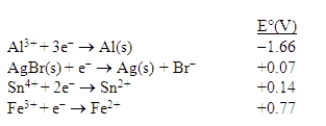 The strongest oxidizing agent among those shown above is
 (Multiple Choice)
4.7/5 (74)
(74) How many coulombs of charge are required to cause reduction of 0.20 mole of Cr3+ to Cr?
(Multiple Choice)
4.7/5 (68)
(68) A metal object is to be gold-plated by an electrolytic procedure using aqueous AuCl3 electrolyte. Calculate the number of moles of gold deposited in 3.0 min by a constant current of 10. A.
(Multiple Choice)
4.9/5 (66)
(66) Consider the following standard reduction potentials in acid solution:  The strongest reducing agent listed above is
 (Multiple Choice)
4.8/5 (70)
(70) Complete and balance the following redox reaction under basic conditions:
PO33-(aq)+ MnO4-(aq) PO43-(aq)+ MnO2(s)
(Essay)
5.0/5 (63)
(63) For the reaction Ni2+(aq)+ 2Fe2+(aq) Ni(s)+ 2Fe3+(aq), the standard cell potential E°cell is
(Multiple Choice)
4.9/5 (68)
(68) Which one of the following reagents is capable of transforming Cu2+(1 M)to Cu(s)?
(Multiple Choice)
4.7/5 (90)
(90) Which one of the following reactions will occur spontaneously at standard-state conditions and 25°C?
(Multiple Choice)
4.9/5 (72)
(72) Under standard-state conditions, which of the following half-reactions occurs at the cathode during the electrolysis of aqueous nickel sulfate at 25°C?
(Multiple Choice)
4.9/5 (81)
(81) How many coulombs of charge are required to cause reduction of 0.25 mole of Cu2+ to Cu?
(Multiple Choice)
4.8/5 (88)
(88) The half-reaction that should occur at the anode during electrolysis of an aqueous potassium bromide solution is
(Multiple Choice)
4.9/5 (81)
(81) For the electrochemical cell Pt(s)| H2(1 atm)| H+(1 M)|| Cu2+(1 M)| Cu(s), which one of the following changes will cause an increase in the cell voltage?
(Multiple Choice)
4.8/5 (80)
(80) 
Filters
- Essay(0)
- Multiple Choice(0)
- Short Answer(0)
- True False(0)
- Matching(0)