



 Chat with AI
Exam 19: Redox Reactions and Electrochemistry

Exam 1: Introduction153 Questions
Exam 2: Atoms, Molecules, and Ions141 Questions
Exam 3: Stoichiometry168 Questions
Exam 4: Reactions in Aqueous Solution156 Questions
Exam 5: Gases109 Questions
Exam 6: Energy Relationships in Chemical Reactions105 Questions
Exam 7: The Electronic Structure of Atoms115 Questions
Exam 8: The Periodic Table119 Questions
Exam 9: Chemical Bonding I: the Covalent Bond118 Questions
Exam 10: Chemical Bonding Ii: Molecular Geometry and Hybridization of Atomic Orbitals120 Questions
Exam 11: Introduction to Organic Chemistry57 Questions
Exam 12: Intermolecular Forces and Liquids and Solids138 Questions
Exam 13: Physical Properties of Solutions109 Questions
Exam 14: Chemical Kinetics114 Questions
Exam 15: Chemical Equilibrium99 Questions
Exam 16: Acids and Bases163 Questions
Exam 17: Acid-Base Equilibria and Solubility Equilibria92 Questions
Exam 18: Thermodynamics112 Questions
Exam 19: Redox Reactions and Electrochemistry138 Questions
Exam 20: The Chemistry of Coordination Compounds76 Questions
Exam 21: Nuclear Chemistry112 Questions
Exam 22: Organic Polymerssynthetic and Natural42 Questions
Select questions type


Calculate the standard cell emf for the following cell: Mg | Mg2+ || NO3- (acid soln)| NO(g)| Pt
(Multiple Choice)
4.7/5  (77)
(77) Complete and balance the following redox reaction under acidic conditions:
MnO4-(aq)+ C2O42-(aq) Mn2+(aq)+ CO2(aq)
(Essay)
4.9/5 (66)
(66) How many grams of chromium would be electroplated by passing a constant current of 5.2 amperes through a solution containing CrCl3 for 45.0 min?
(Multiple Choice)
4.8/5 (75)
(75) A current of 2.50 A was passed through an electrolytic cell containing molten CaCl2 for 4.50 hours. How many moles of calcium metal should be deposited?
(Multiple Choice)
4.8/5 (74)
(74) How many coulombs (C)of electrical charge must pass through an electrolytic cell to reduce 0.44 mol Ca2+ ion to calcium metal?
(Multiple Choice)
4.8/5 (65)
(65) The half-reaction that occurs at the cathode during electrolysis of an aqueous sodium iodide solution is
(Multiple Choice)
4.9/5 (78)
(78) How many grams of copper are deposited on the cathode of an electrolytic cell if an electric current of 2.00 A is passed through a solution of CuSO4 for a period of 19.0 min?
(Short Answer)
4.8/5 (58)
(58) Complete and balance the following redox equation. What is the coefficient of H2S when the equation is balanced using the set of smallest whole-number coefficients? H2S + MnO4- Mn2+ + SO42- (acidic solution)
(Multiple Choice)
4.7/5 (74)
(74) For the reaction, 2Cr2+ + Cl2(g) 2Cr3+ + 2Cl-, E°cell is 1.78 V. Calculate E°cell for the related reaction Cr3+ + Cl- Cr2+ + 1/2Cl2(g).
(Multiple Choice)
4.8/5 (84)
(84) Consider the following standard reduction potentials in acid solution: 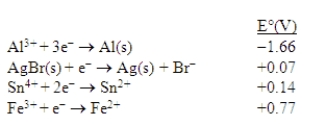 The strongest reducing agent among those shown above is
 (Multiple Choice)
4.9/5 (88)
(88) Gold can be electrochemically "plated" onto a less expensive metal by submerging the object in a solution of gold(III)and applying an electric current to drive the following half-reaction:
Au3+ + 3e- Au(s)
How many grams of gold will be formed if a current of 2.37 A is applied for 71 minutes?
(Short Answer)
4.9/5 (89)
(89) Complete and balance the following redox equation using the smallest whole-number coefficients. What is the coefficient of Sn in the balanced equation? Sn + HNO3 SnO2 + NO2 + H2O (acidic solution)
(Multiple Choice)
4.8/5 (77)
(77) Consider an electrochemical cell involving the overall reaction 2AgBr(s)+ Pb(s) Pb2+ + 2Ag(s)+ 2Br-
Each half-reaction is carried out in a separate compartment. The anion included in the lead half-cell is NO3-. The cation in the silver half-cell is K+. The two half-cells are connected by a KNO3 salt bridge. If [Pb2+] = 1.0 M, what concentration of Br- ion will produce a cell emf of 0.25 V at 298 K?
Given: AgBr(s)+ e- Ag + Br-, E° = +0.07 V.
(Multiple Choice)
4.9/5 (71)
(71) Aluminum metal is formed by the electrolysis of Al2O3 in molten cryolite. How many minutes are required to form 10.0 g of Al using a current of 30 A?
(Short Answer)
4.9/5 (81)
(81) Which one of the following reagents is capable of transforming Fe3+ (1 M)to Fe2+ (1 M)?
(Multiple Choice)
4.9/5 (86)
(86) Which statement is true for a spontaneous redox reaction carried out at standard-state conditions?
(Multiple Choice)
4.9/5 (66)
(66) A current of 0.80 A was applied to an electrolytic cell containing molten CdCl2 for 2.5 hours. Calculate the mass of cadmium metal deposited.
(Multiple Choice)
4.9/5 (74)
(74) 
Filters
- Essay(0)
- Multiple Choice(0)
- Short Answer(0)
- True False(0)
- Matching(0)