



 Chat with AI
Exam 19: Redox Reactions and Electrochemistry

Exam 1: Introduction153 Questions
Exam 2: Atoms, Molecules, and Ions141 Questions
Exam 3: Stoichiometry168 Questions
Exam 4: Reactions in Aqueous Solution156 Questions
Exam 5: Gases109 Questions
Exam 6: Energy Relationships in Chemical Reactions105 Questions
Exam 7: The Electronic Structure of Atoms115 Questions
Exam 8: The Periodic Table119 Questions
Exam 9: Chemical Bonding I: the Covalent Bond118 Questions
Exam 10: Chemical Bonding Ii: Molecular Geometry and Hybridization of Atomic Orbitals120 Questions
Exam 11: Introduction to Organic Chemistry57 Questions
Exam 12: Intermolecular Forces and Liquids and Solids138 Questions
Exam 13: Physical Properties of Solutions109 Questions
Exam 14: Chemical Kinetics114 Questions
Exam 15: Chemical Equilibrium99 Questions
Exam 16: Acids and Bases163 Questions
Exam 17: Acid-Base Equilibria and Solubility Equilibria92 Questions
Exam 18: Thermodynamics112 Questions
Exam 19: Redox Reactions and Electrochemistry138 Questions
Exam 20: The Chemistry of Coordination Compounds76 Questions
Exam 21: Nuclear Chemistry112 Questions
Exam 22: Organic Polymerssynthetic and Natural42 Questions
Select questions type


Which of these metals will reduce water to hydrogen in basic solution under standard conditions?
(Multiple Choice)
5.0/5  (73)
(73) Calculate the cell emf for the following reaction at 25°C:
2Ag+(0.010 M)+ H2(1 atm) 2Ag(s)+ 2H+(pH = 6.0)
(Short Answer)
4.7/5 (89)
(89) Using a table of standard reduction potentials, determine which of these reactions (if any)is/are nonspontaneous in the direction indicated at 25°C.
(Multiple Choice)
4.7/5 (82)
(82) Determine the equilibrium constant (Keq)at 25°C for the reaction Cl2(g)+ 2Br- (aq) 2Cl- (aq)+ Br2(l)
(Multiple Choice)
4.8/5 (67)
(67) Complete and balance the following redox equation using the set of smallest whole-numbers coefficients. What is the sum of the coefficients?
HI + HNO3 I2 + NO (acidic solution)
(Multiple Choice)
4.8/5 (90)
(90) Given the following notation for an electrochemical cell Pt(s)| H2(g)| H+(aq)|| Ag+(aq)| Ag(s)
What is the balanced overall (net)cell reaction?
(Multiple Choice)
4.9/5 (76)
(76) For the electrochemical cell Ni(s)| Ni2+(1 M)|| H+(1 M)| H2(1 atm)| Pt(s), which one of the following changes will cause a decrease in the cell voltage?
(Multiple Choice)
4.8/5 (82)
(82) Consider the following standard reduction potentials in acid solution: 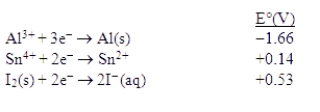 Which is the weakest oxidizing agent in this list?
 (Multiple Choice)
4.8/5 (80)
(80) Calculate the minimum voltage required for the electrolysis of 1.0 M NaCl in neutral solution. 2H2O + 2Cl- (1.0 M) H2(1 atm)+ Cl2(1 atm)+ 2OH- (1 * 10-7 M)
(Multiple Choice)
4.8/5 (87)
(87) Given the following standard reduction potentials in acid solution
O2 + 4H+ + 4e- 2H2O E° = +1.23 V
Sn4+ + 2e- Sn2+ E° = +0.13 V
Zn2+ + 2e- Zn(s)E° = -0.76 V
write the formula of the strongest oxidizing agent.
(Short Answer)
4.9/5 (78)
(78) A certain electrochemical cell has for its cell reaction: Zn + HgO ZnO + Hg
Which is the half-reaction occurring at the anode?
(Multiple Choice)
4.9/5 (79)
(79) When a solution of a certain gadolinium salt is electrolyzed with a current of 1.0 A for 2.0 h, 0.025 mol of Gd metal forms. Calculate the charge on the gadolinium ion in the salt.
(Short Answer)
4.9/5 (77)
(77) Which one of the following reagents is capable of transforming Br- (aq)to Br2(l)under standard-state conditions?
(Multiple Choice)
5.0/5 (88)
(88) The overall reaction 2Co3+(aq)+ 2Cl-(aq) 2Co2+(aq)+ Cl2(g)has the standard cell voltage E°cell = 0.46 V. Given E° = 1.36 V for the reaction Cl2(g)+ 2e- 2Cl-(aq), calculate the standard reduction potential for the following the half reaction at 25°C: Co3+ + e- Co2+
(Multiple Choice)
5.0/5 (73)
(73) Which of these metals will not reduce water to hydrogen in basic solution under standard conditions?
(Multiple Choice)
4.7/5 (83)
(83) Consider an electrochemical cell with the following cell reaction where all reactants and products are at standard-state conditions: Cu2+(aq)+ H2(g) Cu(s)+ 2H+(aq). Predict the effect on the emf of this cell of adding NaOH solution to the hydrogen half-cell until the pH equals 7.0.
(Multiple Choice)
4.8/5 (77)
(77) Determine the equilibrium constant, Keq, at 25°C for the reaction 2Br- (aq)+ I2(s) Br2(l)+ 2I- (aq)
(Multiple Choice)
4.8/5 (73)
(73) Consider an electrochemical cell based on the spontaneous reaction 2AgCl(s)+ Zn(s) 2Ag(s)+ 2Cl- + Zn2+.
If the zinc ion concentration is kept constant at 1 M, and the chlorine ion concentration is decreased from 1 M to 0.001 M, the cell voltage should
(Multiple Choice)
4.9/5 (76)
(76) Complete and balance the following redox equation. What is the coefficient of H2O when the equation is balanced using the set of smallest whole-number coefficients? MnO4- + SO32- Mn2+ + SO42- (acidic solution)
(Multiple Choice)
4.9/5 (65)
(65) 
Filters
- Essay(0)
- Multiple Choice(0)
- Short Answer(0)
- True False(0)
- Matching(0)