



 Chat with AI
Exam 14: Chemical Kinetics

Exam 1: Introduction153 Questions
Exam 2: Atoms, Molecules, and Ions141 Questions
Exam 3: Stoichiometry168 Questions
Exam 4: Reactions in Aqueous Solution156 Questions
Exam 5: Gases109 Questions
Exam 6: Energy Relationships in Chemical Reactions105 Questions
Exam 7: The Electronic Structure of Atoms115 Questions
Exam 8: The Periodic Table119 Questions
Exam 9: Chemical Bonding I: the Covalent Bond118 Questions
Exam 10: Chemical Bonding Ii: Molecular Geometry and Hybridization of Atomic Orbitals120 Questions
Exam 11: Introduction to Organic Chemistry57 Questions
Exam 12: Intermolecular Forces and Liquids and Solids138 Questions
Exam 13: Physical Properties of Solutions109 Questions
Exam 14: Chemical Kinetics114 Questions
Exam 15: Chemical Equilibrium99 Questions
Exam 16: Acids and Bases163 Questions
Exam 17: Acid-Base Equilibria and Solubility Equilibria92 Questions
Exam 18: Thermodynamics112 Questions
Exam 19: Redox Reactions and Electrochemistry138 Questions
Exam 20: The Chemistry of Coordination Compounds76 Questions
Exam 21: Nuclear Chemistry112 Questions
Exam 22: Organic Polymerssynthetic and Natural42 Questions
Select questions type


The graphs below all refer to the same reaction. What is the order of this reaction? 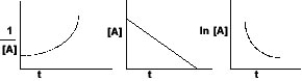
(Multiple Choice)
4.9/5  (86)
(86) The rate constant for the first-order decomposition of C4H8 at 500°C is 9.2 * 10-3 s-1. How long will it take for 10.0% of a 0.100 M sample of C4H8 to decompose at 500°C?
(Short Answer)
4.8/5 (86)
(86) The Arrhenius equation is k = Ae-Ea/RT. The slope of a plot of ln k vs. 1/T is equal to
(Multiple Choice)
4.8/5 (86)
(86) Sucrose, C12H22O11, reacts slowly with water in the presence of an acid to form two other sugars, glucose and fructose, both of which have the same molecular formulas, but different structures.
C12H22O11 + H2O C6H12O6 (glucose)+ C6H12O6 (fructose)
The reaction is first order and has a rate constant of 6.2 * 10-5 /s at 35°C when the H+ concentration is 0.10 M. Suppose that the initial concentration of sucrose in the solution is 0.40 M. How many minutes will it take for the sucrose concentration to drop to 0.30 M?
(Short Answer)
4.8/5 (82)
(82) In the reaction, 2N2O 2N2 + O2, oxygen and nitrogen gases are formed at the same rate (mol/L·s).
(True/False)
4.8/5 (62)
(62) For the following reaction, P(C6H14)/ t was found to be -6.2 * 10-3 atm/s. C6H14(g) C6H6(g)+ 4H2(g)
Determine P(H2)/ t for this reaction at the same time.
(Multiple Choice)
4.7/5 (71)
(71) For the chemical reaction system described by the diagram below, which statement is true? 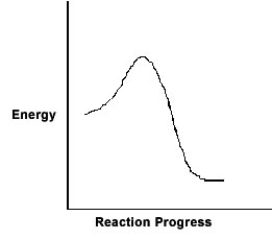 If the Ea for the forward reaction is 25 kJ/mol and the enthalpy of reaction is -95 kJ/mol, what is Ea for the reverse reaction?
 (Multiple Choice)
4.8/5 (88)
(88) The isomerization of cyclopropane to propene follows first-order kinetics. 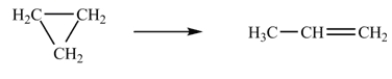 At 700 K, the rate constant for this reaction is 6.2 * 10-4 min-1. How many minutes are required for 10.0% of a sample of cyclopropane to isomerize to propene?
 (Multiple Choice)
5.0/5 (85)
(85) The reaction 2NO2(g) 2NO(g)+ O2(g)is suspected to be second order in NO2. Which of the following kinetic plots would be the most useful to confirm whether or not the reaction is second order?
(Multiple Choice)
4.8/5 (75)
(75) When the concentrations of reactant molecules are increased, the rate of reaction increases. The best explanation for this phenomenon is that as the reactant concentration increases,
(Multiple Choice)
4.7/5 (69)
(69) At a certain temperature, the data below were collected for the reaction below.
2ICl + H2 I2 + 2HCl.
Determine the rate constant for the reaction. 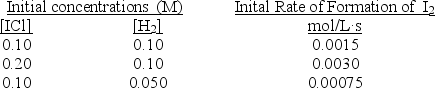
(Essay)
4.9/5 (86)
(86) The thermal decomposition of acetaldehyde, CH3CHO CH4 + CO, is a second-order reaction. The following data were obtained at 518°C. 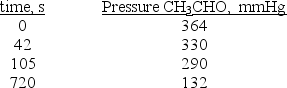 Based on the data given, what is the half-life for the disappearance of acetaldehyde?
 (Multiple Choice)
4.9/5 (72)
(72) A first-order reaction has a rate constant of 7.5 * 10-3 /s. The time required for the reaction to be 60% complete is
(Multiple Choice)
4.8/5 (84)
(84) Aspirin, C9H8O4, slowly decomposes at room temperature by reacting with water in the atmosphere to produce acetic acid, HC2H3O2, and 2-hydroxybenzoic acid, C7H6O3 (this is why old bottles of aspirin often smell like vinegar):
C9H8O4 + H2O HC2H3O2 + C7H6O3
Concentration and rate data for this reaction are given below. 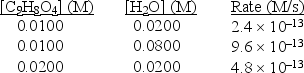 Write the rate law for this reaction and calculate k (be sure to include the correct units).
 (Essay)
4.8/5 (78)
(78) A rate constant will have the units mol · L-1 · s-1 when the reaction is overall
(Multiple Choice)
4.7/5 (76)
(76) A nuclear stress test utilizes a gamma-emitting radioisotope such as thallium-201 to follow the flow of blood through the heart - first at rest, and then under stress. The first-order rate constant for the decay of thallium-201 is 9.5 x 10⁻³ hr-1. Calculate how long it takes for the amount of thallium-201 to fall to 5.0% of its original value.
(Short Answer)
4.9/5 (79)
(79) For the chemical reaction system described by the diagram below, which statement is true? 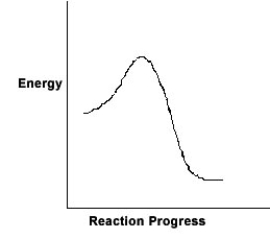
(Multiple Choice)
4.9/5 (96)
(96) A rate constant with the units L2 · mol-2 · s-1 is consistent with a
(Multiple Choice)
4.9/5 (84)
(84) What is the slope of an Arrhenius plot for the following reaction? 2NOCl 2NO + Cl2 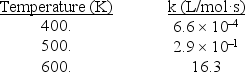
(Multiple Choice)
4.9/5 (64)
(64) 
Filters
- Essay(0)
- Multiple Choice(0)
- Short Answer(0)
- True False(0)
- Matching(0)