



 Chat with AI
Exam 18: Thermodynamics

Exam 1: Introduction153 Questions
Exam 2: Atoms, Molecules, and Ions141 Questions
Exam 3: Stoichiometry168 Questions
Exam 4: Reactions in Aqueous Solution156 Questions
Exam 5: Gases109 Questions
Exam 6: Energy Relationships in Chemical Reactions105 Questions
Exam 7: The Electronic Structure of Atoms115 Questions
Exam 8: The Periodic Table119 Questions
Exam 9: Chemical Bonding I: the Covalent Bond118 Questions
Exam 10: Chemical Bonding Ii: Molecular Geometry and Hybridization of Atomic Orbitals120 Questions
Exam 11: Introduction to Organic Chemistry57 Questions
Exam 12: Intermolecular Forces and Liquids and Solids138 Questions
Exam 13: Physical Properties of Solutions109 Questions
Exam 14: Chemical Kinetics114 Questions
Exam 15: Chemical Equilibrium99 Questions
Exam 16: Acids and Bases163 Questions
Exam 17: Acid-Base Equilibria and Solubility Equilibria92 Questions
Exam 18: Thermodynamics112 Questions
Exam 19: Redox Reactions and Electrochemistry138 Questions
Exam 20: The Chemistry of Coordination Compounds76 Questions
Exam 21: Nuclear Chemistry112 Questions
Exam 22: Organic Polymerssynthetic and Natural42 Questions
Select questions type


Choose the substance with the higher entropy per mole at a given temperature: O2(g)at 5 atm or O2(g)at 0.5 atm.
(Short Answer)
4.9/5  (75)
(75) At 700 K, the equilibrium constant for the reaction CO(g)+ H2O(g) CO2(g)+ H2(g)is 5.10. What is G° for this reaction at this temperature?
(Short Answer)
4.7/5 (89)
(89) For a certain reaction, G° = 87 kJ/mol, H° = 100 kJ/mol at STP. At what temperature, in K, is the reaction in equilibrium, assuming that S° and H° are temperature-independent?
(Short Answer)
4.8/5 (106)
(106) The normal freezing point of ammonia is -78°C. Predict the signs of H, S, and G for ammonia when it freezes at -80°C and 1 atm: NH3(l) NH3(s) H S G
(Multiple Choice)
4.8/5 (69)
(69) The following reaction is nonspontaneous at 25°C:
Cu2O(s) 2Cu(s)+ 1/2O2(g), G° = 141 kJ/mol
If S° = 75.8 J/K·mol, what is the lowest temperature at which the reaction will be spontaneous?
(Short Answer)
4.9/5 (72)
(72) For a given substance the entropy always increases in the following order:
S (gas)< S (liq)< S (solid).
(True/False)
4.7/5 (79)
(79) Consider the reaction CO(g)+ 2H2(g) CH3OH(l)at 25°C.
G°f (CO)= -137.3 kJ/mol
G°f (CH3OH)= -166.3 kJ/mol
H°f (CO)= -110.5 kJ/mol
H°f (CH3OH)= -238.7 kJ/mol
S°(CO)= 197.9 J/K·mol
S°(CH3OH)= 126.8 J/K·mol
Calculate G° at 25°C.
(Short Answer)
4.9/5 (75)
(75) Dissolving an ionic solid in water always results in an increase in entropy.
(True/False)
5.0/5 (78)
(78) For the reaction SbCl5(g) SbCl3(g)+ Cl2(g),
G°f (SbCl5)= -334.34 kJ/mol
G°f (SbCl3)= -301.25 kJ/mol
H°f (SbCl5)= -394.34 kJ/mol
H°f (SbCl3)= -313.80 kJ/mol
Calculate G at 800 K and 1 atm pressure (assume S° and H° do not change with temperature).
(Short Answer)
5.0/5 (85)
(85) Sulfur can be separated from lead in the mineral galena, PbS(s), by "roasting" the ore in the presence of oxygen as shown in the following reaction: 2PbS(s)+ 3O2(g) 2PbO(s)+ 2SO2(g)
Calculate S° for this reaction using the thermodynamic data provided below. 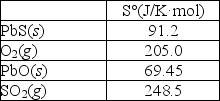
(Multiple Choice)
4.9/5 (71)
(71) Using the thermodynamic data provided below, calculate Ka2 for H2CO3(aq)at 25°. 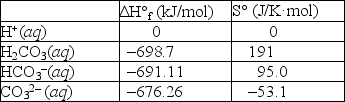
(Essay)
4.9/5 (80)
(80) For the reaction 3H2(g)+ N2(g) 2NH3(g), Kc = 9.0 at 350°C. In what direction does this reaction proceed at 350°C under standard state conditions?
(Short Answer)
4.9/5 (70)
(70) 
Filters
- Essay(0)
- Multiple Choice(0)
- Short Answer(0)
- True False(0)
- Matching(0)