



 Chat with AI
Exam 20: The Chemistry of Coordination Compounds

Exam 1: Introduction153 Questions
Exam 2: Atoms, Molecules, and Ions141 Questions
Exam 3: Stoichiometry168 Questions
Exam 4: Reactions in Aqueous Solution156 Questions
Exam 5: Gases109 Questions
Exam 6: Energy Relationships in Chemical Reactions105 Questions
Exam 7: The Electronic Structure of Atoms115 Questions
Exam 8: The Periodic Table119 Questions
Exam 9: Chemical Bonding I: the Covalent Bond118 Questions
Exam 10: Chemical Bonding Ii: Molecular Geometry and Hybridization of Atomic Orbitals120 Questions
Exam 11: Introduction to Organic Chemistry57 Questions
Exam 12: Intermolecular Forces and Liquids and Solids138 Questions
Exam 13: Physical Properties of Solutions109 Questions
Exam 14: Chemical Kinetics114 Questions
Exam 15: Chemical Equilibrium99 Questions
Exam 16: Acids and Bases163 Questions
Exam 17: Acid-Base Equilibria and Solubility Equilibria92 Questions
Exam 18: Thermodynamics112 Questions
Exam 19: Redox Reactions and Electrochemistry138 Questions
Exam 20: The Chemistry of Coordination Compounds76 Questions
Exam 21: Nuclear Chemistry112 Questions
Exam 22: Organic Polymerssynthetic and Natural42 Questions
Select questions type


The total number of electrons in the 3d orbitals of Ti3+ is
(Multiple Choice)
4.8/5  (73)
(73) Write the chemical formula of the dibromobis(oxalato)cobaltate(III)ion.
(Essay)
4.7/5 (72)
(72) Which of these square planar complex ions can have cis-trans isomers?
(Multiple Choice)
4.8/5 (71)
(71) Which of these ligands produces the strongest crystal field?
(Multiple Choice)
4.9/5 (78)
(78) In K4[Fe(CN)6], how many 3d electrons does the iron atom have?
(Multiple Choice)
4.8/5 (78)
(78) Bidentate and polydentate ligands are also called chelating agents.
(True/False)
4.9/5 (87)
(87) The total number of electrons in the 3d orbitals of a titanium atom is
(Multiple Choice)
4.9/5 (71)
(71) 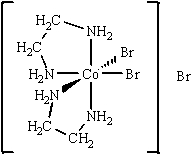
Which of these complex ions would absorb light with the longest wavelength?
(Multiple Choice)
4.8/5 (86)
(86) Predict the number of unpaired electrons in the [Cr(en)3]2+ ion.
(Short Answer)
4.8/5 (82)
(82) Predict the number of unpaired electrons in the [CrCl6]4- ion.
(Short Answer)
4.8/5 (80)
(80) In the coordination compound [Cr(NH3)(en)2Cl]Br2, the coordination number (C.N.)and oxidation number (O.N.)of the metal atom are, respectively,
(Multiple Choice)
4.9/5 (82)
(82) The total number of electrons in the 3d orbitals of Co3+ is
(Multiple Choice)
4.8/5 (83)
(83) 
Filters
- Essay(0)
- Multiple Choice(0)
- Short Answer(0)
- True False(0)
- Matching(0)