



 Chat with AI
Exam 9: Chemical Bonding I: Basic Concepts

Exam 1: Chemistry: The Study of Change175 Questions
Exam 2: Atoms Molecules and Ions156 Questions
Exam 3: Mass Relationships in Chemical Reactions194 Questions
Exam 4: Reactions in Aqueous Solutions192 Questions
Exam 5: Gases130 Questions
Exam 6: Thermochemistry119 Questions
Exam 7: Quantum Theory and the Electronic Structure of Atoms135 Questions
Exam 8: Periodic Relationships Among the Elements144 Questions
Exam 9: Chemical Bonding I: Basic Concepts136 Questions
Exam 10: Chemical Bonding II: Molecular Geometry and Hybridization of Atomic146 Questions
Exam 11: Intermolecular Forces and Liquids and Solids149 Questions
Exam 12: Physical Properties of Solutions122 Questions
Exam 13: Chemical Kinetics131 Questions
Exam 14: Chemical Equilibrium119 Questions
Exam 15: Acids and Bases178 Questions
Exam 16: Acid-Base Equilibria and Solubility Equilibria145 Questions
Exam 17: Entropy Free Energy and Equilibrium128 Questions
Exam 18: Electrochemistry154 Questions
Exam 19: Nuclear Chemistry128 Questions
Exam 20: Chemistry in the Atmosphere50 Questions
Exam 21: Metallurgy and the Chemistry of Metals63 Questions
Exam 22: Nonmetallic Elements and Their Compounds52 Questions
Exam 23: Transition Metals Chemistry and Coordination Compounds92 Questions
Exam 24: Organic Chemistry66 Questions
Exam 25: Synthetic and Natural Organic Polymers46 Questions
Select questions type


The covalent bond with the greatest polarity would form in which of the atom pairs below
(Multiple Choice)
4.8/5  (75)
(75) The azide ion, N3-, is very reactive although it is isoelectronic with the very stable CO2 molecule. This reactivity is reasonable considering that
(Multiple Choice)
4.8/5 (82)
(82) Arrange the following bonds in order of increasing ionic character:
H - Cl
C - H
H - H
O - H
(Multiple Choice)
4.8/5 (62)
(62) Which one of the following compounds does not follow the octet rule
(Multiple Choice)
4.9/5 (89)
(89) Which of the elements listed below would most likely form a nonpolar covalent bond when bonded to bromine
(Multiple Choice)
4.8/5 (78)
(78) List all types of bonding present in the compound NH4NO3.
I. ionic bond
II. polar covalent bond
III. nonpolar covalent bond
(Multiple Choice)
4.9/5 (69)
(69) List all types of bonding present in the ion SO42-.
I. ionic bond
II. polar covalent bond
III. nonpolar covalent bond
(Multiple Choice)
4.8/5 (83)
(83) Use the bond enthalpy data given to estimate the heat released when 6.50 g of nitrogen gas reacts with excess hydrogen gas to form ammonia at 25 C.
BE(N N) = 941.4 kJ/mol
BE(H-H) = 436.4 kJ/mol
BE(N-H) = 393 kJ/mol
(Multiple Choice)
4.7/5 (76)
(76) Estimate the enthalpy change for the combustion of one mole of acetylene, C2H2, to form carbon dioxide and water vapor.
BE(C-H) = 456 kJ/mol
BE(C C) = 962 kJ/mol
BE(O=O) = 499 kJ/mol
BE(C=O) = 802 kJ/mol
BE(O-H) = 462 kJ/mol
(Multiple Choice)
5.0/5 (87)
(87) The total number of valence electrons in the molecule CO2 is
(Multiple Choice)
4.9/5 (81)
(81) The formal charge on the sulfur atom in the resonance structure of sulfur dioxide which has one single bond and one double bond is
(Multiple Choice)
4.9/5 (83)
(83) Which of the following substances will display an incomplete octet in its Lewis structure
(Multiple Choice)
4.9/5 (85)
(85) Calculate the energy required for the gas phase process represented by Na(g) + Br(g) Na+(g) + Br- (g).
Given: Ionization energy (Na) = 496 kJ/mol
Electron affinity (Br) = 324 kJ/mol
Electron affinity (Na) = 53 kJ/mol
(Multiple Choice)
4.8/5 (80)
(80) Examine this Lewis structure for the phosphate ion, PO43-. How many valence electrons are around the P atom in this structure 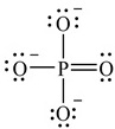
(Multiple Choice)
4.8/5 (83)
(83) Which of the elements listed below would most likely form an ionic bond when bonded to chlorine
(Multiple Choice)
4.9/5 (72)
(72) What type of chemical bond holds the atoms together within a water molecule
(Multiple Choice)
4.8/5 (80)
(80) Of the following substances, KCl, KBr, and KF, KF will have the highest melting point.
(True/False)
4.9/5 (79)
(79) 
Filters
- Essay(0)
- Multiple Choice(0)
- Short Answer(0)
- True False(0)
- Matching(0)