



 Chat with AI
Exam 9: Chemical Bonding I: Basic Concepts

Exam 1: Chemistry: The Study of Change175 Questions
Exam 2: Atoms Molecules and Ions156 Questions
Exam 3: Mass Relationships in Chemical Reactions194 Questions
Exam 4: Reactions in Aqueous Solutions192 Questions
Exam 5: Gases130 Questions
Exam 6: Thermochemistry119 Questions
Exam 7: Quantum Theory and the Electronic Structure of Atoms135 Questions
Exam 8: Periodic Relationships Among the Elements144 Questions
Exam 9: Chemical Bonding I: Basic Concepts136 Questions
Exam 10: Chemical Bonding II: Molecular Geometry and Hybridization of Atomic146 Questions
Exam 11: Intermolecular Forces and Liquids and Solids149 Questions
Exam 12: Physical Properties of Solutions122 Questions
Exam 13: Chemical Kinetics131 Questions
Exam 14: Chemical Equilibrium119 Questions
Exam 15: Acids and Bases178 Questions
Exam 16: Acid-Base Equilibria and Solubility Equilibria145 Questions
Exam 17: Entropy Free Energy and Equilibrium128 Questions
Exam 18: Electrochemistry154 Questions
Exam 19: Nuclear Chemistry128 Questions
Exam 20: Chemistry in the Atmosphere50 Questions
Exam 21: Metallurgy and the Chemistry of Metals63 Questions
Exam 22: Nonmetallic Elements and Their Compounds52 Questions
Exam 23: Transition Metals Chemistry and Coordination Compounds92 Questions
Exam 24: Organic Chemistry66 Questions
Exam 25: Synthetic and Natural Organic Polymers46 Questions
Select questions type


What is the total number of lone pairs in the best Lewis structure for SOF4 that exceeds the octet rule (S is the central atom)
(Multiple Choice)
4.8/5  (74)
(74) A Lewis structure of boron trifluoride is shown here. How many valence electrons are shown directly around the B atom 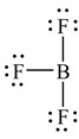
(Multiple Choice)
4.9/5 (82)
(82) Which one of these polar covalent bonds would have the greatest percent ionic character
(Multiple Choice)
4.9/5 (87)
(87) Assuming the octet rule is obeyed, how many covalent bonds will a carbon atom form to give a formal charge of zero
(Multiple Choice)
4.9/5 (81)
(81) The Lewis structure shown here is correct for ammonia (nitrogen trihydride). 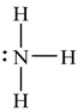
(True/False)
4.8/5 (85)
(85) Which of the following ionic solids would have the largest lattice energy
(Multiple Choice)
4.7/5 (89)
(89) The properties and chemical reactivity of a molecule is best explained by analyzing all possible resonance structures for that molecule.
(True/False)
4.8/5 (72)
(72) Estimate the enthalpy change for the reaction 2CO + O2 2CO2 given the following bond energies.
BE(C O) = 1074 kJ/mol
BE(O=O) = 499 kJ/mol
BE(C=O) = 802 kJ/mol
(Multiple Choice)
4.9/5 (88)
(88) What is the formal charge on the singly bonded oxygens in the Lewis structure for the carbonate ion
(Multiple Choice)
4.8/5 (88)
(88) The formal charge on the bromine atom in BrO3- drawn with three single bonds is
(Multiple Choice)
5.0/5 (71)
(71) A nonpolar covalent bond (i.e., pure covalent) would form in which one of the following pairs of atoms
(Multiple Choice)
5.0/5 (82)
(82) What is the formal charge on phosphorus in a Lewis structure for the phosphate ion that satisfies the octet rule
(Multiple Choice)
4.9/5 (90)
(90) Which of the following solids would have the lowest melting point
(Multiple Choice)
5.0/5 (89)
(89) Which one of the following molecules has an atom with an expanded octet
(Multiple Choice)
4.7/5 (68)
(68) Which one of the following is most likely to be an ionic compound
(Multiple Choice)
4.8/5 (70)
(70) Use the Born-Haber cycle to calculate the lattice energy of KCl(s) given the following data: H(sublimation) K = 79.2 kJ/mol
I1 (K) = 418.7 kJ/mol
Bond energy (Cl-Cl) = 242.8 kJ/mol
EA (Cl) = 348 kJ/mol
(KCl(s)) = -435.7 kJ/mol
(Multiple Choice)
4.9/5 (76)
(76) Which of the following is a useful guideline for the application of formal charges in neutral molecules
(Multiple Choice)
4.9/5 (76)
(76) Which of the bonds below would have the greatest polarity (i.e., highest percent ionic character)
(Multiple Choice)
4.7/5 (83)
(83) 
Filters
- Essay(0)
- Multiple Choice(0)
- Short Answer(0)
- True False(0)
- Matching(0)