



 Chat with AI
Exam 13: Chemical Kinetics

Exam 1: Chemistry: The Study of Change175 Questions
Exam 2: Atoms Molecules and Ions156 Questions
Exam 3: Mass Relationships in Chemical Reactions194 Questions
Exam 4: Reactions in Aqueous Solutions192 Questions
Exam 5: Gases130 Questions
Exam 6: Thermochemistry119 Questions
Exam 7: Quantum Theory and the Electronic Structure of Atoms135 Questions
Exam 8: Periodic Relationships Among the Elements144 Questions
Exam 9: Chemical Bonding I: Basic Concepts136 Questions
Exam 10: Chemical Bonding II: Molecular Geometry and Hybridization of Atomic146 Questions
Exam 11: Intermolecular Forces and Liquids and Solids149 Questions
Exam 12: Physical Properties of Solutions122 Questions
Exam 13: Chemical Kinetics131 Questions
Exam 14: Chemical Equilibrium119 Questions
Exam 15: Acids and Bases178 Questions
Exam 16: Acid-Base Equilibria and Solubility Equilibria145 Questions
Exam 17: Entropy Free Energy and Equilibrium128 Questions
Exam 18: Electrochemistry154 Questions
Exam 19: Nuclear Chemistry128 Questions
Exam 20: Chemistry in the Atmosphere50 Questions
Exam 21: Metallurgy and the Chemistry of Metals63 Questions
Exam 22: Nonmetallic Elements and Their Compounds52 Questions
Exam 23: Transition Metals Chemistry and Coordination Compounds92 Questions
Exam 24: Organic Chemistry66 Questions
Exam 25: Synthetic and Natural Organic Polymers46 Questions
Select questions type


At a particular temperature the first-order gas-phase reaction N2O5 2NO2 + 1/2O2 has a half-life for the disappearance of dinitrogen pentoxide of 5130 s. Suppose 0.450 atm of N2O5 is introduced into an evacuated 2.00 L flask. What will be the total gas pressure inside the flask after 3.00 hours

Free
(Multiple Choice)
4.8/5  (62)
(62) Correct Answer: Verified
A
What is the slope of an Arrhenius plot for the following reaction
2NOCl 2NO + Cl2
Temperature (K) (/\cdot) 400. 6.6\times1 500. 2.9\times1 600. 16.3
Free
(Multiple Choice)
4.8/5 (71)
(71) Correct Answer:Verified
VerifiedC
For the chemical reaction system described by the diagram below, which statement is true 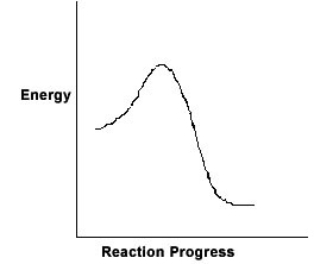 If the Ea for the forward reaction is 25 kJ/mol and the enthalpy of reaction is -95 kJ/mol, what is Ea for the reverse reaction
Free
(Multiple Choice)
4.8/5 (84)
(84) Correct Answer:Verified
VerifiedA
For the first-order reaction 2N2O5 2N2O4 + O2 at a particular temperature, the half-life of N2O5 is 0.90 hr. What fraction of the initial concentration of N2O5 will remain after 2.4 hours
(Multiple Choice)
4.8/5 (75)
(75) The half life for a first order reaction is 27 min. How long will it take for 4 half lives to occur
(Multiple Choice)
4.7/5 (80)
(80) The activation energy for the reaction O + O3 2O2 is 25 kJ/mol, and the enthalpy change is H = -388 kJ/mol. What is the activation energy for the decomposition of O2 by the reverse reaction
(Multiple Choice)
4.9/5 (86)
(86) The graphs below all refer to the same reaction. What is the order of this reaction 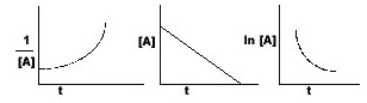
(Multiple Choice)
4.7/5 (65)
(65) Concerning the rate law, Rate = k[A][B][C], what are appropriate units for the rate constant k
(Multiple Choice)
4.8/5 (76)
(76) A certain reaction, reaction A products, is first order with respect toA. Starting with [A] = 0.250M, it takes 45 min to reduce the concentration of A to 0.110M. What is its rate constant for this reaction
(Multiple Choice)
4.9/5 (82)
(82) In general, to calculate the time required for a given initial concentration to decrease by 35% given the rate constant with units of 1/M-1s-1, which equation should be used
(Multiple Choice)
4.7/5 (87)
(87) The isomerization of cyclopropane follows first order kinetics. The rate constant at 700 K is 6.20 *10-4 min-1, and the half-life at 760 K is 29.0 min. Calculate the activation energy for this reaction.
(Multiple Choice)
4.8/5 (86)
(86) For the reaction BrO3- + 5Br-+ 6H+ 3Br2 + 3H2O at a particular time, - [BrO3-]/ t = 1.5 * 10-2 M/s. What is - [Br-]/ t at the same instant
(Multiple Choice)
4.9/5 (70)
(70) A certain first-order reaction A B is 25% complete in 42 min at 25 C. What is the half-life of the reaction
(Multiple Choice)
4.7/5 (80)
(80) Benzoyl chloride, C6H5COCl, reacts with water to form benzoic acid, C6H5COOH, and hydrochloric acid. This first-order reaction is 25% complete after 26 s. How much longer would one have to wait in order to obtain 99% conversion of benzoyl chloride to benzoic acid
(Multiple Choice)
4.9/5 (97)
(97) The following mechanism has been suggested for the reaction: +2+2\rightarrow+2 +\rightarrow+ +\rightarrow ++\rightarrow+ Identify all intermediates included in this mechanism.
(Multiple Choice)
4.9/5 (69)
(69) The isomerization of cyclopropane to propene follows first-order kinetics.  At 700 K, the rate constant for this reaction is 6.2 * 10-4 min-1. How many minutes are required for 10.0% of a sample of cyclopropane to isomerize to propene
 (Multiple Choice)
4.7/5 (80)
(80) Chlorine dioxide reacts in basic water to form chlorite and chlorate according to the following chemical equation: 2ClO2(aq) + 2OH-(aq) ClO2-(aq) + ClO3-(aq) + H2O(l)
Under a certain set of conditions, the initial rate of disappearance of chlorine dioxide was determined to be 2.30 x 10⁻¹ M/s. What is the initial rate of appearance of chlorite ion under those same conditions
(Multiple Choice)
4.9/5 (80)
(80) At a certain temperature, the data below were collected for the reaction below.2ICl + H2 I2 + 2HCl.Determine the rate law for the reaction. 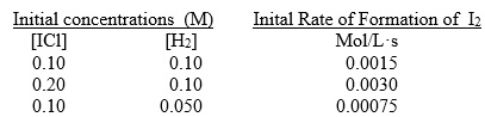
(Multiple Choice)
4.8/5 (73)
(73) If Ea for a certain biological reaction is 50. kJ/mol, by what factor (how many times) will the rate of this reaction increase when body temperature increases from 37 C (normal) to 40 C (fever)
(Multiple Choice)
4.8/5 (92)
(92) 
Filters
- Essay(0)
- Multiple Choice(0)
- Short Answer(0)
- True False(0)
- Matching(0)