Multiple Choice
At a certain temperature, the data below were collected for the reaction below.2ICl + H2 I2 + 2HCl.Determine the rate law for the reaction. 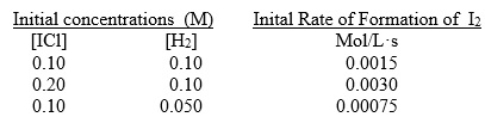
A) rate = k[ICl][H2]2
B) rate = k[ICl]2[H2]
C) rate = k[ICl][H2]
D) rate = k[ICl]2[H2]2
E) None of the above
Correct Answer:

Verified
Correct Answer:
Verified
Q14: A certain first-order reaction A
Q15: Benzoyl chloride, C<sub>6</sub>H<sub>5</sub>COCl, reacts with water to
Q16: The following mechanism has been suggested
Q17: The isomerization of cyclopropane to propene follows
Q18: Chlorine dioxide reacts in basic water
Q20: If E<sub>a</sub> for a certain biological
Q21: The first-order decomposition of SO<sub>2</sub>Cl<sub>2</sub> to
Q22: The following initial rate data apply
Q23: For the overall chemical reaction shown
Q24: A certain reaction A <span