



 Chat with AI
Exam 9: Chemical Bonding I: Basic Concepts

Exam 1: Chemistry: The Study of Change175 Questions
Exam 2: Atoms Molecules and Ions156 Questions
Exam 3: Mass Relationships in Chemical Reactions194 Questions
Exam 4: Reactions in Aqueous Solutions192 Questions
Exam 5: Gases130 Questions
Exam 6: Thermochemistry119 Questions
Exam 7: Quantum Theory and the Electronic Structure of Atoms135 Questions
Exam 8: Periodic Relationships Among the Elements144 Questions
Exam 9: Chemical Bonding I: Basic Concepts136 Questions
Exam 10: Chemical Bonding II: Molecular Geometry and Hybridization of Atomic146 Questions
Exam 11: Intermolecular Forces and Liquids and Solids149 Questions
Exam 12: Physical Properties of Solutions122 Questions
Exam 13: Chemical Kinetics131 Questions
Exam 14: Chemical Equilibrium119 Questions
Exam 15: Acids and Bases178 Questions
Exam 16: Acid-Base Equilibria and Solubility Equilibria145 Questions
Exam 17: Entropy Free Energy and Equilibrium128 Questions
Exam 18: Electrochemistry154 Questions
Exam 19: Nuclear Chemistry128 Questions
Exam 20: Chemistry in the Atmosphere50 Questions
Exam 21: Metallurgy and the Chemistry of Metals63 Questions
Exam 22: Nonmetallic Elements and Their Compounds52 Questions
Exam 23: Transition Metals Chemistry and Coordination Compounds92 Questions
Exam 24: Organic Chemistry66 Questions
Exam 25: Synthetic and Natural Organic Polymers46 Questions
Select questions type


Use the Born-Haber cycle to calculate the lattice energy of NaBr(s) given the following data: H(sublimation) Na = 109 kJ/mol
I1 (Na) = 496 kJ/mol
Bond energy (Br-Br) = 192 kJ/mol
EA (Br) = 324 kJ/mol
Hf (NaBr(s)) = -361 kJ/mol

Free
(Multiple Choice)
4.7/5  (86)
(86) Correct Answer: Verified
A
Arrange the elements F, P, and Cl in order of increasing electronegativity.
Free
(Multiple Choice)
4.7/5 (88)
(88) Correct Answer:Verified
VerifiedB
BeF42- is called the fluoberyllate ion. The formal charge on the beryllium atom in this ion is
Free
(Multiple Choice)
4.9/5 (70)
(70) Correct Answer:Verified
VerifiedA
List all types of bonding present in the molecule S8.
I. ionic bond
II. polar covalent bond
III. nonpolar covalent bond
(Multiple Choice)
4.7/5 (66)
(66) Calculate the energy change for the reaction K(g) + I(g) K+(g) + I - (g)
Given the following ionization energy (IE) and electron affinity (EA) values. IE EA K: 419/ 48/ I: 1,010/ 295/
(Multiple Choice)
4.9/5 (77)
(77) The Lewis structure reveals an unpaired electron (free radical) in which of the following species
(Multiple Choice)
4.8/5 (72)
(72) Use the Born-Haber cycle to calculate the standard enthalpy of formation ( ) for LiCl(s) given the following data: H(sublimation) Li = 155.2 kJ/mol
I1 (Li) = 520 kJ/mol
Bond energy (Cl-Cl) = 242.7 kJ/mol
EA (Cl) = 349 kJ/mol
Lattice energy (LiCl(s)) = 828 kJ/mol
(Multiple Choice)
4.9/5 (88)
(88) The polarity of covalent bonds increases as the percent ionic character increases.
(True/False)
4.7/5 (94)
(94) Which of the elements listed below would most likely form an ionic bond when bonded to oxygen
(Multiple Choice)
4.9/5 (89)
(89) Which response includes all the molecules below that do not follow the octet rule
(1) H2S
(2) BCl3
(3) PH3
(4) SF4
(Multiple Choice)
4.9/5 (67)
(67) Classify the Ca - Cl bond in CaCl2 as ionic, polar covalent, or nonpolar covalent.
(Multiple Choice)
4.9/5 (80)
(80) The Lewis structure reveals only single bonds in which of the following species
(Multiple Choice)
4.8/5 (92)
(92) The Lewis structure for the nitrate ion, NO3-, showing all non-zero formal charges is shown here.
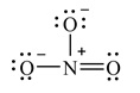 This structure shows a violation of the octet rule.
 (True/False)
4.7/5 (73)
(73) Which one of the following compounds utilizes both ionic and covalent bonding
(Multiple Choice)
4.9/5 (80)
(80) A Lewis structure for SO3 that obeys the octet rule, showing all non-zero formal charges, is shown here. How many resonance structures for SO3 that obey the octet rule, are possible
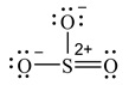
(Multiple Choice)
4.9/5 (83)
(83) Calculate the energy change for the reaction K(g) + Br(g) K+(g) + Br- (g)
Given the following ionization energy (IE) and electron affinity (EA) values. IE EA K: :419/ 48/ :1140/ 324/
(Multiple Choice)
4.9/5 (76)
(76) Shown here is a Lewis structure for the chlorate ion, ClO3-, that expands the octet to minimize formal charge and if necessary places negative formal charges on the most electronegative atom(s). What is the formal charge on Cl 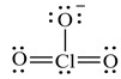
(Multiple Choice)
4.9/5 (95)
(95) A polar covalent bond would form in which one of the following pairs of atoms
(Multiple Choice)
4.8/5 (73)
(73) 
Filters
- Essay(0)
- Multiple Choice(0)
- Short Answer(0)
- True False(0)
- Matching(0)