



 Chat with AI
Exam 9: Chemical Bonding I: Basic Concepts

Exam 1: Chemistry: The Study of Change175 Questions
Exam 2: Atoms Molecules and Ions156 Questions
Exam 3: Mass Relationships in Chemical Reactions194 Questions
Exam 4: Reactions in Aqueous Solutions192 Questions
Exam 5: Gases130 Questions
Exam 6: Thermochemistry119 Questions
Exam 7: Quantum Theory and the Electronic Structure of Atoms135 Questions
Exam 8: Periodic Relationships Among the Elements144 Questions
Exam 9: Chemical Bonding I: Basic Concepts136 Questions
Exam 10: Chemical Bonding II: Molecular Geometry and Hybridization of Atomic146 Questions
Exam 11: Intermolecular Forces and Liquids and Solids149 Questions
Exam 12: Physical Properties of Solutions122 Questions
Exam 13: Chemical Kinetics131 Questions
Exam 14: Chemical Equilibrium119 Questions
Exam 15: Acids and Bases178 Questions
Exam 16: Acid-Base Equilibria and Solubility Equilibria145 Questions
Exam 17: Entropy Free Energy and Equilibrium128 Questions
Exam 18: Electrochemistry154 Questions
Exam 19: Nuclear Chemistry128 Questions
Exam 20: Chemistry in the Atmosphere50 Questions
Exam 21: Metallurgy and the Chemistry of Metals63 Questions
Exam 22: Nonmetallic Elements and Their Compounds52 Questions
Exam 23: Transition Metals Chemistry and Coordination Compounds92 Questions
Exam 24: Organic Chemistry66 Questions
Exam 25: Synthetic and Natural Organic Polymers46 Questions
Select questions type


What is the formal charge on the central nitrogen atom in the most favorable Lewis structure for the fulminate ion, CNO-, based on minimizing formal charge overall
(Multiple Choice)
4.7/5  (83)
(83) Assuming the octet rule is obeyed, how many covalent bonds will a nitrogen atom form to give a formal charge of zero
(Multiple Choice)
4.8/5 (79)
(79) Use the bond enthalpy data given to estimate the heat released when 25.0 g of acetylene gas, C2H2, burns in excess oxygen to yield carbon dioxide and water vapor at 25 C.
BE(C-C) = 347 kJ/mol
BE(C C) = 812 kJ/mol
BE(C=O in CO2) = 799 kJ/mol
BE(C-H) = 414 kJ/mol
BE(O-H) = 460 kJ/mol
BE(O=O) = 498.7 kJ/mol
(Multiple Choice)
4.8/5 (79)
(79) Which one of the following compounds utilizes both ionic and covalent bonding
(Multiple Choice)
4.9/5 (78)
(78) Which of the following ionic solids would have the largest lattice energy
(Multiple Choice)
4.8/5 (67)
(67) Shown here is a Lewis structure for the chlorate ion, ClO3-, that obeys the octet rule, showing all non-zero formal charges. How many resonance structures for ClO3- are possible that obey the octet rule 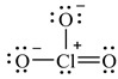
(Multiple Choice)
5.0/5 (89)
(89) Which of the elements listed below is most likely to exhibit an expanded octet in its compounds
(Multiple Choice)
4.7/5 (84)
(84) For which of these species does the best Lewis structure have two or more equivalent resonance structures
(Multiple Choice)
4.9/5 (69)
(69) The structure below depicts the correct Lewis structure for Dichloromethane, CH2Cl2 (an important solvent in synthetic chemistry). 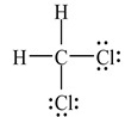
(True/False)
4.9/5 (89)
(89) The number of lone electron pairs in the N2 molecule is ___.
(Multiple Choice)
5.0/5 (82)
(82) Use the bond enthalpy data given to estimate the heat released when 50.0 g of propane gas, C3H8, burns in excess oxygen to yield carbon dioxide and water vapor at 25 C.
BE(C-C) = 347 kJ/mol
BE(C=O in CO2) = 799 kJ/mol
BE(C-H) = 414 kJ/mol
BE(O-H) = 460 kJ/mol
BE(O=O) = 498.7 kJ/mol
(Multiple Choice)
4.8/5 (88)
(88) Which one of the following molecules has an atom with an incomplete octet
(Multiple Choice)
4.8/5 (72)
(72) Assuming the octet rule is obeyed, how many covalent bonds will an oxygen atom form to give a formal charge of zero
(Multiple Choice)
4.7/5 (74)
(74) How many resonance phosphate Lewis structures can be drawn for the phosphate ion, PO43-, that obey the octet rule
(Multiple Choice)
4.9/5 (73)
(73) A molecule with two resonance structures is shifting quickly back and forth from one structure to the other.
(True/False)
4.8/5 (84)
(84) Arrange the elements C, O, and H in order of increasing electronegativity.
(Multiple Choice)
4.8/5 (67)
(67) 
Filters
- Essay(0)
- Multiple Choice(0)
- Short Answer(0)
- True False(0)
- Matching(0)