



 Chat with AI
Exam 9: Chemical Bonding I: Basic Concepts

Exam 1: Chemistry: The Study of Change175 Questions
Exam 2: Atoms Molecules and Ions156 Questions
Exam 3: Mass Relationships in Chemical Reactions194 Questions
Exam 4: Reactions in Aqueous Solutions192 Questions
Exam 5: Gases130 Questions
Exam 6: Thermochemistry119 Questions
Exam 7: Quantum Theory and the Electronic Structure of Atoms135 Questions
Exam 8: Periodic Relationships Among the Elements144 Questions
Exam 9: Chemical Bonding I: Basic Concepts136 Questions
Exam 10: Chemical Bonding II: Molecular Geometry and Hybridization of Atomic146 Questions
Exam 11: Intermolecular Forces and Liquids and Solids149 Questions
Exam 12: Physical Properties of Solutions122 Questions
Exam 13: Chemical Kinetics131 Questions
Exam 14: Chemical Equilibrium119 Questions
Exam 15: Acids and Bases178 Questions
Exam 16: Acid-Base Equilibria and Solubility Equilibria145 Questions
Exam 17: Entropy Free Energy and Equilibrium128 Questions
Exam 18: Electrochemistry154 Questions
Exam 19: Nuclear Chemistry128 Questions
Exam 20: Chemistry in the Atmosphere50 Questions
Exam 21: Metallurgy and the Chemistry of Metals63 Questions
Exam 22: Nonmetallic Elements and Their Compounds52 Questions
Exam 23: Transition Metals Chemistry and Coordination Compounds92 Questions
Exam 24: Organic Chemistry66 Questions
Exam 25: Synthetic and Natural Organic Polymers46 Questions
Select questions type


Classify the O - H bond in CH3OH as ionic, polar covalent, or nonpolar covalent.
(Multiple Choice)
4.8/5  (83)
(83) The standard enthalpy of formation of ammonia at 25 C is -46.3 kJ/mol. Estimate the N-H bond enthalpy at this temperature.(Given: BE(N N) = 941.4 kJ/mol, BE(H-H) = 436.4 kJ/mol)
(Multiple Choice)
4.9/5 (71)
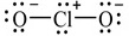
(71) Shown here is a Lewis structure for the chlorite ion, ClO2-, that obeys the octet rule, showing all non-zero formal charges. How many resonance structures for ClO2- that obey the octet are possible ?
(Multiple Choice)
4.8/5 (83)
(83) Shown here is a Lewis structure for SO3 that expands the octet to minimize formal charges. The formal charge on the sulfur atom is zero. 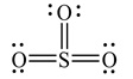
(True/False)
4.8/5 (79)
(79) Covalent bonding is the only type of bonding present in the ClO2- ion.
(True/False)
4.9/5 (95)
(95) Which one of the following is most likely to be a covalent compound
(Multiple Choice)
4.8/5 (78)
(78) What is the formal charge on sulfur in the most favorable Lewis structure for the SCN- (thiocyanate) ion based on minimizing formal charge overall
(Multiple Choice)
4.8/5 (73)
(73) Of the species NO2, NO, and N2, only NO2 is an exception to the octet rule.
(True/False)
4.8/5 (81)
(81) Which of the elements listed below would most likely form a polar covalent bond when bonded to oxygen
(Multiple Choice)
4.7/5 (81)
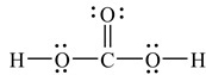
(81) Carbonic acid, H2CO3, is a weak acid that contributes to the taste and produces the carbon dioxide bubbles in all carbonated beverages. How many valence electrons are used to show the Lewis structure for H2CO3
(Multiple Choice)
4.8/5 (88)
(88) Which one of the following is most likely to be an ionic compound
(Multiple Choice)
4.8/5 (77)
(77) Arrange the elements Ba, Br, and Ga in order of increasing electronegativity.
(Multiple Choice)
4.9/5 (79)
(79) Classify the C - Cl bond in CCl4 as ionic, polar covalent, or nonpolar covalent.
(Multiple Choice)
4.8/5 (83)
(83) Which of the following solids would have the highest melting point
(Multiple Choice)
4.7/5 (79)
(79) Which one of the following compounds utilizes both ionic and covalent bonding
(Multiple Choice)
4.9/5 (95)
(95) Use the Born-Haber cycle to calculate the lattice energy of MgO (s) given the following data: H(sublimation) Mg = 130 kJ/mol
I1 (Mg) = 738.1 kJ/mol
I2 (Mg) = 1450 kJ/mol
Bond energy (O=O) = 498.7 kJ/mol
EA (O) = 141 kJ/mol
EA (O-) = -780 kJ/mol
(MgO(s)) = -601.8 kJ/mol
(Multiple Choice)
4.8/5 (79)
(79) Assuming the octet rule is obeyed, how many covalent bonds will a neon atom form to give a formal charge of zero
(Multiple Choice)
4.8/5 (94)
(94) Shown here is the Lewis structure for the chlorite ion, ClO2-, that expands the octet to minimize formal charge and if necessary places negative formal charges on the most electronegative atom(s). 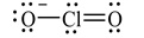
(True/False)
4.8/5 (81)
(81) The total number of valence electrons in the compound NH4NO3 is
(Multiple Choice)
4.9/5 (71)
(71) 
Filters
- Essay(0)
- Multiple Choice(0)
- Short Answer(0)
- True False(0)
- Matching(0)