



 Chat with AI
Exam 23: Transition Metals Chemistry and Coordination Compounds

Exam 1: Chemistry: The Study of Change175 Questions
Exam 2: Atoms Molecules and Ions156 Questions
Exam 3: Mass Relationships in Chemical Reactions194 Questions
Exam 4: Reactions in Aqueous Solutions192 Questions
Exam 5: Gases130 Questions
Exam 6: Thermochemistry119 Questions
Exam 7: Quantum Theory and the Electronic Structure of Atoms135 Questions
Exam 8: Periodic Relationships Among the Elements144 Questions
Exam 9: Chemical Bonding I: Basic Concepts136 Questions
Exam 10: Chemical Bonding II: Molecular Geometry and Hybridization of Atomic146 Questions
Exam 11: Intermolecular Forces and Liquids and Solids149 Questions
Exam 12: Physical Properties of Solutions122 Questions
Exam 13: Chemical Kinetics131 Questions
Exam 14: Chemical Equilibrium119 Questions
Exam 15: Acids and Bases178 Questions
Exam 16: Acid-Base Equilibria and Solubility Equilibria145 Questions
Exam 17: Entropy Free Energy and Equilibrium128 Questions
Exam 18: Electrochemistry154 Questions
Exam 19: Nuclear Chemistry128 Questions
Exam 20: Chemistry in the Atmosphere50 Questions
Exam 21: Metallurgy and the Chemistry of Metals63 Questions
Exam 22: Nonmetallic Elements and Their Compounds52 Questions
Exam 23: Transition Metals Chemistry and Coordination Compounds92 Questions
Exam 24: Organic Chemistry66 Questions
Exam 25: Synthetic and Natural Organic Polymers46 Questions
Select questions type


The total number of electrons in the 3d orbitals of Co3+ is

Free
(Multiple Choice)
4.9/5  (73)
(73) Correct Answer: Verified
C
What is the oxidation number of Fe in [Fe(CN)6]4-
Free
(Multiple Choice)
4.8/5 (81)
(81) Correct Answer:Verified
VerifiedB
The correct name of the complex ion [CuCl3Br(NH3)2]2- is:
diamminebromotrichlorocuprate(I) ion
(True/False)
4.9/5 (76)
(76) Which of the following complexes has optical (chiral) isomers
(Multiple Choice)
4.8/5 (90)
(90) How many unpaired electrons are there in the complex ion [Mn(CN)6]3-
(Multiple Choice)
4.9/5 (70)
(70) Assuming a coordination complex is formed with Fe2+ and 1,10-phenanthroline (shown below), which of the following statements is true 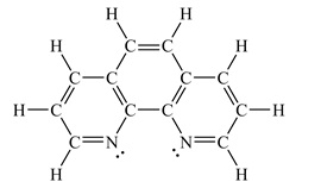
(Multiple Choice)
4.9/5 (81)
(81) Which of these electron energy level patterns would absorb light with the shortest wavelength 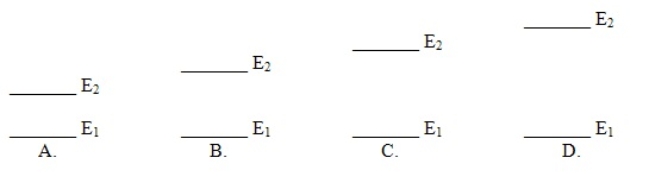
(Multiple Choice)
4.8/5 (83)
(83) In the complex ion [ML6]n+, Mn+ has six d electrons and L is a weak field ligand. According to crystal field theory, the magnetic properties of the complex ion correspond to how many unpaired electrons
(Multiple Choice)
4.8/5 (81)
(81) The total number of electrons in the 3d orbitals of a copper atom is
(Multiple Choice)
4.9/5 (80)
(80) In the complex ion [ML6]n+, Mn+ has five d electrons and L is a strong field ligand. According to crystal field theory, the magnetic properties of the complex ion correspond to how many unpaired electrons
(Multiple Choice)
4.8/5 (79)
(79) The terms that describe the geometric isomers that are possible for the complex [CrF2Cl4]3- are cis and trans.
(True/False)
4.9/5 (78)
(78) In the coordination compound K2[Co(en)Cl4], the coordination number (C.N.) and oxidation number (O.N.) of cobalt are
(Multiple Choice)
4.7/5 (77)
(77) Predict the number of unpaired electrons in the [Fe(CN)6]4- ion.
(Multiple Choice)
4.9/5 (89)
(89) Predict the number of unpaired electrons in the [Cr(en)3]2+ ion.
(Multiple Choice)
4.9/5 (82)
(82) Bidentate and polydentate ligands are also called chelating agents.
(True/False)
4.7/5 (79)
(79) In the coordination compound [Co(en)2Cl2]Cl, the coordination number and oxidation number of the central atom are, respectively,
(Multiple Choice)
5.0/5 (66)
(66) Which of the following complexes has optical (chiral) isomers
(Multiple Choice)
4.9/5 (72)
(72) What is the oxidation number of Co in the complex Co(H2O)3Cl3
(Multiple Choice)
5.0/5 (72)
(72) 
Filters
- Essay(0)
- Multiple Choice(0)
- Short Answer(0)
- True False(0)
- Matching(0)