



 Chat with AI
Exam 13: Chemical Kinetics

Exam 1: Chemistry: The Study of Change175 Questions
Exam 2: Atoms Molecules and Ions156 Questions
Exam 3: Mass Relationships in Chemical Reactions194 Questions
Exam 4: Reactions in Aqueous Solutions192 Questions
Exam 5: Gases130 Questions
Exam 6: Thermochemistry119 Questions
Exam 7: Quantum Theory and the Electronic Structure of Atoms135 Questions
Exam 8: Periodic Relationships Among the Elements144 Questions
Exam 9: Chemical Bonding I: Basic Concepts136 Questions
Exam 10: Chemical Bonding II: Molecular Geometry and Hybridization of Atomic146 Questions
Exam 11: Intermolecular Forces and Liquids and Solids149 Questions
Exam 12: Physical Properties of Solutions122 Questions
Exam 13: Chemical Kinetics131 Questions
Exam 14: Chemical Equilibrium119 Questions
Exam 15: Acids and Bases178 Questions
Exam 16: Acid-Base Equilibria and Solubility Equilibria145 Questions
Exam 17: Entropy Free Energy and Equilibrium128 Questions
Exam 18: Electrochemistry154 Questions
Exam 19: Nuclear Chemistry128 Questions
Exam 20: Chemistry in the Atmosphere50 Questions
Exam 21: Metallurgy and the Chemistry of Metals63 Questions
Exam 22: Nonmetallic Elements and Their Compounds52 Questions
Exam 23: Transition Metals Chemistry and Coordination Compounds92 Questions
Exam 24: Organic Chemistry66 Questions
Exam 25: Synthetic and Natural Organic Polymers46 Questions
Select questions type


For the hypothetical reaction A + 3B 2C, the rate of appearance of C given by ( [C]/ t) may also be expressed as
(Multiple Choice)
4.8/5  (79)
(79) When the concentrations of reactant molecules are increased, the rate of reaction increases. The best explanation for this phenomenon is that as the reactant concentration increases,
(Multiple Choice)
4.7/5 (74)
(74) Concerning the rate law, Rate = k[A]0, what are appropriate units for the rate constant k
(Multiple Choice)
4.9/5 (81)
(81) A reaction is experimentally found to follow the rate law, Rate = k[A]2 where k = 0.355 M-1min-1. Starting with [A]o = 1.55 M, how many seconds will it take for [A]t = 0.150M
(Multiple Choice)
4.8/5 (93)
(93) The thermal decomposition of acetaldehyde, CH3CHO CH4 + CO, is a second-order reaction. The following data were obtained at 518 C. Time, Pressure , 0 364 42 330 105 290 720 132 Calculate the rate constant for the decomposition of acetaldehyde from the above data.
(Multiple Choice)
4.9/5 (84)
(84) B is a catalyst in the following mechanism: \rightarrow+ slow +\rightarrow+ fast
(True/False)
4.9/5 (80)
(80) At 25 C, the second-order reaction NOCl(g) NO(g) + 1/2Cl2(g)is 50% complete after 5.82 hours when the initial concentration of NOCl is 4.46 mol/L. How long will it take for the reaction to be 75% complete
(Multiple Choice)
4.8/5 (83)
(83) The reaction 2A + B products is second order with respect to A and zero-order with respect toB. Starting with 0.135 M of A, what is the concentration of A after 35 min if the rate constant is 0.11 M-1s-1
(Multiple Choice)
4.9/5 (81)
(81) Use the table of data shown below to calculate the average rate of the reaction A B between 10 s and 20 s. time () []/ 0 0.20 5 0.14 10 0.10 15 0.071 20 0.050
(Multiple Choice)
4.9/5 (91)
(91) Nitric acid is formed by the gas-phase hydrolysis of N2O5. The energy profile curve for the reaction N2O5 + H2O 2HNO3 is shown here. The reaction is endothermic and the activation energy of the reverse reaction is larger than for the forward reaction. 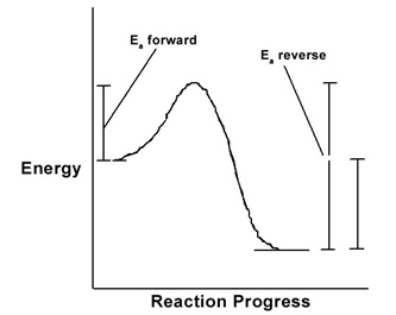
(True/False)
4.7/5 (81)
(81) The activation energy of a certain uncatalyzed reaction is 64 kJ/mol. In the presence of a catalyst, the Ea is 55 kJ/mol. How many times faster is the catalyzed than the uncatalyzed reaction at 400 C Assume that the frequency factor remains the same.
(Multiple Choice)
4.7/5 (81)
(81) 
Filters
- Essay(0)
- Multiple Choice(0)
- Short Answer(0)
- True False(0)
- Matching(0)