



 Chat with AI
Exam 4: Energy and Cellular Metabolism

Exam 1: Introduction to Physiology63 Questions
Exam 2: Molecular Interactions149 Questions
Exam 3: Compartmentation: Cells and Tissues159 Questions
Exam 4: Energy and Cellular Metabolism144 Questions
Exam 5: Membrane Dynamics136 Questions
Exam 6: Communication, Integration, and Homeostasis79 Questions
Exam 7: Introduction to the Endocrine System76 Questions
Exam 8: Neurons: Cellular and Network Properties223 Questions
Exam 9: The Central Nervous System107 Questions
Exam 10: Sensory Physiology173 Questions
Exam 11: Efferent Division: Autonomic and Somatic Motor Control75 Questions
Exam 12: Muscles100 Questions
Exam 13: Integrative Physiology I: Control of Body Movement69 Questions
Exam 14: Cardiovascular Physiology184 Questions
Exam 15: Blood Flow and the Control of Blood Pressure121 Questions
Exam 16: Blood107 Questions
Exam 17: Mechanics of Breathing117 Questions
Exam 18: Gas Exchange and Transport84 Questions
Exam 19: The Kidneys75 Questions
Exam 20: Integrative Physiology II: Fluid and Electrolyte Balance80 Questions
Exam 21: The Digestive System131 Questions
Exam 22: Metabolism and Energy Balance132 Questions
Exam 23: Endocrine Control of Growth and Metabolism97 Questions
Exam 24: The Immune System116 Questions
Exam 25: Integrative Physiology III: Exercise62 Questions
Exam 26: Reproduction and Development122 Questions
Select questions type


The TAC sequence of DNA is the ________ of a coding sequence that is preceded by the ________ that regulates transcription.
(Multiple Choice)
4.8/5  (67)
(67) Carbon dioxide and water readily combine to form carbonic acid.The change in pH as the acid dissociates can be demonstrated with an indicator dye that changes color at a particular pH.In your physiology lab,you perform this experiment in two beakers containing room-temperature water and indicator,labeled as A and B.CO2 is bubbled into solutions A and B from a pressurized tank for 10 seconds.A stopwatch was used to measure how long it took for the solutions to change color.The data below were generated by the students.
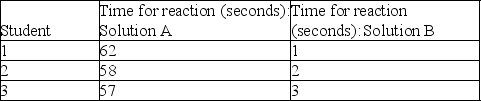 Write the chemical equation for this reaction.Determine average values for each beaker.Explain how the reaction times differed.What may be present in beaker B that is absent from beaker A?
 (Essay)
4.9/5 (85)
(85) Increasing ________ will decrease the amount of mRNA transcript within a cell for a constitutively active gene.
(Multiple Choice)
4.9/5 (77)
(77) Chemical reactions that require an input of energy are said to be ________.
(Short Answer)
4.9/5 (82)
(82) The activity of an enzyme is changed by environmental factors such as temperature or pH; these factors are referred to as
(Multiple Choice)
4.8/5 (78)
(78) Explain how these statements differ,and identify which one(s)is/are correct.Explain what is wrong with each incorrect statement.Explain when chemical reactions continue and when they stop.
A.A chemical reaction proceeds until the enzyme molecules are all consumed.
B.A chemical reaction proceeds until the substrate molecules are all consumed.
C.A chemical reaction proceeds until equilibrium is established.
D.A chemical reaction proceeds until all the product molecules are removed.
(Essay)
4.8/5 (79)
(79) Some diseases,such as phenylketonuria,classical hemophilia,cystic fibrosis,and muscular dystrophy are a result of enzyme malfunction.Each of these diseases is inherited.Explain how there might be a relationship among these observations.
(Essay)
4.8/5 (73)
(73) To activate a regulated gene,the formation of mRNA is ________ by the binding of ________ to the promoter.
(Multiple Choice)
4.8/5 (81)
(81) Phosphate groups may be transferred from one molecule to another during
(Multiple Choice)
4.9/5 (65)
(65) Regulatory-protein transcription factors bind to ________ and activate ________,which tells the RNA polymerase ________.
(Short Answer)
4.9/5 (66)
(66) Which of the following is a key intermediate of glucose catabolism to the citric acid cycle?
(Multiple Choice)
5.0/5 (88)
(88) Carbon dioxide and water readily combine to form carbonic acid.The change in pH as the acid dissociates can be demonstrated with an indicator dye that changes color at a particular pH.Following this lab in which the color of the solution was observed to change,one lab group forgot to dump the beakers at the end of the lab period.The next day would you expect the beakers to look the same as they did after being bubbled with CO2? If not,explain in terms of reversible reactions and equilibrium disturbance.
(Essay)
4.8/5 (68)
(68) The ________ is the portion of the mRNA that contains the coding sequence of the gene.
(Short Answer)
5.0/5 (85)
(85) 
Filters
- Essay(0)
- Multiple Choice(0)
- Short Answer(0)
- True False(0)
- Matching(0)