



 Chat with AI
Exam 4: Energy and Cellular Metabolism

Exam 1: Introduction to Physiology63 Questions
Exam 2: Molecular Interactions149 Questions
Exam 3: Compartmentation: Cells and Tissues159 Questions
Exam 4: Energy and Cellular Metabolism144 Questions
Exam 5: Membrane Dynamics136 Questions
Exam 6: Communication, Integration, and Homeostasis79 Questions
Exam 7: Introduction to the Endocrine System76 Questions
Exam 8: Neurons: Cellular and Network Properties223 Questions
Exam 9: The Central Nervous System107 Questions
Exam 10: Sensory Physiology173 Questions
Exam 11: Efferent Division: Autonomic and Somatic Motor Control75 Questions
Exam 12: Muscles100 Questions
Exam 13: Integrative Physiology I: Control of Body Movement69 Questions
Exam 14: Cardiovascular Physiology184 Questions
Exam 15: Blood Flow and the Control of Blood Pressure121 Questions
Exam 16: Blood107 Questions
Exam 17: Mechanics of Breathing117 Questions
Exam 18: Gas Exchange and Transport84 Questions
Exam 19: The Kidneys75 Questions
Exam 20: Integrative Physiology II: Fluid and Electrolyte Balance80 Questions
Exam 21: The Digestive System131 Questions
Exam 22: Metabolism and Energy Balance132 Questions
Exam 23: Endocrine Control of Growth and Metabolism97 Questions
Exam 24: The Immune System116 Questions
Exam 25: Integrative Physiology III: Exercise62 Questions
Exam 26: Reproduction and Development122 Questions
Select questions type


Following post-translational modification,any misfolded protein will be destroyed by
(Multiple Choice)
4.9/5  (71)
(71) The ________ of glycogen from many glucose molecules is an ________ reaction.
(Multiple Choice)
4.9/5 (77)
(77) For the following strand of DNA,use the table below to provide: bases for the complementary mRNA and bases for the corresponding tRNA molecules and the associated amino acids.What do you notice about the relationship between the DNA and the anticodons? What do you notice about the genetic code for proline in the peptide? How would the loss of the first G or switching that G to a T affect the structure and function of this protein?
DNA: GGC CTA CAA GCC GGA ACA GTT ACC GCG TAA CGA
mRNA:
tRNA: 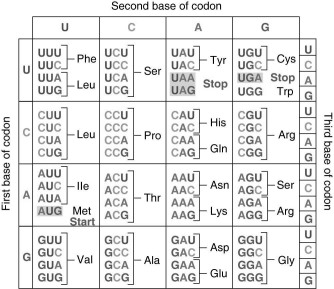
(Essay)
4.7/5 (75)
(75) ________ describes how much product is generated or substrate destroyed within a period of time.
(Short Answer)
4.9/5 (86)
(86) The reactions of glycolysis occur in the cell's ________; the reactions of the citric acid cycle occur in the ________.
(Multiple Choice)
4.8/5 (86)
(86) Candy bars are well known to supply large amounts of energy for metabolism.With all this energy trapped inside,how can the candy bar sit still on the shelf in the grocery store?
(Essay)
4.7/5 (69)
(69) How would the lack of a required cofactor for an enzyme affect that enzyme's function?
(Multiple Choice)
4.9/5 (84)
(84) A certain molecule that participates in more than one biochemical pathway and acts as a branch point for channeling substrate in one direction or another is called a ________.
(Short Answer)
4.8/5 (76)
(76) Analysis of a single DNA strand yielded this information on amounts of some nucleotides: 43 units of cytosine and 51 units of adenine.What amounts would you expect of guanine and thymine in that strand? What amounts would you expect of all bases in the complementary strand?
(Essay)
4.8/5 (95)
(95) Based on the facts about chemical equilibria in animal systems,indicate for each summary reaction below if it is reversible or irreversible (don't worry about balancing the reactions).Explain the lack of reversibility.In what kind of system would the reaction(s)you selected as irreversible be reversible? Explain.
A.C6H12O6 → CO2 + H2O
B.ADP + Pi → ATP
C.H2O + CO2 → H2CO3
(Essay)
4.9/5 (73)
(73) What happens to the oxygen that is metabolized within the mitochondria?
(Multiple Choice)
4.9/5 (88)
(88) The net energy yield for the anaerobic metabolism of one glucose molecule is
(Multiple Choice)
4.8/5 (70)
(70) Energy released by electrons moving through the electron transport system is stored as ________ by H+ ions concentrated in the ________.
(Short Answer)
4.8/5 (83)
(83) Amino acids are carried to the ribosomes to be incorporated into polypeptide chains by ________.
(Short Answer)
4.7/5 (76)
(76) The general term that describes energy stored in chemical bonds is
(Multiple Choice)
4.9/5 (67)
(67) 
Filters
- Essay(0)
- Multiple Choice(0)
- Short Answer(0)
- True False(0)
- Matching(0)