



 Chat with AI
Exam 18: Gas Exchange and Transport

Exam 1: Introduction to Physiology63 Questions
Exam 2: Molecular Interactions149 Questions
Exam 3: Compartmentation: Cells and Tissues159 Questions
Exam 4: Energy and Cellular Metabolism144 Questions
Exam 5: Membrane Dynamics136 Questions
Exam 6: Communication, Integration, and Homeostasis79 Questions
Exam 7: Introduction to the Endocrine System76 Questions
Exam 8: Neurons: Cellular and Network Properties223 Questions
Exam 9: The Central Nervous System107 Questions
Exam 10: Sensory Physiology173 Questions
Exam 11: Efferent Division: Autonomic and Somatic Motor Control75 Questions
Exam 12: Muscles100 Questions
Exam 13: Integrative Physiology I: Control of Body Movement69 Questions
Exam 14: Cardiovascular Physiology184 Questions
Exam 15: Blood Flow and the Control of Blood Pressure121 Questions
Exam 16: Blood107 Questions
Exam 17: Mechanics of Breathing117 Questions
Exam 18: Gas Exchange and Transport84 Questions
Exam 19: The Kidneys75 Questions
Exam 20: Integrative Physiology II: Fluid and Electrolyte Balance80 Questions
Exam 21: The Digestive System131 Questions
Exam 22: Metabolism and Energy Balance132 Questions
Exam 23: Endocrine Control of Growth and Metabolism97 Questions
Exam 24: The Immune System116 Questions
Exam 25: Integrative Physiology III: Exercise62 Questions
Exam 26: Reproduction and Development122 Questions
Select questions type


The partial pressure of carbon dioxide in the cells of peripheral tissues is approximately ________ mm Hg.

Free
(Multiple Choice)
4.9/5  (71)
(71) Correct Answer: Verified
B
If the neural connections between the pons and medulla are severed,breathing will stop.
Free
(True/False)
4.7/5 (86)
(86) Correct Answer:Verified
VerifiedFalse
Which of the following characteristics makes hemoglobin's structure such a good match for its function as an oxygen carrier?
Free
(Multiple Choice)
4.8/5 (79)
(79) Correct Answer:Verified
VerifiedC
Which is typically more important in regulating the respiratory system,PO2 or PCO2? Explain your answer and briefly discuss the receptors involved.Give examples of situations in which each of those factors changes enough to stimulate a reflex.How and why are these factors related to each other?
(Essay)
4.7/5 (79)
(79) Refer to the graph below. 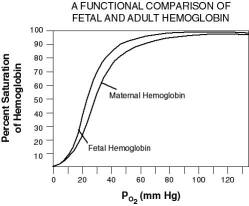 A.At a PO2 of 80 mm Hg,which type of hemoglobin binds more oxygen?
B.At a PO2 of 40 mm Hg,which type of hemoglobin has released more oxygen to the cell?
C.Explain the significance of the differences in fetal and maternal hemoglobin affinity.
D.If a worm lived in low oxygen mud flats where the PO2 is 60 mm Hg,which type of hemoglobin would be better for it to have? Explain.
A.At a PO2 of 80 mm Hg,which type of hemoglobin binds more oxygen?
B.At a PO2 of 40 mm Hg,which type of hemoglobin has released more oxygen to the cell?
C.Explain the significance of the differences in fetal and maternal hemoglobin affinity.
D.If a worm lived in low oxygen mud flats where the PO2 is 60 mm Hg,which type of hemoglobin would be better for it to have? Explain. (Essay)
5.0/5 (90)
(90) The graph below shows an oxygen dissociation curve,with the normal curve in the center.What is the name of the phenomenon that shifts the curve to the right? What causes this change in oxygen dissociation? Is the shift beneficial or detrimental? Explain. 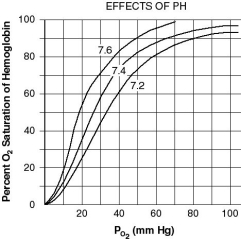
(Essay)
4.8/5 (68)
(68) Blocking afferent action potentials from the chemoreceptors in the carotid and aortic bodies would interfere with the brain's ability to regulate breathing in response to all EXCEPT which of the following?
(Multiple Choice)
4.8/5 (70)
(70) The carotid and aortic bodies contain specialized ________ cells,which can increase ventilation in response to changes in PO2,PCO2,or pH.
(Short Answer)
4.9/5 (78)
(78) The process by which dissolved gases are exchanged between the blood and interstitial fluids is
(Multiple Choice)
4.8/5 (75)
(75) Oxygen consumption increases with exercise due to the fact that the contracting muscles are doing work and require ATP to produce the contractions.
A) How does the body meet the increased demand for oxygen?
B) Calculate the oxygen consumption of a runner using the following information:
Heart Rate: 130 bpm; Stroke Volume: 270 mL/beat;
Arterial oxygen content: 250 mL O2/L blood,
(Essay)
4.7/5 (82)
(82) What are the two possible causes of lower alveolar PO2? Give examples of each.
(Essay)
4.8/5 (82)
(82) Match the lung disease to its description.
-increased airway resistance
(Multiple Choice)
4.8/5 (90)
(90) List,compare,and contrast the brain's centers for monitoring and controlling respiration.
(Essay)
4.9/5 (86)
(86) ________ is the enzyme that converts CO2 into bicarbonate ions.
(Short Answer)
4.8/5 (89)
(89) ________ is characterized by a thickened alveolar membrane,slowing respiratory gas exchange.
(Short Answer)
4.8/5 (65)
(65) An industrious 10-year-old swimmer has attached an extension to his snorkel tube,so that he can sit on the bottom of the ocean for a longer period of time,watching the fish of the coral reef.What problems would you expect him to have? Assuming he is successful in breathing this way for a little while,what are some of the differences he will experience compared to normal breathing?
(Essay)
4.9/5 (88)
(88) PCO2 tends to be ________ in tissues than in systemic capillaries.
(Short Answer)
4.8/5 (87)
(87) Drowning is often the introduction of outside water into the alveoli,yet some water is normally present in alveoli.Why is water normally present in the alveoli? What is present in alveolar fluid,besides water,that aids in respiration? What properties of water are detrimental to respiration? What causes drowning? While extremely rare,there have even been documented cases of people walking away from recreational swimming only to die later,on dry land,as a result of drowning (termed "delayed" or "secondary" drowning).Propose an explanation for delayed drowning.
(Essay)
4.7/5 (86)
(86) 
Filters
- Essay(0)
- Multiple Choice(0)
- Short Answer(0)
- True False(0)
- Matching(0)