



 Chat with AI
Exam 4: The Market Forces of Supply and Demand

Exam 1: Ten Lessons From Economics149 Questions
Exam 2: Thinking Like an Economist147 Questions
Exam 3: Interdependence and the Gains From Trade153 Questions
Exam 4: The Market Forces of Supply and Demand222 Questions
Exam 5: Elasticity and Its Application181 Questions
Exam 6: Supply, Demand and Government Policies148 Questions
Exam 7: Consumers, Producers and the Efficiency of Markets177 Questions
Exam 8: Application: The Costs of Taxation141 Questions
Exam 9: Application: International Trade161 Questions
Exam 10: Externalities199 Questions
Exam 11: Public Goods and Common Resources182 Questions
Exam 12: The Design of the Tax System154 Questions
Exam 13: The Costs of Production191 Questions
Exam 14: Firms in Competitive Markets200 Questions
Exam 15: Monopoly214 Questions
Exam 16: Business Strategy184 Questions
Exam 17: Competition Policy104 Questions
Exam 18: Monopolistic Competition214 Questions
Exam 19: The Markets for the Factors of Production215 Questions
Exam 20: Earnings, Unions and Discrimination206 Questions
Exam 21: Income Inequity and Poverty111 Questions
Exam 22: The Theory of Consumer Choice161 Questions
Exam 23: Frontiers of Microeconomics120 Questions
Exam 24: Measuring a Nations Income51 Questions
Exam 25: Measuring the Cost of Living52 Questions
Exam 26: Production and Growth62 Questions
Exam 27: Saving, Investment and the Financial System62 Questions
Exam 28: The Natural Rate of Unemployment59 Questions
Exam 29: The Monetary System66 Questions
Exam 30: Inflation: Its Causes and Costs74 Questions
Exam 31: Open-Economy Macroeconomics: Basic Concepts68 Questions
Exam 32: A Macroeconomic Theory of the Open Economy64 Questions
Exam 33: Aggregate Demand and Aggregate Supply82 Questions
Exam 34: The Influence of Monetary and Fiscal Policy on Aggregate Demand73 Questions
Exam 35: The Short-Run Trade-Off Between Inflation and Unemployment58 Questions
Exam 36: Five Debates Over Macroeconomic Policy38 Questions
Select questions type


Given the following information about three consumers' monthly demand, construct a market demand curve for potato chips. What would happen to demand if Ryan decided to buy popcorn and not to buy chips? Show this change on your graph.
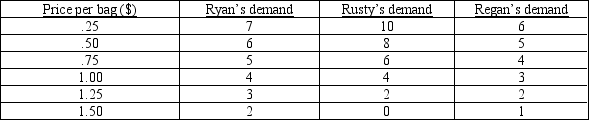
(Essay)
4.8/5  (72)
(72) A perfectly competitive market has which of the following characteristics?
(Multiple Choice)
5.0/5 (77)
(77) Graph 4-2
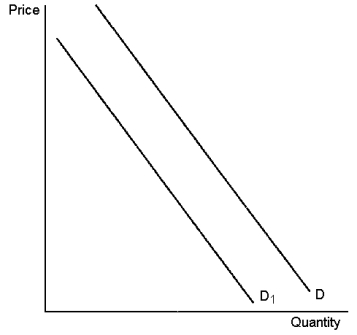 -Refer to Graph 4-2. On the graph, the movement from D to D1 is called:
 (Multiple Choice)
4.8/5 (85)
(85) What characteristics or requirements must be met for a market to be considered as each of the following?
a. perfectly competitive
b. a monopoly
c. an oligopoly
d. monopolistic competition
(Essay)
4.8/5 (80)
(80) The law of supply states that, other things being equal, when the price of a good rises, the quantity supplied of the good falls.
(True/False)
4.8/5 (79)
(79) What is the difference between a change in demand and a change in quantity demanded? Graph your answer.
(Essay)
4.9/5 (81)
(81) The internet has enabled markets to move towards the competitive model.
(True/False)
4.9/5 (92)
(92) Increasing the number of sellers in a market is demonstrated by a movement along the supply curve.
(True/False)
4.7/5 (73)
(73) Graph 4-1
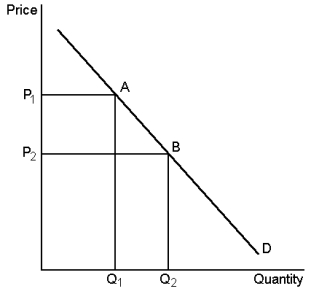 -Refer to Graph 4-1. The movement from point B to point A on the graph shows:
 (Multiple Choice)
4.8/5 (85)
(85) Suppose that the incomes of buyers in a particular market for a normal good decline and there is also a reduction in input prices. What would we expect to occur in this market?
(Multiple Choice)
4.7/5 (79)
(79) Table 4-1
A market is represented by the table below:
Quantities demanded:
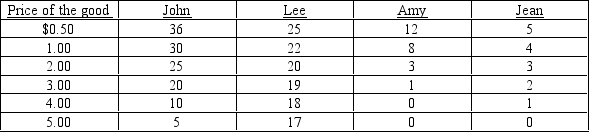 -Refer to Table 4-1. If the price of the good is $1, the quantity demanded in this market would be:
 (Multiple Choice)
4.9/5 (95)
(95) The quantity supplied of a good or service is the amount that sellers are willing and able to sell at a particular price.
(True/False)
4.9/5 (82)
(82) For each of the following products and industries, determine whether the market structure is perfect competition, monopolistic competition, oligopoly or monopoly.
a. mobile phone services
b. soft drinks
c. local water
d. the automobile industry
e. fast food in a city
f. the textbook industry
g. television networks
h. market for second hand cars
(Essay)
4.9/5 (73)
(73) In a competitive market, buyers cannot influence the price because:
(Multiple Choice)
4.9/5 (63)
(63) If mad cow disease causes a beef-scare in Europe, demand for wild meat like deer or kangaroo is likely to shift to the right in that market.
(True/False)
4.9/5 (69)
(69) 
Filters
- Essay(0)
- Multiple Choice(0)
- Short Answer(0)
- True False(0)
- Matching(0)