



 Chat with AI
Exam 4: The Market Forces of Supply and Demand

Exam 1: Ten Lessons From Economics149 Questions
Exam 2: Thinking Like an Economist147 Questions
Exam 3: Interdependence and the Gains From Trade153 Questions
Exam 4: The Market Forces of Supply and Demand222 Questions
Exam 5: Elasticity and Its Application181 Questions
Exam 6: Supply, Demand and Government Policies148 Questions
Exam 7: Consumers, Producers and the Efficiency of Markets177 Questions
Exam 8: Application: The Costs of Taxation141 Questions
Exam 9: Application: International Trade161 Questions
Exam 10: Externalities199 Questions
Exam 11: Public Goods and Common Resources182 Questions
Exam 12: The Design of the Tax System154 Questions
Exam 13: The Costs of Production191 Questions
Exam 14: Firms in Competitive Markets200 Questions
Exam 15: Monopoly214 Questions
Exam 16: Business Strategy184 Questions
Exam 17: Competition Policy104 Questions
Exam 18: Monopolistic Competition214 Questions
Exam 19: The Markets for the Factors of Production215 Questions
Exam 20: Earnings, Unions and Discrimination206 Questions
Exam 21: Income Inequity and Poverty111 Questions
Exam 22: The Theory of Consumer Choice161 Questions
Exam 23: Frontiers of Microeconomics120 Questions
Exam 24: Measuring a Nations Income51 Questions
Exam 25: Measuring the Cost of Living52 Questions
Exam 26: Production and Growth62 Questions
Exam 27: Saving, Investment and the Financial System62 Questions
Exam 28: The Natural Rate of Unemployment59 Questions
Exam 29: The Monetary System66 Questions
Exam 30: Inflation: Its Causes and Costs74 Questions
Exam 31: Open-Economy Macroeconomics: Basic Concepts68 Questions
Exam 32: A Macroeconomic Theory of the Open Economy64 Questions
Exam 33: Aggregate Demand and Aggregate Supply82 Questions
Exam 34: The Influence of Monetary and Fiscal Policy on Aggregate Demand73 Questions
Exam 35: The Short-Run Trade-Off Between Inflation and Unemployment58 Questions
Exam 36: Five Debates Over Macroeconomic Policy38 Questions
Select questions type


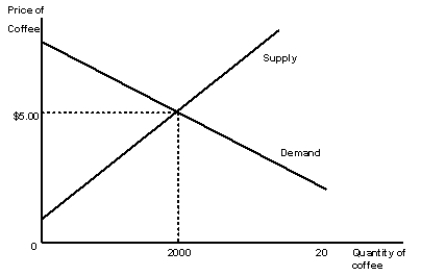
Given the graph shown, what will be the result in the market if the price was $6, or $5 or $4?
(Essay)
4.8/5  (87)
(87) As a seller, you would be considered part of a perfectly competitive market if:
(Multiple Choice)
5.0/5 (74)
(74) Graph 4-5
 -Refer to Graph 4-5. According to the graph, equilibrium price and quantity are:
 (Multiple Choice)
4.9/5 (74)
(74) A market supply curve is found by summing vertically all of the individual supply curves.
(True/False)
5.0/5 (69)
(69) Graph 4-5
-Refer to Graph 4-5. According to the graph, at a price of $3:
-Refer to Graph 4-5. According to the graph, at a price of $3: (Multiple Choice)
5.0/5 (84)
(84) Demand curves are often upward sloping when prices are very high.
(True/False)
4.9/5 (88)
(88) Graph 4-6
 -Refer to the Graph 4-6. If price were $25, quantity demanded would be:
 (Multiple Choice)
4.8/5 (84)
(84) If the price of DVD players falls, there is likely to be a leftward shift in the demand for DVD movie rentals.
(True/False)
4.7/5 (72)
(72) Graph 4-5
-Refer to Graph 4-5. According to the graph, at a price of $7:
-Refer to Graph 4-5. According to the graph, at a price of $7: (Multiple Choice)
5.0/5 (62)
(62) Suppose that there is an decrease in input prices for the manufacture of cameras. We would expect the supply of cameras to:
(Multiple Choice)
4.9/5 (74)
(74) Equilibrium in a market is found where the supply curve and the demand curve intersect.
(True/False)
4.9/5 (81)
(81) A game console and games designed for that console are substitute goods.
(True/False)
4.8/5 (69)
(69) If the Government subsidises forest clearance to create more pastoral land for cattle then:
(Multiple Choice)
4.7/5 (90)
(90) If the market price is below the equilibrium price, there will be a surplus and the price will rise.
(True/False)
4.8/5 (68)
(68) A market with many sellers offering slightly different products is called a monopoly.
(True/False)
4.8/5 (66)
(66) 
Filters
- Essay(0)
- Multiple Choice(0)
- Short Answer(0)
- True False(0)
- Matching(0)