



 Chat with AI
Exam 4: The Market Forces of Supply and Demand

Exam 1: Ten Lessons From Economics149 Questions
Exam 2: Thinking Like an Economist147 Questions
Exam 3: Interdependence and the Gains From Trade153 Questions
Exam 4: The Market Forces of Supply and Demand222 Questions
Exam 5: Elasticity and Its Application181 Questions
Exam 6: Supply, Demand and Government Policies148 Questions
Exam 7: Consumers, Producers and the Efficiency of Markets177 Questions
Exam 8: Application: The Costs of Taxation141 Questions
Exam 9: Application: International Trade161 Questions
Exam 10: Externalities199 Questions
Exam 11: Public Goods and Common Resources182 Questions
Exam 12: The Design of the Tax System154 Questions
Exam 13: The Costs of Production191 Questions
Exam 14: Firms in Competitive Markets200 Questions
Exam 15: Monopoly214 Questions
Exam 16: Business Strategy184 Questions
Exam 17: Competition Policy104 Questions
Exam 18: Monopolistic Competition214 Questions
Exam 19: The Markets for the Factors of Production215 Questions
Exam 20: Earnings, Unions and Discrimination206 Questions
Exam 21: Income Inequity and Poverty111 Questions
Exam 22: The Theory of Consumer Choice161 Questions
Exam 23: Frontiers of Microeconomics120 Questions
Exam 24: Measuring a Nations Income51 Questions
Exam 25: Measuring the Cost of Living52 Questions
Exam 26: Production and Growth62 Questions
Exam 27: Saving, Investment and the Financial System62 Questions
Exam 28: The Natural Rate of Unemployment59 Questions
Exam 29: The Monetary System66 Questions
Exam 30: Inflation: Its Causes and Costs74 Questions
Exam 31: Open-Economy Macroeconomics: Basic Concepts68 Questions
Exam 32: A Macroeconomic Theory of the Open Economy64 Questions
Exam 33: Aggregate Demand and Aggregate Supply82 Questions
Exam 34: The Influence of Monetary and Fiscal Policy on Aggregate Demand73 Questions
Exam 35: The Short-Run Trade-Off Between Inflation and Unemployment58 Questions
Exam 36: Five Debates Over Macroeconomic Policy38 Questions
Select questions type


For each of the following situations in the Australian crocodile market, determine whether the quantity supplied changes, or whether the supply curve shifts and determine the direction of the change.
a. the number of crocodile farms and ranches closes, ceteris paribus
b. Professor Webb develops an antibiotic that ensures more hatchlings survive on ranches
c. the cost of meat to feed crocodiles rises
d. Thailand announces it is going to increase the number of crocodile farms in the next five years
(Essay)
4.7/5  (80)
(80) It is not possible for demand and supply to shift at the same time.
(True/False)
4.9/5 (91)
(91) Graph each of the following changes and explain what would happen to equilibrium price and quantity.
1. demand increases and supply increases
2. demand increases and supply decreases
3. demand decreases and supply decreases
4. demand decreases and supply increases
(Short Answer)
4.9/5 (81)
(81) Which of the following would cause both the equilibrium price and equilibrium quantity of number-two-grade potatoes (an inferior good) to increase?
(Multiple Choice)
4.9/5 (93)
(93) Graph 4-1
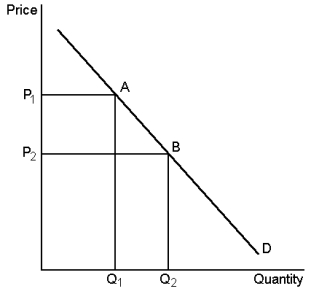 -Refer to Graph 4-1. The movement from point A to point B on the graph would be caused by:
 (Multiple Choice)
4.9/5 (83)
(83) When large areas of the US Pacific North-West were protected from logging in 1990 (to conserve spotted owl habitat), this is likely to have caused the equilibrium price of logs to increase and the equilibrium quantity of logs sold to decrease.
(True/False)
4.9/5 (82)
(82) A reduction in an input price will cause a change in quantity supplied, but not a change in supply.
(True/False)
4.9/5 (80)
(80) The quantity demanded of a product is the amount that buyers are willing and able to purchase at a particular price.
(True/False)
4.9/5 (82)
(82) A table showing how the quantity supplied of a product varies with its price, other things being equal, is a supply schedule and the graph of the supply schedule is called a supply curve.
(True/False)
4.9/5 (71)
(71) Graph 4-6
 -Refer to the Graph 4-6. If price were $15, quantity supplied would be:
 (Multiple Choice)
4.8/5 (70)
(70) Demand for fish is higher in India than Australia because:
(Multiple Choice)
4.8/5 (81)
(81) A weaker demand together with a stronger supply would necessarily result in:
(Multiple Choice)
4.8/5 (78)
(78) Suppose that demand for black market koala skins increases AND supply decreases because of falling koala populations. What would happen in the black market for koala skins?
(Multiple Choice)
4.9/5 (66)
(66) 
Filters
- Essay(0)
- Multiple Choice(0)
- Short Answer(0)
- True False(0)
- Matching(0)