



 Chat with AI
Exam 4: The Market Forces of Supply and Demand

Exam 1: Ten Lessons From Economics149 Questions
Exam 2: Thinking Like an Economist147 Questions
Exam 3: Interdependence and the Gains From Trade153 Questions
Exam 4: The Market Forces of Supply and Demand222 Questions
Exam 5: Elasticity and Its Application181 Questions
Exam 6: Supply, Demand and Government Policies148 Questions
Exam 7: Consumers, Producers and the Efficiency of Markets177 Questions
Exam 8: Application: The Costs of Taxation141 Questions
Exam 9: Application: International Trade161 Questions
Exam 10: Externalities199 Questions
Exam 11: Public Goods and Common Resources182 Questions
Exam 12: The Design of the Tax System154 Questions
Exam 13: The Costs of Production191 Questions
Exam 14: Firms in Competitive Markets200 Questions
Exam 15: Monopoly214 Questions
Exam 16: Business Strategy184 Questions
Exam 17: Competition Policy104 Questions
Exam 18: Monopolistic Competition214 Questions
Exam 19: The Markets for the Factors of Production215 Questions
Exam 20: Earnings, Unions and Discrimination206 Questions
Exam 21: Income Inequity and Poverty111 Questions
Exam 22: The Theory of Consumer Choice161 Questions
Exam 23: Frontiers of Microeconomics120 Questions
Exam 24: Measuring a Nations Income51 Questions
Exam 25: Measuring the Cost of Living52 Questions
Exam 26: Production and Growth62 Questions
Exam 27: Saving, Investment and the Financial System62 Questions
Exam 28: The Natural Rate of Unemployment59 Questions
Exam 29: The Monetary System66 Questions
Exam 30: Inflation: Its Causes and Costs74 Questions
Exam 31: Open-Economy Macroeconomics: Basic Concepts68 Questions
Exam 32: A Macroeconomic Theory of the Open Economy64 Questions
Exam 33: Aggregate Demand and Aggregate Supply82 Questions
Exam 34: The Influence of Monetary and Fiscal Policy on Aggregate Demand73 Questions
Exam 35: The Short-Run Trade-Off Between Inflation and Unemployment58 Questions
Exam 36: Five Debates Over Macroeconomic Policy38 Questions
Select questions type


Holding all else constant, a higher price for ski lift tickets would be expected to:
(Multiple Choice)
4.9/5  (76)
(76) Suppose that a decrease in the price of X results in less of good Y sold. This would mean that X and Y are:
(Multiple Choice)
4.9/5 (76)
(76) If the number of buyers of DVD movies increases, other things being equal, there will be an increase in the equilibrium price of DVD movies and a decrease in the equilibrium quantity sold.
(True/False)
5.0/5 (91)
(91) If a seller in a competitive market chooses to charge more than the market price, then:
(Multiple Choice)
4.8/5 (93)
(93) The news that oat bran helped reduce serum cholesterol, caused people to prefer to eat more oatmeal. This change in preference would be expected to cause the demand curve for oats to shift to the right, and equilibrium price and quantity of oats to increase. What effects might be felt in other markets?
(Essay)
4.8/5 (82)
(82) Why do we use the demand-and-supply graphs to explain human behaviours regarding production and consumption?
(Essay)
4.8/5 (84)
(84) For each of the following situations in the wheat market, determine whether the quantity demanded changes, or the demand curve shifts and determine the direction of the change.
a. consumer income increases
b. the price of wheat increases
c. scientists determine that eating wheat causes high blood pressure
d. the price of oats increases
e. in June, insects destroy part of the country's wheat crop
(Essay)
4.9/5 (75)
(75) If good Z is 'inferior', then an increase in income will cause:
(Multiple Choice)
4.8/5 (74)
(74) The price where quantity supplied equals quantity demanded is called:
(Multiple Choice)
4.8/5 (73)
(73) Graph 4-2
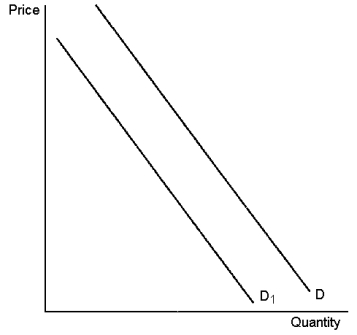 -Refer to Graph 4-2. On the graph, the movement from D to D1 could be caused by:
 (Multiple Choice)
4.8/5 (70)
(70) The behaviour of firms to different market conditions is known as:
(Multiple Choice)
4.9/5 (70)
(70) Given the following table, graph the demand and supply curves for flashlights. Be sure to label equilibrium price and equilibrium quantity.

(Essay)
4.7/5 (68)
(68) If the price of tea increases, there is likely to be a rightward shift in the demand for coffee.
(True/False)
4.9/5 (77)
(77) Graph 4-3
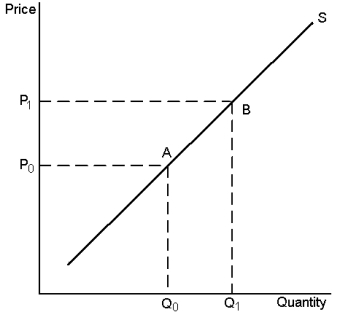 -Refer to Graph 4-3. Suppose we observe the movement from point B to point A on the graph. This would be caused by:
 (Multiple Choice)
4.8/5 (74)
(74) 
Filters
- Essay(0)
- Multiple Choice(0)
- Short Answer(0)
- True False(0)
- Matching(0)