



 Chat with AI
Exam 8: Monopoly, Oligopoly, and Monopolistic Competition

Exam 1: Thinking Like an Economist142 Questions
Exam 2: Comparative Advantage163 Questions
Exam 3: Supply and Demand181 Questions
Exam 4: Elasticity154 Questions
Exam 5: Demand144 Questions
Exam 6: Perfectly Competitive Supply159 Questions
Exam 7: Efficiency, Exchange, and the Invisible Hand in Action159 Questions
Exam 8: Monopoly, Oligopoly, and Monopolistic Competition147 Questions
Exam 9: Games and Strategic Behavior150 Questions
Exam 10: An Introduction to Behavioral Economics111 Questions
Exam 11: Externalities, Property Rights, and the Environment184 Questions
Exam 12: The Economics of Information127 Questions
Exam 13: Labor Markets, Poverty, and Income Distribution138 Questions
Exam 14: Public Goods and Tax Policy142 Questions
Exam 15: International Trade and Trade Policy164 Questions
Exam 16: Macroeconomics: The Birds Eye View of the Economy154 Questions
Exam 17: Measuring Economic Activity: GDP and Unemployment210 Questions
Exam 18: Measuring the Price Level and Inflation160 Questions
Exam 19: Economic Growth, Productivity, and Living Standards158 Questions
Exam 20: The Labor Market: Workers, Wages, and Unemployment121 Questions
Exam 21: Saving and Capital Formation144 Questions
Exam 22: Money Prices and the Federal Reserve107 Questions
Exam 23: Financial Markets and International Capital Flows104 Questions
Exam 24: Short-Term Economic Fluctuations: An Introduction124 Questions
Exam 25: Spending and Output in the Short Run146 Questions
Exam 26: Stabilizing the Economy: The Role of the Fed162 Questions
Exam 27: Aggregate Demand, Aggregate Supply, and Inflation159 Questions
Exam 28: Exchange Rates and the Open Economy157 Questions
Select questions type


Suppose Campus Books, a profit-maximizing firm, is the only supplier of the textbook for a given class. The marginal cost of supplying each book is constant and equal to $10, and Campus Books has no fixed costs. The table shows the reservation prices of the eight students enrolled in the class.
Custamer Reservutian Price (S/Bank) 60 54 48 42 36 30 24 18 What will be Campus Books' economic profit if it must charge a single price to all of its customers?
(Multiple Choice)
4.9/5  (75)
(75) If a natural monopoly decreases the quantity of output it produces, then:
(Multiple Choice)
4.8/5 (88)
(88) Which of the following is NOT an example of the hurdle method of price discrimination?
(Multiple Choice)
4.9/5 (90)
(90) If the demand curve facing a monopolist shifts, then the monopolist's:
(Multiple Choice)
4.7/5 (76)
(76) Suppose the accompanying figure illustrates the demand curve facing a monopolist. 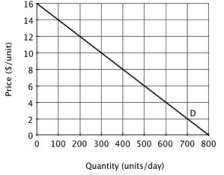 Suppose this firm maximizes its profits by charging a price of $8 per unit. This implies that the firm's:
 (Multiple Choice)
4.8/5 (80)
(80) 
Filters
- Essay(0)
- Multiple Choice(0)
- Short Answer(0)
- True False(0)
- Matching(0)