



 Chat with AI
Exam 22: Money Prices and the Federal Reserve

Exam 1: Thinking Like an Economist142 Questions
Exam 2: Comparative Advantage163 Questions
Exam 3: Supply and Demand181 Questions
Exam 4: Elasticity154 Questions
Exam 5: Demand144 Questions
Exam 6: Perfectly Competitive Supply159 Questions
Exam 7: Efficiency, Exchange, and the Invisible Hand in Action159 Questions
Exam 8: Monopoly, Oligopoly, and Monopolistic Competition147 Questions
Exam 9: Games and Strategic Behavior150 Questions
Exam 10: An Introduction to Behavioral Economics111 Questions
Exam 11: Externalities, Property Rights, and the Environment184 Questions
Exam 12: The Economics of Information127 Questions
Exam 13: Labor Markets, Poverty, and Income Distribution138 Questions
Exam 14: Public Goods and Tax Policy142 Questions
Exam 15: International Trade and Trade Policy164 Questions
Exam 16: Macroeconomics: The Birds Eye View of the Economy154 Questions
Exam 17: Measuring Economic Activity: GDP and Unemployment210 Questions
Exam 18: Measuring the Price Level and Inflation160 Questions
Exam 19: Economic Growth, Productivity, and Living Standards158 Questions
Exam 20: The Labor Market: Workers, Wages, and Unemployment121 Questions
Exam 21: Saving and Capital Formation144 Questions
Exam 22: Money Prices and the Federal Reserve107 Questions
Exam 23: Financial Markets and International Capital Flows104 Questions
Exam 24: Short-Term Economic Fluctuations: An Introduction124 Questions
Exam 25: Spending and Output in the Short Run146 Questions
Exam 26: Stabilizing the Economy: The Role of the Fed162 Questions
Exam 27: Aggregate Demand, Aggregate Supply, and Inflation159 Questions
Exam 28: Exchange Rates and the Open Economy157 Questions
Select questions type


If banks' desired reserve ratio increases from 0.10 to 0.15, the public still desires to hold the same amount of currency, the money supply will:

Free
(Multiple Choice)
4.7/5  (75)
(75) Correct Answer: Verified
B
The Board of Governors consists of ________ governors appointed for staggered ________ terms.
Free
(Multiple Choice)
4.7/5 (61)
(61) Correct Answer:Verified
VerifiedD
Based on the following information, the value of the M1 measure of the money supply is ________ and the value of the M2 measure of the money supply is ________. Assets Billims af Dallars Curency Demand deposits Money market rmutual Furds Traveler's checks 10 Bavings deposits Other checkable deposits Brmall denomination tirne deposits 1,100
Free
(Multiple Choice)
4.9/5 (87)
(87) Correct Answer:Verified
VerifiedD
Based on the information in the table, we can conclude that, in 1932, each of the following events occurred except: 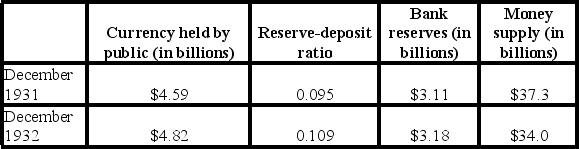
(Multiple Choice)
4.7/5 (90)
(90) Deposit insurance is a system in which the government guarantees that:
(Multiple Choice)
4.8/5 (89)
(89) When the Federal Reserve buys government bonds from the public, this is an example of a(n):
(Multiple Choice)
4.8/5 (79)
(79) Two countries, Alpha and Beta, have the same levels of nominal and real GDP. Each dollar in Alpha is used more frequently than each dollar in Beta. Therefore, it must be the case that ________ in Alpha than in Beta.
(Multiple Choice)
4.8/5 (70)
(70) When the actual reserve-deposit ratio exceeds the desired reserve-deposit ratio banks:
(Multiple Choice)
4.8/5 (80)
(80) The introduction of credit cards and debit cards has ________ velocity.
(Multiple Choice)
4.8/5 (78)
(78) An open-market purchase of government securities by the Fed will:
(Multiple Choice)
4.9/5 (80)
(80) The main disadvantage of using money as a store of value is that:
(Multiple Choice)
4.9/5 (89)
(89) If you use $1,000 to purchase silver bullion, which you plan to keep in a safe, you are using money as:
(Multiple Choice)
4.9/5 (75)
(75) When a baker exchanges a pie for dollars, this is an example of dollars serving as:
(Multiple Choice)
4.8/5 (89)
(89) The U.S. Congress instituted a system of deposit insurance for banks in:
(Multiple Choice)
4.9/5 (73)
(73) 
Filters
- Essay(0)
- Multiple Choice(0)
- Short Answer(0)
- True False(0)
- Matching(0)