



 Chat with AI
Exam 22: Money Prices and the Federal Reserve

Exam 1: Thinking Like an Economist142 Questions
Exam 2: Comparative Advantage163 Questions
Exam 3: Supply and Demand181 Questions
Exam 4: Elasticity154 Questions
Exam 5: Demand144 Questions
Exam 6: Perfectly Competitive Supply159 Questions
Exam 7: Efficiency, Exchange, and the Invisible Hand in Action159 Questions
Exam 8: Monopoly, Oligopoly, and Monopolistic Competition147 Questions
Exam 9: Games and Strategic Behavior150 Questions
Exam 10: An Introduction to Behavioral Economics111 Questions
Exam 11: Externalities, Property Rights, and the Environment184 Questions
Exam 12: The Economics of Information127 Questions
Exam 13: Labor Markets, Poverty, and Income Distribution138 Questions
Exam 14: Public Goods and Tax Policy142 Questions
Exam 15: International Trade and Trade Policy164 Questions
Exam 16: Macroeconomics: The Birds Eye View of the Economy154 Questions
Exam 17: Measuring Economic Activity: GDP and Unemployment210 Questions
Exam 18: Measuring the Price Level and Inflation160 Questions
Exam 19: Economic Growth, Productivity, and Living Standards158 Questions
Exam 20: The Labor Market: Workers, Wages, and Unemployment121 Questions
Exam 21: Saving and Capital Formation144 Questions
Exam 22: Money Prices and the Federal Reserve107 Questions
Exam 23: Financial Markets and International Capital Flows104 Questions
Exam 24: Short-Term Economic Fluctuations: An Introduction124 Questions
Exam 25: Spending and Output in the Short Run146 Questions
Exam 26: Stabilizing the Economy: The Role of the Fed162 Questions
Exam 27: Aggregate Demand, Aggregate Supply, and Inflation159 Questions
Exam 28: Exchange Rates and the Open Economy157 Questions
Select questions type


Savings deposits are ________ the M1 measure of money and ________ the M2 measure of money.
(Multiple Choice)
4.9/5  (83)
(83) If you put a $20 bill in the pocket of your winter coat at the beginning of spring so that you will be surprised when you find it again next winter, you are using money as:
(Multiple Choice)
4.8/5 (66)
(66) If the public switches from using cash for most transactions to using checks instead, then all else equal, the money supply will:
(Multiple Choice)
4.8/5 (81)
(81) Refer to the information in the table. The amount of currency held by the public ________, and the amount of reserves held by banks ________. It must be the case that, in 1932, the Federal Reserve ________. 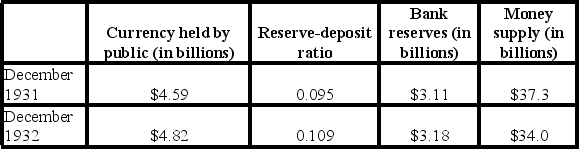
(Multiple Choice)
4.8/5 (82)
(82) According to the quantity equation, if velocity and output are constant, then an increase in the money supply leads to ________ in inflation.
(Multiple Choice)
4.9/5 (72)
(72) The link between the money supply and prices is strongest in:
(Multiple Choice)
5.0/5 (85)
(85) If a bank's desired reserve-deposit ratio is 0.33 and it has deposit liabilities of $100 million and reserves of $50 million, it:
(Multiple Choice)
4.9/5 (73)
(73) If real GDP equals 3,500, nominal GDP equals 5,250, and the price level equals 1.5, then what is velocity if the money stock equals 2,100?
(Multiple Choice)
4.9/5 (77)
(77) Based on the information in the table, the total amount of bank deposits decreased from ________ to ________ over the course of 1932. 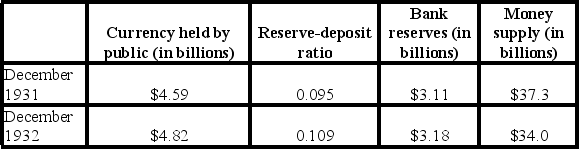
(Multiple Choice)
4.9/5 (89)
(89) In Macroland there is $1,000,000 in currency that can either be held by the public as currency or deposited into banks. Banks' desired reserve/deposit ratio is 10 percent. If the public of Macroland decides to hold more currency, increasing the proportion they hold from 50 percent to 75 percent, the money supply in Macroland will ________.
(Multiple Choice)
4.8/5 (73)
(73) If you post your car on eBay with a Buy-It-Now price of $1,800, you are using money as:
(Multiple Choice)
4.8/5 (73)
(73) In Macroland, currency held by the public is 2,000 econs, bank reserves are 300 econs, and the desired reserve/deposit ratio is 10 percent. If the Central Bank prints an additional 200 econs and uses this new currency to buy government bonds from the public, the money supply in Macroland will increase from ________ econs to ________ econs, assuming that the public does not wish to change the amount of currency it holds.
(Multiple Choice)
4.8/5 (78)
(78) The direct trade of goods and services for other goods and services is called:
(Multiple Choice)
4.9/5 (87)
(87) Money serves as a basic yardstick for measuring economic value (a unit of account), allowing:
(Multiple Choice)
4.8/5 (74)
(74) The money supply in Econland is 1,000, and currency held by the public equals bank reserves. The desired reserve-deposit ratio is 0.25. Bank reserves equal ________.
(Multiple Choice)
4.9/5 (85)
(85) After the Federal Reserve increases reserves in the banking system, banks create new deposits through multiple rounds of lending and accepting deposits until the:
(Multiple Choice)
4.7/5 (84)
(84) Money market mutual funds are ________ the M1 measure of money and ________ the M2 measure of money.
(Multiple Choice)
4.9/5 (76)
(76) 
Filters
- Essay(0)
- Multiple Choice(0)
- Short Answer(0)
- True False(0)
- Matching(0)