



 Chat with AI
Exam 3: Supply and Demand

Exam 1: Thinking Like an Economist142 Questions
Exam 2: Comparative Advantage163 Questions
Exam 3: Supply and Demand181 Questions
Exam 4: Elasticity154 Questions
Exam 5: Demand144 Questions
Exam 6: Perfectly Competitive Supply159 Questions
Exam 7: Efficiency, Exchange, and the Invisible Hand in Action159 Questions
Exam 8: Monopoly, Oligopoly, and Monopolistic Competition147 Questions
Exam 9: Games and Strategic Behavior150 Questions
Exam 10: An Introduction to Behavioral Economics111 Questions
Exam 11: Externalities, Property Rights, and the Environment184 Questions
Exam 12: The Economics of Information127 Questions
Exam 13: Labor Markets, Poverty, and Income Distribution138 Questions
Exam 14: Public Goods and Tax Policy142 Questions
Exam 15: International Trade and Trade Policy164 Questions
Exam 16: Macroeconomics: The Birds Eye View of the Economy154 Questions
Exam 17: Measuring Economic Activity: GDP and Unemployment210 Questions
Exam 18: Measuring the Price Level and Inflation160 Questions
Exam 19: Economic Growth, Productivity, and Living Standards158 Questions
Exam 20: The Labor Market: Workers, Wages, and Unemployment121 Questions
Exam 21: Saving and Capital Formation144 Questions
Exam 22: Money Prices and the Federal Reserve107 Questions
Exam 23: Financial Markets and International Capital Flows104 Questions
Exam 24: Short-Term Economic Fluctuations: An Introduction124 Questions
Exam 25: Spending and Output in the Short Run146 Questions
Exam 26: Stabilizing the Economy: The Role of the Fed162 Questions
Exam 27: Aggregate Demand, Aggregate Supply, and Inflation159 Questions
Exam 28: Exchange Rates and the Open Economy157 Questions
Select questions type


Suppose you bought a concert ticket from Ticketmaster for $50, but when you get to the concert, there are a large number of people waiting outside who offer to pay you more than $50 for your ticket. What is probably true?

Free
(Multiple Choice)
4.9/5  (75)
(75) Correct Answer: Verified
A
Refer to the accompanying figure. Moving from demand curve D2 to demand curve D1 could be caused by a(n): 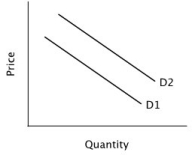
Free
(Multiple Choice)
4.7/5 (87)
(87) Correct Answer:Verified
VerifiedD
Suppose that the market price for hot dogs sold by street vendors has just risen from $4.50 to $5.00, and that in response Curly has now begun operating a hot dog cart. We can assume that Curly's reservation price for hot dogs is:
(Multiple Choice)
4.8/5 (80)
(80) When the price of a good changes, the amount of that good that buyers wish to buy changes:
(Multiple Choice)
4.8/5 (79)
(79) Suppose one knows two facts: first, the market for prescription drugs experiences chronic shortages and second, the government sets the price for prescription drugs. One can conclude that the government has:
(Multiple Choice)
5.0/5 (80)
(80) Suppose the equilibrium price and quantity of ketchup fall. The most likely explanation for these changes is:
(Multiple Choice)
4.9/5 (69)
(69) Suppose you observe a decrease in the equilibrium price and quantity of corn. Of the options listed below, this is best explained by:
(Multiple Choice)
4.8/5 (77)
(77) If the production of oranges reduces global warming, then the equilibrium quantity of oranges will be ________ the socially optimal quantity.
(Multiple Choice)
5.0/5 (80)
(80) Refer to the accompanying figure, which shows the market for cups of coffee. What might cause a shift from the original demand curve to the new demand curve? 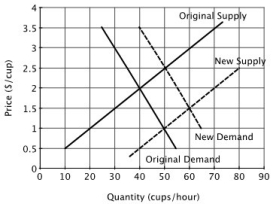
(Multiple Choice)
4.8/5 (85)
(85) When the current price of a good is below the equilibrium price:
(Multiple Choice)
4.9/5 (83)
(83) A market equilibrium might not maximize total economic surplus because:
(Multiple Choice)
4.9/5 (80)
(80) Refer to the accompanying figure. Assume the market is originally at point W. Movement to point Y is the result of: 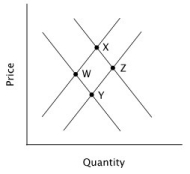
(Multiple Choice)
4.8/5 (88)
(88) Which of the following would cause an increase in quantity of wheat supplied?
(Multiple Choice)
4.8/5 (75)
(75) Refer to the accompanying figure. Moving from demand curve D1 to demand curve D2 illustrates a(n): 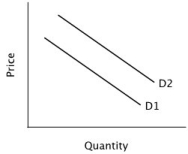
(Multiple Choice)
4.9/5 (74)
(74) An increase in both the equilibrium price and the equilibrium quantity of DVD players is best explained by:
(Multiple Choice)
4.9/5 (79)
(79) Assume both the demand for beef and the supply of beef decrease. Which of the following outcomes is certain to occur?
(Multiple Choice)
4.8/5 (76)
(76) If there is an excess supply of sport utility vehicles, then:
(Multiple Choice)
4.9/5 (76)
(76) Refer to the figure below. There would be an excess supply of 25 at a price of ________. 
(Multiple Choice)
4.8/5 (83)
(83) 
Filters
- Essay(0)
- Multiple Choice(0)
- Short Answer(0)
- True False(0)
- Matching(0)