



 Chat with AI
Exam 3: Supply and Demand

Exam 1: Thinking Like an Economist142 Questions
Exam 2: Comparative Advantage163 Questions
Exam 3: Supply and Demand181 Questions
Exam 4: Elasticity154 Questions
Exam 5: Demand144 Questions
Exam 6: Perfectly Competitive Supply159 Questions
Exam 7: Efficiency, Exchange, and the Invisible Hand in Action159 Questions
Exam 8: Monopoly, Oligopoly, and Monopolistic Competition147 Questions
Exam 9: Games and Strategic Behavior150 Questions
Exam 10: An Introduction to Behavioral Economics111 Questions
Exam 11: Externalities, Property Rights, and the Environment184 Questions
Exam 12: The Economics of Information127 Questions
Exam 13: Labor Markets, Poverty, and Income Distribution138 Questions
Exam 14: Public Goods and Tax Policy142 Questions
Exam 15: International Trade and Trade Policy164 Questions
Exam 16: Macroeconomics: The Birds Eye View of the Economy154 Questions
Exam 17: Measuring Economic Activity: GDP and Unemployment210 Questions
Exam 18: Measuring the Price Level and Inflation160 Questions
Exam 19: Economic Growth, Productivity, and Living Standards158 Questions
Exam 20: The Labor Market: Workers, Wages, and Unemployment121 Questions
Exam 21: Saving and Capital Formation144 Questions
Exam 22: Money Prices and the Federal Reserve107 Questions
Exam 23: Financial Markets and International Capital Flows104 Questions
Exam 24: Short-Term Economic Fluctuations: An Introduction124 Questions
Exam 25: Spending and Output in the Short Run146 Questions
Exam 26: Stabilizing the Economy: The Role of the Fed162 Questions
Exam 27: Aggregate Demand, Aggregate Supply, and Inflation159 Questions
Exam 28: Exchange Rates and the Open Economy157 Questions
Select questions type


One reason the demand curve slopes ________ is that as prices fall ________.
(Multiple Choice)
5.0/5  (74)
(74) Suppose Bianca buys a used a textbook from Sebastian for $55. If Bianca's surplus from this transaction was $10, we can infer that:
(Multiple Choice)
4.9/5 (80)
(80) Suppose quantity demanded is given by Qᵈ = 100 - P, and quantity supplied is given by Qˢ = 20 + 3P. In this case, equilibrium price, P*, and equilibrium quantity, Q*, are as follows:
(Multiple Choice)
4.9/5 (73)
(73) Suppose one observes that when the price of peanut butter increases, the demand for jelly increases. One should conclude that:
(Multiple Choice)
4.9/5 (87)
(87) Refer to the accompanying figure. The equilibrium price is ________, and the equilibrium quantity is ________. 
(Multiple Choice)
4.7/5 (73)
(73) Everyone in the neighborhood has been complaining about the deteriorating condition of the park, but nobody has cleaned it up. Why not?
(Multiple Choice)
4.8/5 (75)
(75) Refer to the accompanying figure. Assume demand remains unchanged at D1. If supply shifts from S2 to S1, then the equilibrium price will ________ and the equilibrium quantity will ________. 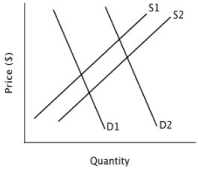
(Multiple Choice)
4.8/5 (78)
(78) Suppose you camped out in front of an electronics store to be one of the 200 lucky people able to purchase the latest gaming system. You bought the system for $350. Two weeks later you see that the same system can be sold on e-Bay for $600, so you sell your system. Your market role was as a:
(Multiple Choice)
5.0/5 (83)
(83) Suppose we observe a decrease in the equilibrium price of tuna and an increase in the equilibrium quantity of tuna. This is best explained by:
(Multiple Choice)
4.8/5 (85)
(85) The entire group of buyers and sellers of a particular good or service makes up:
(Multiple Choice)
4.9/5 (88)
(88) If pencils and paper are complements for most consumers, then if the price of paper increases, you would expect:
(Multiple Choice)
4.9/5 (86)
(86) Refer to the accompanying figure. A decrease in demand is represented by a shift from: 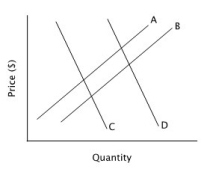
(Multiple Choice)
4.8/5 (75)
(75) Refer to the accompanying figure. At a price of $3, there will be: 
(Multiple Choice)
4.9/5 (91)
(91) Refer to the accompanying figure. Assume demand remains unchanged at D1. If supply shifts from S1 to S2, then the equilibrium price will ________ and the equilibrium quantity will ________. 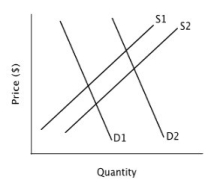
(Multiple Choice)
4.7/5 (79)
(79) The demand curve illustrates the fact that consumers tend to purchase:
(Multiple Choice)
4.9/5 (78)
(78) Refer to the accompanying figure. Suppose all the sellers in this market started out charging a price of $45 per unit. What is the most likely result? 
(Multiple Choice)
4.8/5 (72)
(72) If the demand for steak increases as income increases, then steak is a(n):
(Multiple Choice)
4.9/5 (86)
(86) If an increase in the price of good X leads to a decrease in the demand for good Y, then:
(Multiple Choice)
4.8/5 (86)
(86) When a slice of pizza at the student union sold for $2, Moe did not purchase any. When the price fell to $1.75, Moe purchased a slice each day for lunch. Thus, we can infer that Moe's reservation price for a slice of pizza is:
(Multiple Choice)
5.0/5 (74)
(74) 
Filters
- Essay(0)
- Multiple Choice(0)
- Short Answer(0)
- True False(0)
- Matching(0)