



 Chat with AI
Exam 3: Supply and Demand

Exam 1: Thinking Like an Economist142 Questions
Exam 2: Comparative Advantage163 Questions
Exam 3: Supply and Demand181 Questions
Exam 4: Elasticity154 Questions
Exam 5: Demand144 Questions
Exam 6: Perfectly Competitive Supply159 Questions
Exam 7: Efficiency, Exchange, and the Invisible Hand in Action159 Questions
Exam 8: Monopoly, Oligopoly, and Monopolistic Competition147 Questions
Exam 9: Games and Strategic Behavior150 Questions
Exam 10: An Introduction to Behavioral Economics111 Questions
Exam 11: Externalities, Property Rights, and the Environment184 Questions
Exam 12: The Economics of Information127 Questions
Exam 13: Labor Markets, Poverty, and Income Distribution138 Questions
Exam 14: Public Goods and Tax Policy142 Questions
Exam 15: International Trade and Trade Policy164 Questions
Exam 16: Macroeconomics: The Birds Eye View of the Economy154 Questions
Exam 17: Measuring Economic Activity: GDP and Unemployment210 Questions
Exam 18: Measuring the Price Level and Inflation160 Questions
Exam 19: Economic Growth, Productivity, and Living Standards158 Questions
Exam 20: The Labor Market: Workers, Wages, and Unemployment121 Questions
Exam 21: Saving and Capital Formation144 Questions
Exam 22: Money Prices and the Federal Reserve107 Questions
Exam 23: Financial Markets and International Capital Flows104 Questions
Exam 24: Short-Term Economic Fluctuations: An Introduction124 Questions
Exam 25: Spending and Output in the Short Run146 Questions
Exam 26: Stabilizing the Economy: The Role of the Fed162 Questions
Exam 27: Aggregate Demand, Aggregate Supply, and Inflation159 Questions
Exam 28: Exchange Rates and the Open Economy157 Questions
Select questions type


If the price of rubber (an input to the production of tires)increases:
(Multiple Choice)
4.7/5  (72)
(72) If the demand curve for bologna shifts to the right as income falls then bologna is a(n):
(Multiple Choice)
4.9/5 (83)
(83) Gertie saw a pair of jeans that she was willing to buy for $35. The price tag, though, said they were $29.99. Therefore:
(Multiple Choice)
4.9/5 (77)
(77) Refer to the accompanying figure. If the price is $4 today and there is no change in either supply or demand, one would expect the price in the future to be: 
(Multiple Choice)
4.8/5 (79)
(79) Refer to the accompanying figure. Suppose the solid line shows the demand for coffee. If coffee and tea are substitutes, and the price of tea falls, then you would expect: 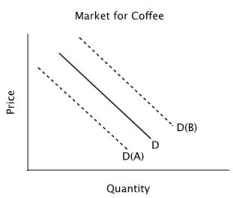
(Multiple Choice)
4.7/5 (76)
(76) According to the textbook, government price controls fail because:
(Multiple Choice)
4.8/5 (66)
(66) Refer to the accompanying figure. Suppose the solid line represents the current supply of Star Wars action figures. If the price of the plastic used to make action figures rises, current supply will: 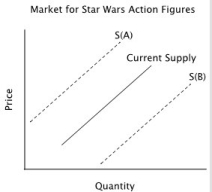
(Multiple Choice)
4.9/5 (69)
(69) Refer to the accompanying figure. If the government imposed a price ceiling of $40, what would happen in this market? 
(Multiple Choice)
4.9/5 (80)
(80) Refer to the accompanying figure. Suppose the solid line shows the current demand for coffee. In response to a news story explaining that coffee causes heart disease, you should expect: 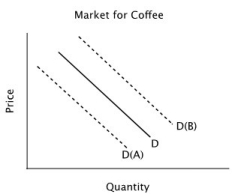
(Multiple Choice)
4.9/5 (96)
(96) Suppose you observe an increase in the equilibrium price of coffee and a decrease in the equilibrium quantity of coffee. Of the options listed below, this is most consistent with:
(Multiple Choice)
4.9/5 (80)
(80) Refer to the accompanying figure. A decrease in supply is represented by a shift from: 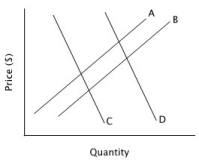
(Multiple Choice)
4.9/5 (91)
(91) Suppose that the equilibrium price of apples decreases and the equilibrium quantity of apples increases. This is best explained by:
(Multiple Choice)
4.8/5 (82)
(82) Refer to the accompanying figure, which shows the market for cups of coffee. At the original market equilibrium: 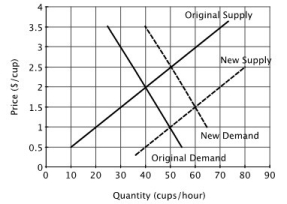
(Multiple Choice)
4.9/5 (82)
(82) 
Filters
- Essay(0)
- Multiple Choice(0)
- Short Answer(0)
- True False(0)
- Matching(0)