



 Chat with AI
Exam 3: Supply and Demand

Exam 1: Thinking Like an Economist142 Questions
Exam 2: Comparative Advantage163 Questions
Exam 3: Supply and Demand181 Questions
Exam 4: Elasticity154 Questions
Exam 5: Demand144 Questions
Exam 6: Perfectly Competitive Supply159 Questions
Exam 7: Efficiency, Exchange, and the Invisible Hand in Action159 Questions
Exam 8: Monopoly, Oligopoly, and Monopolistic Competition147 Questions
Exam 9: Games and Strategic Behavior150 Questions
Exam 10: An Introduction to Behavioral Economics111 Questions
Exam 11: Externalities, Property Rights, and the Environment184 Questions
Exam 12: The Economics of Information127 Questions
Exam 13: Labor Markets, Poverty, and Income Distribution138 Questions
Exam 14: Public Goods and Tax Policy142 Questions
Exam 15: International Trade and Trade Policy164 Questions
Exam 16: Macroeconomics: The Birds Eye View of the Economy154 Questions
Exam 17: Measuring Economic Activity: GDP and Unemployment210 Questions
Exam 18: Measuring the Price Level and Inflation160 Questions
Exam 19: Economic Growth, Productivity, and Living Standards158 Questions
Exam 20: The Labor Market: Workers, Wages, and Unemployment121 Questions
Exam 21: Saving and Capital Formation144 Questions
Exam 22: Money Prices and the Federal Reserve107 Questions
Exam 23: Financial Markets and International Capital Flows104 Questions
Exam 24: Short-Term Economic Fluctuations: An Introduction124 Questions
Exam 25: Spending and Output in the Short Run146 Questions
Exam 26: Stabilizing the Economy: The Role of the Fed162 Questions
Exam 27: Aggregate Demand, Aggregate Supply, and Inflation159 Questions
Exam 28: Exchange Rates and the Open Economy157 Questions
Select questions type


Suppose that the price of doughnuts decreases. Given that doughnut holes are a by-product of producing doughnuts, one would expect:
(Multiple Choice)
4.8/5  (82)
(82) Refer to the given table. Suppose the columns in this table reflect demand and supply. At a price of $30: Price Per Unit Columu A Units Per Year Colum B Units Per Year \ 20 100 40 \ 30 95 50 \ 40 80 60 \ 50 65 70 \ 60 50
(Multiple Choice)
5.0/5 (75)
(75) To understand how the price of a good is determined in a free market, one must account for the desires of:
(Multiple Choice)
4.9/5 (81)
(81) Suppose that the technology used to manufacture laptops has improved. The likely result would be:
(Multiple Choice)
4.9/5 (81)
(81) If the demand for cucumbers falls when the price of tomatoes rises, then we know that tomatoes and cucumbers are:
(Multiple Choice)
4.7/5 (77)
(77) If the demand for computers increases as consumers' incomes rise, then computers are:
(Multiple Choice)
5.0/5 (74)
(74) After the price of Revlon nail polish increased, Jen stopped buying Revlon nail polish and started buying a cheaper brand of nail polish instead. This is called:
(Multiple Choice)
4.9/5 (79)
(79) Which of the following is likely to lead to a decrease in the demand for tennis balls?
(Multiple Choice)
4.9/5 (84)
(84) When two people agree to a price in a negotiation, we can assume that:
(Multiple Choice)
4.9/5 (68)
(68) The buyer's reservation price for a particular good or service is the:
(Multiple Choice)
4.7/5 (86)
(86) "All else constant, consumers will purchase more of a good as the price falls." This statement reflects the behavior underlying:
(Multiple Choice)
4.9/5 (84)
(84) Suppose the residents of Metropolis travel to work either by bus or train. If the price of train tickets increases, then:
(Multiple Choice)
4.9/5 (85)
(85) Refer to the accompanying figure, which shows the market for cups of coffee. What might cause a shift from the original supply curve to the new supply curve? 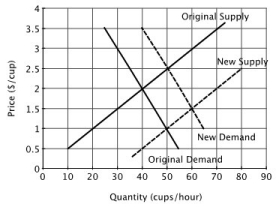
(Multiple Choice)
4.8/5 (90)
(90) If there are no unexploited opportunities for individuals in a particular market, then one can conclude that:
(Multiple Choice)
4.8/5 (78)
(78) Refer to the accompanying figure. An increase in supply is represented by a shift from: 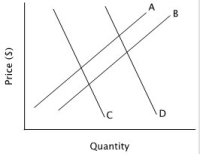
(Multiple Choice)
4.9/5 (72)
(72) The situation described in the book as "smart for one, dumb for all" occurs when:
(Multiple Choice)
4.8/5 (75)
(75) 
Filters
- Essay(0)
- Multiple Choice(0)
- Short Answer(0)
- True False(0)
- Matching(0)