



 Chat with AI
Exam 13: Labor Markets, Poverty, and Income Distribution

Exam 1: Thinking Like an Economist142 Questions
Exam 2: Comparative Advantage163 Questions
Exam 3: Supply and Demand181 Questions
Exam 4: Elasticity154 Questions
Exam 5: Demand144 Questions
Exam 6: Perfectly Competitive Supply159 Questions
Exam 7: Efficiency, Exchange, and the Invisible Hand in Action159 Questions
Exam 8: Monopoly, Oligopoly, and Monopolistic Competition147 Questions
Exam 9: Games and Strategic Behavior150 Questions
Exam 10: An Introduction to Behavioral Economics111 Questions
Exam 11: Externalities, Property Rights, and the Environment184 Questions
Exam 12: The Economics of Information127 Questions
Exam 13: Labor Markets, Poverty, and Income Distribution138 Questions
Exam 14: Public Goods and Tax Policy142 Questions
Exam 15: International Trade and Trade Policy164 Questions
Exam 16: Macroeconomics: The Birds Eye View of the Economy154 Questions
Exam 17: Measuring Economic Activity: GDP and Unemployment210 Questions
Exam 18: Measuring the Price Level and Inflation160 Questions
Exam 19: Economic Growth, Productivity, and Living Standards158 Questions
Exam 20: The Labor Market: Workers, Wages, and Unemployment121 Questions
Exam 21: Saving and Capital Formation144 Questions
Exam 22: Money Prices and the Federal Reserve107 Questions
Exam 23: Financial Markets and International Capital Flows104 Questions
Exam 24: Short-Term Economic Fluctuations: An Introduction124 Questions
Exam 25: Spending and Output in the Short Run146 Questions
Exam 26: Stabilizing the Economy: The Role of the Fed162 Questions
Exam 27: Aggregate Demand, Aggregate Supply, and Inflation159 Questions
Exam 28: Exchange Rates and the Open Economy157 Questions
Select questions type


Espresso Yourself Coffee Shop hires workers in a competitive labor market to make coffee. The ingredients required to make each cup of coffee cost 50 cents. The coffee shop's hourly output of coffee varies with the number of workers hired, as shown in the table. Each cup of coffee sells for $2.00. Number df wurkers Caftee (cups/hour) 0 0 1 25 2 45 3 60 4 70 5 75
The most the coffee shop would be willing pay the third worker is ________ per hour.

Free
(Multiple Choice)
4.7/5  (80)
(80) Correct Answer: Verified
C
Balanced across the board, U.S. income growth characterizes the period of the:
Free
(Multiple Choice)
4.8/5 (78)
(78) Correct Answer:Verified
VerifiedD
Espresso Yourself Coffee Shop hires workers in a competitive labor market to make coffee. The ingredients required to make each cup of coffee cost 50 cents. The coffee shop's hourly output of coffee varies with the number of workers hired, as shown in the table. Each cup of coffee sells for $2.00. Number df wurkers Caftee (cups/hour) 0 0 1 25 2 45 3 60 4 70 5 75
The marginal product of the fourth worker is ________ cups of coffee per hour.
Free
(Multiple Choice)
4.9/5 (72)
(72) Correct Answer:Verified
VerifiedD
Ben and Ashley are identical in every way except for one: Ashley has a master's degree and Ben does not. You would expect Ashley to be paid:
(Multiple Choice)
5.0/5 (71)
(71) The degree of income inequality produced by competitive markets, in Professor Rawls' view, is:
(Multiple Choice)
4.9/5 (76)
(76) Inga and Ron both work for the same firm on the same career ladder. Each has the same stock of human capital except for one difference: Inga has worked at the firm for 10 continuous years but Ron has had two leaves of absence mixed in with his 10 years of experience with the firm. One should expect:
(Multiple Choice)
4.9/5 (81)
(81) Suppose males place less importance on the social approval of their job and more on the income they receive. The gender wage gap would therefore be ________ than if this difference did not exist because of ________.
(Multiple Choice)
5.0/5 (69)
(69) Consider the accompanying figure representing the labor markets shown below. 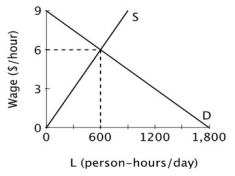 If the government imposes a minimum wage above $6 per hour, then total earnings will ________.
 (Multiple Choice)
4.9/5 (80)
(80) When the government transfers resources to the poor in the form of a good or service, it is called:
(Multiple Choice)
4.8/5 (82)
(82) Espresso Yourself Coffee Shop hires workers in a competitive labor market to make coffee. The ingredients required to make each cup of coffee cost 50 cents. The coffee shop's hourly output of coffee varies with the number of workers hired, as shown in the table. Each cup of coffee sells for $2.00.
Number df wurkers Caftee (cups/hour) 0 0 1 25 2 45 3 60 4 70 5 75
The value of marginal product of the first worker is ________ per hour.
(Multiple Choice)
4.9/5 (78)
(78) Jen is offered a job answering the phone in the State U economics department during lunchtime, from noon to 1 p.m., Tuesdays and Thursdays. Her reservation wage for this job is $15 per hour. If the department chair offers Jen $150 per week, how much economic surplus will she enjoy as a result of accepting the job?
(Multiple Choice)
5.0/5 (69)
(69) Assume that this graph illustrates a perfectly competitive labor market. 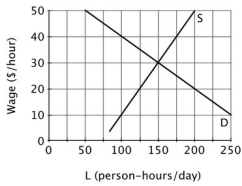 Equilibrium in this labor market is at a wage of ________ per hour and an employment level of ________ person-hours per day.
 (Multiple Choice)
4.8/5 (68)
(68) Curly just graduated from State U and has three job offers: teaching at a prestigious private high school nine months a year with summers off, working forty hours a week at a bank in a small city, and working more than sixty hours a week for a high-powered investment firm in New York. Suppose all of the jobs currently offer exactly the same annual salary, and that most people prefer leisure to work, all else equal. In order to attract workers, the ________ would have to offer a ________ salary than the others.
(Multiple Choice)
4.9/5 (87)
(87) The marginal product of the 14ᵗʰ worker is 8 and the firm sells its output for $4 per unit. If labor is the only variable cost, then the value of the 14ᵗʰ worker's marginal product is
(Multiple Choice)
4.9/5 (80)
(80) Suppose the Fluffy Pillow Company produces pillows. The number of pillows it can produce each hour depends on the number of workers it hires, as shown in the accompanying table. In addition, each pillow can be sold for $2 more than the cost of the materials needed to produce it.
Number af warkers per haur Number of pillavs per hour 0 0 1 24 2 42 3 54 4 60 5 61
If the hourly wage for people who make pillows is $10, then how many workers should the Fluffy Pillow Company hire each hour?
(Multiple Choice)
4.9/5 (66)
(66) Assume that this graph illustrates a perfectly competitive labor market. 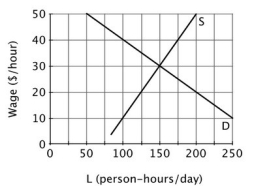 Suppose a minimum wage law required the wage to be at least $20 per hour in this market. If that happened, then:
 (Multiple Choice)
4.9/5 (77)
(77) Consider the accompanying figure representing the labor market below. Suppose the government passes a minimum wage requiring employers to pay at least $8.00 per hour. 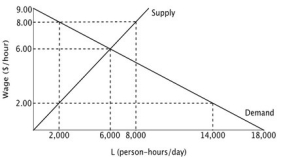 Prior to the imposition of the minimum wage, employer surplus is ________ per day, and after the imposition of the minimum wage, employer surplus is ________ per day.
 (Multiple Choice)
4.9/5 (78)
(78) Suppose the market wage for cashiers increases from $7 per hour to $9 per hour. As a result, Pat, who is a cashier, now works five more hours per week. On the other hand Chris, who is also a cashier, now works five fewer hours per week. Chris's behavior illustrates the ________ effect of a wage increase.
(Multiple Choice)
4.8/5 (88)
(88) 
Filters
- Essay(0)
- Multiple Choice(0)
- Short Answer(0)
- True False(0)
- Matching(0)