



 Chat with AI
Exam 13: Labor Markets, Poverty, and Income Distribution

Exam 1: Thinking Like an Economist142 Questions
Exam 2: Comparative Advantage163 Questions
Exam 3: Supply and Demand181 Questions
Exam 4: Elasticity154 Questions
Exam 5: Demand144 Questions
Exam 6: Perfectly Competitive Supply159 Questions
Exam 7: Efficiency, Exchange, and the Invisible Hand in Action159 Questions
Exam 8: Monopoly, Oligopoly, and Monopolistic Competition147 Questions
Exam 9: Games and Strategic Behavior150 Questions
Exam 10: An Introduction to Behavioral Economics111 Questions
Exam 11: Externalities, Property Rights, and the Environment184 Questions
Exam 12: The Economics of Information127 Questions
Exam 13: Labor Markets, Poverty, and Income Distribution138 Questions
Exam 14: Public Goods and Tax Policy142 Questions
Exam 15: International Trade and Trade Policy164 Questions
Exam 16: Macroeconomics: The Birds Eye View of the Economy154 Questions
Exam 17: Measuring Economic Activity: GDP and Unemployment210 Questions
Exam 18: Measuring the Price Level and Inflation160 Questions
Exam 19: Economic Growth, Productivity, and Living Standards158 Questions
Exam 20: The Labor Market: Workers, Wages, and Unemployment121 Questions
Exam 21: Saving and Capital Formation144 Questions
Exam 22: Money Prices and the Federal Reserve107 Questions
Exam 23: Financial Markets and International Capital Flows104 Questions
Exam 24: Short-Term Economic Fluctuations: An Introduction124 Questions
Exam 25: Spending and Output in the Short Run146 Questions
Exam 26: Stabilizing the Economy: The Role of the Fed162 Questions
Exam 27: Aggregate Demand, Aggregate Supply, and Inflation159 Questions
Exam 28: Exchange Rates and the Open Economy157 Questions
Select questions type


Leo is a welfare recipient who qualifies for two means-tested cash benefit programs. If he does not earn any income, he receives $225 from each program. For each dollar he earns (which his employer is required to report to the welfare agency), his benefit from each program is reduced by 75 cents until the benefit equals zero. If Leo values income and not the source of the income, then if he can only earn $400 he will choose to:
(Multiple Choice)
4.8/5  (69)
(69) The fact that many primary and secondary school teachers enjoy work schedules that coincide with their children's school schedules:
(Multiple Choice)
4.9/5 (79)
(79) Consider the accompanying figure representing the labor market below. Suppose the government passes a minimum wage requiring employers to pay at least $8.00 per hour. 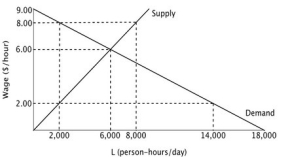 As a result of the imposition of the minimum wage, total economic surplus falls by ________ per day
 (Multiple Choice)
4.8/5 (74)
(74) Consumer discrimination exists when consumers are willing to pay ________ for a good or service produced by the favored group, even though the quality of the good or service is ________.
(Multiple Choice)
4.7/5 (81)
(81) According to John Rawls, if people had to choose an income distribution without any knowledge of their own talents and abilities, they would likely prefer an income distribution that:
(Multiple Choice)
4.8/5 (80)
(80) Consider the accompanying figure representing the labor market below. 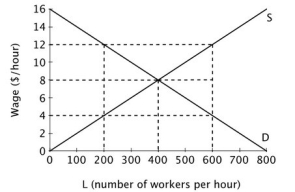 The imposition of a $12 per hour minimum wage causes total economic surplus in this labor market to ________ by ________.
 (Multiple Choice)
4.9/5 (73)
(73) Sam owns a candy factory and hires workers in a competitive labor market to pack cases of candy. The company's weekly output of cases of candy varies with the number of workers hired, as shown in the following table:
Number d warkers Cases/reek 0 0 1 160 2 310 3 450 4 580 5 700 6 810
If each case sells for $5 more than the cost of the materials used in producing it, then the value of marginal product of the 2?? worker is ________ per week.
(Multiple Choice)
4.9/5 (80)
(80) Paper Pushers Inc. hires workers in a competitive labor market. Apart from labor, the company has no other variable inputs. The company's hourly output varies with the number of workers hired, as shown in the table. Warkers Puges/huur 0 0 1 40 2 75 3 105 4 125 5 140 6 150 7 155
If the price of each page increases, then the demand for workers will
(Multiple Choice)
4.9/5 (92)
(92) Suppose the MC Hammer Company produces hammers. The number of hammers it can produce each hour depends on the number of workers it hires, as shown in the accompanying table. In addition, each hammer can be sold for $2 more than the cost of the materials needed to produce it. Number of warkers per hour Number of humers per haur 0 0 1 20 2 36 3 48 4 56 5 60
What is the value of the marginal product of the 2nd worker hired each hour?
(Multiple Choice)
5.0/5 (70)
(70) Which of the following factors is not part of an individual's stock of human capital?
(Multiple Choice)
4.9/5 (76)
(76) Matt is offered a job driving the campus shuttle bus from 4 p.m. to 6 p.m. each Monday. His reservation wage for this job is $7 per hour. If the campus transportation director offers Matt $50 per hour, how much economic surplus will Matt enjoy as a result of accepting the job?
(Multiple Choice)
4.8/5 (75)
(75) In a perfectly competitive labor market, if the value of marginal product of the last worker hired is $20 and the wage rate is $25, then the firm should:
(Multiple Choice)
4.9/5 (77)
(77) A program under which the government gives all citizens a substantial lump sum payment that is financed by a tax earned income is termed a(n):
(Multiple Choice)
5.0/5 (77)
(77) Taken together, factors such as education, training, experience, intelligence, and work habits are known as:
(Multiple Choice)
4.8/5 (66)
(66) According to the textbook, the real mean income of the top 5 percent of families increased by ________ percent from 1980 to 2016.
(Multiple Choice)
4.8/5 (77)
(77) Consider the accompanying figure representing the labor market below. Suppose the government passes a minimum wage requiring employers to pay at least $8.00 per hour. 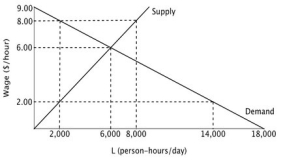 After the imposition of the minimum wage, employment will equal ________ person-hours per day.
 (Multiple Choice)
4.8/5 (66)
(66) Assume that the graph below describes the current labor market for nurses in a mid-sized city and that the labor market is perfectly competitive. 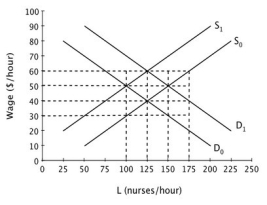 If supply shifts from S₀ to S₁ and demand shifts from D₀ to D₁, then the equilibrium wage will ________, and the equilibrium number of nurses will ________.
 (Multiple Choice)
5.0/5 (77)
(77) An arbitrary preference by an employer for one group of workers over another is termed:
(Multiple Choice)
4.9/5 (87)
(87) In order to maximize its profits, a firm that hires workers in a perfectly competitive labor market will hire workers until the:
(Multiple Choice)
4.8/5 (70)
(70) Assume that the graph below describes the current labor market for nurses in a mid-sized city and that the labor market is perfectly competitive. 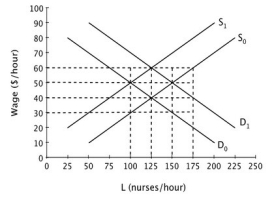 Suppose that several years ago the supply of nurses in this city was S₀. What might explain the change from S₀ to S₁?
 (Multiple Choice)
4.8/5 (72)
(72) 
Filters
- Essay(0)
- Multiple Choice(0)
- Short Answer(0)
- True False(0)
- Matching(0)