



 Chat with AI
Exam 8: Monopoly, Oligopoly, and Monopolistic Competition

Exam 1: Thinking Like an Economist142 Questions
Exam 2: Comparative Advantage163 Questions
Exam 3: Supply and Demand181 Questions
Exam 4: Elasticity154 Questions
Exam 5: Demand144 Questions
Exam 6: Perfectly Competitive Supply159 Questions
Exam 7: Efficiency, Exchange, and the Invisible Hand in Action159 Questions
Exam 8: Monopoly, Oligopoly, and Monopolistic Competition147 Questions
Exam 9: Games and Strategic Behavior150 Questions
Exam 10: An Introduction to Behavioral Economics111 Questions
Exam 11: Externalities, Property Rights, and the Environment184 Questions
Exam 12: The Economics of Information127 Questions
Exam 13: Labor Markets, Poverty, and Income Distribution138 Questions
Exam 14: Public Goods and Tax Policy142 Questions
Exam 15: International Trade and Trade Policy164 Questions
Exam 16: Macroeconomics: The Birds Eye View of the Economy154 Questions
Exam 17: Measuring Economic Activity: GDP and Unemployment210 Questions
Exam 18: Measuring the Price Level and Inflation160 Questions
Exam 19: Economic Growth, Productivity, and Living Standards158 Questions
Exam 20: The Labor Market: Workers, Wages, and Unemployment121 Questions
Exam 21: Saving and Capital Formation144 Questions
Exam 22: Money Prices and the Federal Reserve107 Questions
Exam 23: Financial Markets and International Capital Flows104 Questions
Exam 24: Short-Term Economic Fluctuations: An Introduction124 Questions
Exam 25: Spending and Output in the Short Run146 Questions
Exam 26: Stabilizing the Economy: The Role of the Fed162 Questions
Exam 27: Aggregate Demand, Aggregate Supply, and Inflation159 Questions
Exam 28: Exchange Rates and the Open Economy157 Questions
Select questions type


Relative to a monopolist charging a single price to all consumers, price discrimination ________ total economic surplus.

Free
(Multiple Choice)
4.8/5  (84)
(84) Correct Answer: Verified
D
Suppose the accompanying figure illustrates the demand curve facing a monopolist.
 At a price of $8 per unit, the total revenue for this monopolist is ________ per day, and the marginal revenue earned from the last unit sold is ________.
Free
(Multiple Choice)
4.8/5 (73)
(73) Correct Answer:Verified
VerifiedD
Suppose Island Bikes, a profit-maximizing firm, is the only bike rental company in a small resort town. The marginal cost to Island Bikes of renting out a bike is $3, and Island Bikes has no fixed costs. Each day Island Bikes has six potential customers, whose reservations prices are listed in the table.
Custamer Reservetion Price ( \/ Rental) 22 16 12 6 4 If Island Bikes charges a single price to all of its customers, then how many bikes will it rent out each day?
Free
(Multiple Choice)
4.8/5 (82)
(82) Correct Answer:Verified
VerifiedD
Suppose a perfectly competitive firm and a monopolist are both charging $5 for their respective products. From this, one can infer that:
(Multiple Choice)
4.7/5 (64)
(64) Suppose Island Bikes, a profit-maximizing firm, is the only bike rental company in a small resort town. The marginal cost to Island Bikes of renting out a bike is $3, and Island Bikes has no fixed costs. Each day Island Bikes has six potential customers, whose reservations prices are listed in the table.
Custamer Reservetion Price (\ /Rental) 22 16 12 6 4 If Island Bikes charges a single price to all of its customers, then what will be its daily economic profit?
(Multiple Choice)
4.9/5 (79)
(79) Suppose a monopolist offers a $20 mail-in rebate on an item with a list price of $100. In order for the rebate to be a perfect hurdle, it must be the case that:
(Multiple Choice)
5.0/5 (89)
(89) If a monopolist calculates its marginal revenue to be $15 and marginal cost to be $16, then the monopolist should:
(Multiple Choice)
5.0/5 (80)
(80) In exchange for a share of the revenues earned on campus, State U has granted CheapFizz the exclusive right to sell soft drinks in the student union and in vending machines on campus. Prior to the deal, three soft drink companies sold beverages on campus; now no other soft drink company is allowed to sell its products on campus. Prior to the deal, a 12-ounce can of CheapFizz sold for 75 cents. After the deal you would expect a 12-ounce can of CheapFizz to sell for:
(Multiple Choice)
4.9/5 (78)
(78) If a monopolist's marginal revenue exceeds its marginal cost at its current level of output, then to maximize its profit the monopolist should:
(Multiple Choice)
4.9/5 (83)
(83) Suppose Island Bikes, a profit-maximizing firm, is the only bike rental company in a small resort town. The marginal cost to Island Bikes of renting out a bike is $3, and Island Bikes has no fixed costs. Each day Island Bikes has six potential customers, whose reservations prices are listed in the table.
Custamer Reservetion Price (\ /Rental) 22 16 12 6 4 If Island Bikes charges a single price to all of its customers, then what price will it charge?
(Multiple Choice)
4.7/5 (67)
(67) When a consumer must take some sort of additional action to receive a lower price, the consumer is being subjected to:
(Multiple Choice)
4.8/5 (74)
(74) The accompanying figure shows the demand curve, marginal revenue curve, marginal cost curve and average total cost curve for a monopolist. 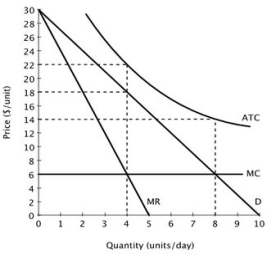 At the socially optimal level of output, this monopolist would:
 (Multiple Choice)
4.9/5 (81)
(81) Suppose a monopolist faces the following demand curve.
 This demand curve can be used to determine:
 (Multiple Choice)
4.8/5 (87)
(87) A firm is most likely to experience economies of scale if its start-up costs are high and its marginal cost is ________.
(Multiple Choice)
5.0/5 (79)
(79) Imagine that you are an entrepreneur, making designer t-shirts in your garage. Your total cost (in dollars)is given by the equation TC = 300 + 10Q, where Q represents the number of t-shirts you make. If you make 100 t-shirts, your average total cost is ________.
(Multiple Choice)
4.9/5 (80)
(80) The profit-maximizing level of output for a perfectly competitive firm is socially efficient, while the profit-maximizing level of output for a monopolist is not because under perfect competition ________, while under monopoly ________.
(Multiple Choice)
4.8/5 (80)
(80) Suppose the accompanying figure shows the demand curve, marginal revenue curve and marginal cost curve for a monopolist. 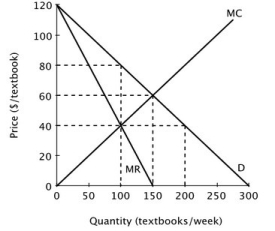 This monopolist maximizes its profit by producing ________ textbooks per week and charging a price of ________ per textbook.
 (Multiple Choice)
4.8/5 (74)
(74) When a pharmaceutical company introduces a new drug, its research and development costs are ________, and the cost of the chemicals used in manufacturing the drug are ________.
(Multiple Choice)
5.0/5 (69)
(69) 
Filters
- Essay(0)
- Multiple Choice(0)
- Short Answer(0)
- True False(0)
- Matching(0)