



 Chat with AI
Exam 8: Monopoly, Oligopoly, and Monopolistic Competition

Exam 1: Thinking Like an Economist142 Questions
Exam 2: Comparative Advantage163 Questions
Exam 3: Supply and Demand181 Questions
Exam 4: Elasticity154 Questions
Exam 5: Demand144 Questions
Exam 6: Perfectly Competitive Supply159 Questions
Exam 7: Efficiency, Exchange, and the Invisible Hand in Action159 Questions
Exam 8: Monopoly, Oligopoly, and Monopolistic Competition147 Questions
Exam 9: Games and Strategic Behavior150 Questions
Exam 10: An Introduction to Behavioral Economics111 Questions
Exam 11: Externalities, Property Rights, and the Environment184 Questions
Exam 12: The Economics of Information127 Questions
Exam 13: Labor Markets, Poverty, and Income Distribution138 Questions
Exam 14: Public Goods and Tax Policy142 Questions
Exam 15: International Trade and Trade Policy164 Questions
Exam 16: Macroeconomics: The Birds Eye View of the Economy154 Questions
Exam 17: Measuring Economic Activity: GDP and Unemployment210 Questions
Exam 18: Measuring the Price Level and Inflation160 Questions
Exam 19: Economic Growth, Productivity, and Living Standards158 Questions
Exam 20: The Labor Market: Workers, Wages, and Unemployment121 Questions
Exam 21: Saving and Capital Formation144 Questions
Exam 22: Money Prices and the Federal Reserve107 Questions
Exam 23: Financial Markets and International Capital Flows104 Questions
Exam 24: Short-Term Economic Fluctuations: An Introduction124 Questions
Exam 25: Spending and Output in the Short Run146 Questions
Exam 26: Stabilizing the Economy: The Role of the Fed162 Questions
Exam 27: Aggregate Demand, Aggregate Supply, and Inflation159 Questions
Exam 28: Exchange Rates and the Open Economy157 Questions
Select questions type


Suppose the accompanying table describes the relationship between price and quantity demanded for a monopolist.
Quntity Price 1 \ 10 2 \ 9 3 \ 8 4 \ 7 5 \ 6 6 \ 5 7 \ 4 8 \ 3 If the marginal cost of producing each unit of output is $5, then at the monopolist's profit-maximizing level of output, the monopolist produces ________ units of output than is socially optimal.
(Multiple Choice)
4.9/5  (70)
(70) Consider an industry with two firms producing similar products. Each firm's total cost (in dollars)is given below. Mega Corp: TC = 5,000 + 100Q
Big Inc: TC = 4,000 + 200Q
If each firm produces 10 units, Mega Corp's total cost will be ________, and Big Inc's total cost will be ________.
(Multiple Choice)
4.9/5 (82)
(82) Suppose the accompanying table describes the relationship between price and quantity demanded for a monopolist.
Quntity Price 1 \ 10 2 \ 9 3 \ 8 4 \ 7 5 \ 6 6 \ 5 7 \ 4 8 \ 3 If the marginal cost of producing each unit of output is $5, then this monopolist's profit-maximizing level of output is ________.
(Multiple Choice)
5.0/5 (84)
(84) Suppose Campus Books, a profit-maximizing firm, is the only supplier of the textbook for a given class. The marginal cost of supplying each book is constant and equal to $10, and Campus Books has no fixed costs. The table shows the reservation prices of the eight students enrolled in the class.
Custamer Reservutian Price (S/Bank) 60 54 48 42 36 30 24 18 What price will Campus Books charge if it must charge a single price to all of its customers?
(Multiple Choice)
4.9/5 (79)
(79) Suppose a monopolist produces two different products. If the marginal cost of producing one is lower than the marginal cost of producing the other, and the monopolist charges a different price for the two goods, then the monopolist is:
(Multiple Choice)
4.7/5 (91)
(91) Suppose the accompanying figure shows the demand curve, marginal revenue curve and marginal cost curve for a monopolist. 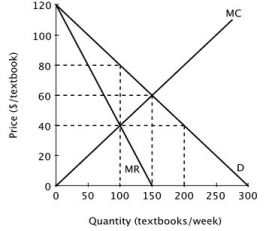 At this monopolist's profit-maximizing level of output, deadweight loss equals ________.
 (Multiple Choice)
4.7/5 (78)
(78) Suppose Campus Books, a profit-maximizing firm, is the only supplier of the textbook for a given class. The marginal cost of supplying each book is constant and equal to $10, and Campus Books has no fixed costs. The table shows the reservation prices of the eight students enrolled in the class.
Custamer Reservutian Price (S/Bank) 60 54 48 42 36 30 24 18 If Campus Books is permitted to charge 2 prices, and the bookstore knows customers with a reservation price above $30 never bother with coupons, whereas those with a reservation price of $30 or less always use them, then the bookstore will set the list price of the book to be ________ and the discounted price of the book to be ________.
(Multiple Choice)
4.8/5 (85)
(85) Suppose the accompanying table describes the demand for a good produced by monopolist. Price Quantity \ 10 1 \ 9 2 \ 8 3 \ 7 4 \ 6 5 \ 5 6 \ 4 7 The monopolist's marginal revenue from selling the 4th unit of output is less than $7 because:
(Multiple Choice)
4.8/5 (88)
(88) Natural monopolies are most likely to arise when firms have:
(Multiple Choice)
4.8/5 (82)
(82) The reason economists consider monopoly to be socially undesirable is that monopolists:
(Multiple Choice)
4.8/5 (69)
(69) Suppose the accompanying table describes the relationship between price and quantity demanded for a monopolist.
Quntity Price 1 \ 10 2 \ 9 3 \ 8 4 \ 7 5 \ 6 6 \ 5 7 \ 4 8 \ 3 If the marginal cost of producing each unit of output is $5, then the socially optimal level of output is ________.
(Multiple Choice)
4.9/5 (74)
(74) Suppose a monopolist faces the following demand curve.
 The marginal revenue of the 35ᵗʰ unit of output is:
 (Multiple Choice)
4.9/5 (92)
(92) Given the demand curve it faces, if an imperfectly competitive firm wants to sell another unit of output, it must:
(Multiple Choice)
4.8/5 (87)
(87) The accompanying figure shows the demand curve, marginal revenue curve, marginal cost curve and average total cost curve for a monopolist. 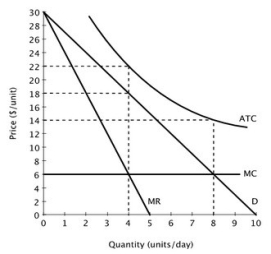 At this monopolist's profit-maximizing level of output, the deadweight loss to society equals:
 (Multiple Choice)
4.8/5 (83)
(83) An imperfectly competitive firm faces a demand curve that is:
(Multiple Choice)
4.7/5 (87)
(87) In order to effectively price discriminate, one requirement is that a seller must be able to:
(Multiple Choice)
4.9/5 (83)
(83) If a firm's production process exhibits increasing returns to scale, then doubling all the firm's inputs will lead output to ________.
(Multiple Choice)
4.9/5 (76)
(76) A perfectly price discriminating monopolist charges each buyer:
(Multiple Choice)
4.8/5 (75)
(75) 
Filters
- Essay(0)
- Multiple Choice(0)
- Short Answer(0)
- True False(0)
- Matching(0)