



 Chat with AI
Exam 8: Monopoly, Oligopoly, and Monopolistic Competition

Exam 1: Thinking Like an Economist142 Questions
Exam 2: Comparative Advantage163 Questions
Exam 3: Supply and Demand181 Questions
Exam 4: Elasticity154 Questions
Exam 5: Demand144 Questions
Exam 6: Perfectly Competitive Supply159 Questions
Exam 7: Efficiency, Exchange, and the Invisible Hand in Action159 Questions
Exam 8: Monopoly, Oligopoly, and Monopolistic Competition147 Questions
Exam 9: Games and Strategic Behavior150 Questions
Exam 10: An Introduction to Behavioral Economics111 Questions
Exam 11: Externalities, Property Rights, and the Environment184 Questions
Exam 12: The Economics of Information127 Questions
Exam 13: Labor Markets, Poverty, and Income Distribution138 Questions
Exam 14: Public Goods and Tax Policy142 Questions
Exam 15: International Trade and Trade Policy164 Questions
Exam 16: Macroeconomics: The Birds Eye View of the Economy154 Questions
Exam 17: Measuring Economic Activity: GDP and Unemployment210 Questions
Exam 18: Measuring the Price Level and Inflation160 Questions
Exam 19: Economic Growth, Productivity, and Living Standards158 Questions
Exam 20: The Labor Market: Workers, Wages, and Unemployment121 Questions
Exam 21: Saving and Capital Formation144 Questions
Exam 22: Money Prices and the Federal Reserve107 Questions
Exam 23: Financial Markets and International Capital Flows104 Questions
Exam 24: Short-Term Economic Fluctuations: An Introduction124 Questions
Exam 25: Spending and Output in the Short Run146 Questions
Exam 26: Stabilizing the Economy: The Role of the Fed162 Questions
Exam 27: Aggregate Demand, Aggregate Supply, and Inflation159 Questions
Exam 28: Exchange Rates and the Open Economy157 Questions
Select questions type


The primary objective of an imperfectly competitive firm is to:
(Multiple Choice)
4.9/5  (84)
(84) All profit-maximizing firms chose the level of output at which:
(Multiple Choice)
5.0/5 (68)
(68) Relative to a single price monopolist, a price discriminating monopolist generates:
(Multiple Choice)
4.8/5 (73)
(73) Suppose Island Bikes, a profit-maximizing firm, is the only bike rental company in a small resort town. The marginal cost to Island Bikes of renting out a bike is $3, and Island Bikes has no fixed costs. Each day Island Bikes has six potential customers, whose reservations prices are listed in the table.
Custamer Reservetion Price (\ /Rental) 22 16 12 6 4 Suppose Island Bikes knows that customers whose reservation prices are at least $10 always rent bikes before noon, while those whose reservation prices are below $10 never do so. If Island Bikes charges a different price in the morning and in the afternoon, then what will be its daily economic profit?
(Multiple Choice)
4.8/5 (77)
(77) Once a firm has determined the quantity of output it wishes to sell, the maximum price it can charge for each unit is determined by:
(Multiple Choice)
4.7/5 (67)
(67) Suppose the accompanying figure illustrates the demand curve facing a monopolist.  If the monopolist decreases its price from $12 to $10, its total revenue will ________.
 (Multiple Choice)
4.8/5 (80)
(80) Which of the following is NOT an example of the hurdle method of price discrimination?
(Multiple Choice)
4.9/5 (79)
(79) Suppose the accompanying table describes the relationship between price and quantity demanded for a monopolist.
Quntity Price 1 \ 10 2 \ 9 3 \ 8 4 \ 7 5 \ 6 6 \ 5 7 \ 4 8 \ 3 If the marginal cost of producing each unit of output is $5, then this monopolist maximizes its profit by charging ________ per unit.
(Multiple Choice)
4.9/5 (94)
(94) Suppose the accompanying figure shows the demand curve, marginal revenue curve and marginal cost curve for a monopolist. 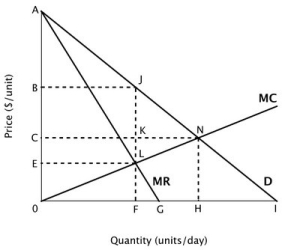 The socially optimal level of output is ________ units per day.
 (Multiple Choice)
4.9/5 (73)
(73) Industries in which firms have high fixed costs and low marginal costs are likely to have a:
(Multiple Choice)
4.8/5 (79)
(79) The accompanying figure shows the demand curve, marginal revenue curve, marginal cost curve and average total cost curve for a monopolist. 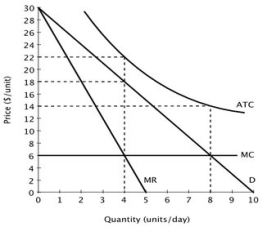 The socially optimal level of output is:
 (Multiple Choice)
4.9/5 (87)
(87) Consider an industry with two firms producing similar products. Each firm's total cost (in dollars)is given below. Acme Manufacturing: TC = 100 + 3Q
Generic Industries: TC = 500 + 3Q
Suppose that Acme and Generic face the same demand curve. If each firm produces its profit-maximizing level of output and earns a positive economic profit, then which of the following statements is true?
(Multiple Choice)
4.8/5 (87)
(87) Relative to a monopoly charging a single price to all consumers, perfect price discrimination ________ producer surplus and ________ consumer surplus.
(Multiple Choice)
4.9/5 (83)
(83) Consider a monopolist who charges a single price to all of its customers. If this monopolist starts price discriminating, its output will ________ and its profit will ________.
(Multiple Choice)
4.8/5 (83)
(83) Both a perfectly competitive firm and a monopolist find that:
(Multiple Choice)
4.9/5 (80)
(80) Suppose the accompanying table describes the demand for a good produced by monopolist. Price Quantity \ 10 1 \ 9 2 \ 8 3 \ 7 4 \ 6 5 \ 5 6 \ 4 7
Based on the data in the table, we know the firm should:
(Multiple Choice)
4.8/5 (74)
(74) De Beers accounts for approximately 80% of diamond sales worldwide. The source of its market power is:
(Multiple Choice)
4.8/5 (75)
(75) Which of the following firms is most likely to be a pure monopolist?
(Multiple Choice)
4.9/5 (85)
(85) 
Filters
- Essay(0)
- Multiple Choice(0)
- Short Answer(0)
- True False(0)
- Matching(0)