



 Chat with AI
Exam 8: Monopoly, Oligopoly, and Monopolistic Competition

Exam 1: Thinking Like an Economist142 Questions
Exam 2: Comparative Advantage163 Questions
Exam 3: Supply and Demand181 Questions
Exam 4: Elasticity154 Questions
Exam 5: Demand144 Questions
Exam 6: Perfectly Competitive Supply159 Questions
Exam 7: Efficiency, Exchange, and the Invisible Hand in Action159 Questions
Exam 8: Monopoly, Oligopoly, and Monopolistic Competition147 Questions
Exam 9: Games and Strategic Behavior150 Questions
Exam 10: An Introduction to Behavioral Economics111 Questions
Exam 11: Externalities, Property Rights, and the Environment184 Questions
Exam 12: The Economics of Information127 Questions
Exam 13: Labor Markets, Poverty, and Income Distribution138 Questions
Exam 14: Public Goods and Tax Policy142 Questions
Exam 15: International Trade and Trade Policy164 Questions
Exam 16: Macroeconomics: The Birds Eye View of the Economy154 Questions
Exam 17: Measuring Economic Activity: GDP and Unemployment210 Questions
Exam 18: Measuring the Price Level and Inflation160 Questions
Exam 19: Economic Growth, Productivity, and Living Standards158 Questions
Exam 20: The Labor Market: Workers, Wages, and Unemployment121 Questions
Exam 21: Saving and Capital Formation144 Questions
Exam 22: Money Prices and the Federal Reserve107 Questions
Exam 23: Financial Markets and International Capital Flows104 Questions
Exam 24: Short-Term Economic Fluctuations: An Introduction124 Questions
Exam 25: Spending and Output in the Short Run146 Questions
Exam 26: Stabilizing the Economy: The Role of the Fed162 Questions
Exam 27: Aggregate Demand, Aggregate Supply, and Inflation159 Questions
Exam 28: Exchange Rates and the Open Economy157 Questions
Select questions type


Suppose the accompanying figure shows the demand curve, marginal revenue curve and marginal cost curve for a monopolist. 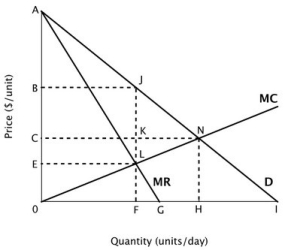 At this monopolist's profit-maximizing level of output, its total revenue equals the area:
 (Multiple Choice)
4.9/5  (79)
(79) Suppose the accompanying figure shows the demand curve, marginal revenue curve and marginal cost curve for a monopolist. 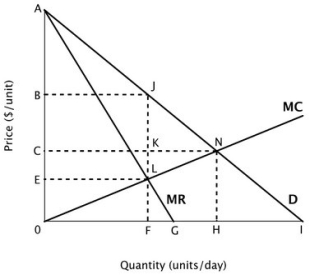 The profit-maximizing level of output for this monopolist is ________ units per day.
 (Multiple Choice)
4.8/5 (87)
(87) If a natural monopoly increases the quantity of output it produces, then:
(Multiple Choice)
4.9/5 (70)
(70) Consider an industry with two firms producing similar products. Each firm's total cost (in dollars)is given below. Acme Manufacturing: TC = 100 + 3Q.
Generic Industries: TC = 500 + 3Q.
Which of the following statements is true?
(Multiple Choice)
4.7/5 (81)
(81) If a firm's total revenue is $112 when it sells 16 units, $119 when it sells 17 units and $126 when it sells 18 units, then the firm is:
(Multiple Choice)
4.8/5 (91)
(91) Suppose a monopolist faces the following demand curve.  If the monopolist were to sell 20 units of output, its total revenue would be:
 (Multiple Choice)
4.9/5 (86)
(86) Airlines that charge higher prices for customers who purchase their tickets at the last minute are:
(Multiple Choice)
4.9/5 (79)
(79) Monopolists use the hurdle method of price discrimination in order to:
(Multiple Choice)
4.8/5 (76)
(76) Airlines that charge higher prices for seats in the first class cabin are:
(Multiple Choice)
4.9/5 (80)
(80) In many cities in the United States, a single firm provides electricity. Those firms are:
(Multiple Choice)
4.7/5 (78)
(78) Suppose Island Bikes, a profit-maximizing firm, is the only bike rental company in a small resort town. The marginal cost to Island Bikes of renting out a bike is $3, and Island Bikes has no fixed costs. Each day Island Bikes has six potential customers, whose reservations prices are listed in the table.
Custamer Reservetion Price (\ /Rental) 22 16 12 6 4 Suppose Island Bikes knows that customers whose reservation prices are at least $10 always rent bikes before noon, while those whose reservation prices are below $10 never do so. If Island Bikes charges a different price in the morning and in the afternoon, then what will be the total economic surplus?
(Multiple Choice)
4.8/5 (92)
(92) Suppose a monopolist faces the following demand curve.  The monopolist maximizes its profits by:
 (Multiple Choice)
4.8/5 (64)
(64) One problem with government ownership of natural monopolies is that:
(Multiple Choice)
4.8/5 (87)
(87) Suppose Campus Books, a profit-maximizing firm, is the only supplier of the textbook for a given class. The marginal cost of supplying each book is constant and equal to $10, and Campus Books has no fixed costs. The table shows the reservation prices of the eight students enrolled in the class.
Custamer Reservutian Price (S/Bank) 60 54 48 42 36 30 24 18 If Campus Books is permitted to charge 2 prices, and the bookstore knows customers with a reservation price above $30 never bother with coupons, whereas those with a reservation price of $30 or less always use them, then how many in total books will the bookstore sell?
(Multiple Choice)
5.0/5 (65)
(65) An imperfectly competitive firm faces a demand curve that is ________, while a perfectly competitive firm faces a demand curve that is ________.
(Multiple Choice)
4.8/5 (61)
(61) Suppose the accompanying figure shows the demand curve, marginal revenue curve and marginal cost curve for a monopolist. 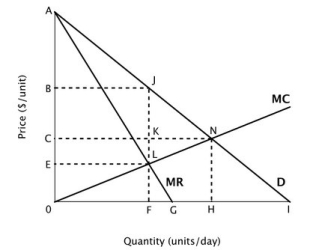 The profit-maximizing price for this monopolist to charge is:
 (Multiple Choice)
4.8/5 (78)
(78) Consider an industry with two firms producing similar products. Each firm's total cost (in dollars)is given below. Mega Corp: TC = 5,000 + 100Q
Big Inc: TC = 4,000 + 200Q
If each firm is producing 15 units, you would expect:
(Multiple Choice)
4.8/5 (79)
(79) Consider an industry with two firms producing similar products. Each firm's total cost (in dollars)is given below. Mega Corp: TC = 5,000 + 100Q
Big Inc: TC = 4,000 + 200Q
When each firm produces 8 units, ________ has a lower total cost, and when each firm produces 12 units, ________ has a lower total cost.
(Multiple Choice)
4.8/5 (77)
(77) 
Filters
- Essay(0)
- Multiple Choice(0)
- Short Answer(0)
- True False(0)
- Matching(0)