



 Chat with AI
Exam 9: Games and Strategic Behavior

Exam 1: Thinking Like an Economist142 Questions
Exam 2: Comparative Advantage163 Questions
Exam 3: Supply and Demand181 Questions
Exam 4: Elasticity154 Questions
Exam 5: Demand144 Questions
Exam 6: Perfectly Competitive Supply159 Questions
Exam 7: Efficiency, Exchange, and the Invisible Hand in Action159 Questions
Exam 8: Monopoly, Oligopoly, and Monopolistic Competition147 Questions
Exam 9: Games and Strategic Behavior150 Questions
Exam 10: An Introduction to Behavioral Economics111 Questions
Exam 11: Externalities, Property Rights, and the Environment184 Questions
Exam 12: The Economics of Information127 Questions
Exam 13: Labor Markets, Poverty, and Income Distribution138 Questions
Exam 14: Public Goods and Tax Policy142 Questions
Exam 15: International Trade and Trade Policy164 Questions
Exam 16: Macroeconomics: The Birds Eye View of the Economy154 Questions
Exam 17: Measuring Economic Activity: GDP and Unemployment210 Questions
Exam 18: Measuring the Price Level and Inflation160 Questions
Exam 19: Economic Growth, Productivity, and Living Standards158 Questions
Exam 20: The Labor Market: Workers, Wages, and Unemployment121 Questions
Exam 21: Saving and Capital Formation144 Questions
Exam 22: Money Prices and the Federal Reserve107 Questions
Exam 23: Financial Markets and International Capital Flows104 Questions
Exam 24: Short-Term Economic Fluctuations: An Introduction124 Questions
Exam 25: Spending and Output in the Short Run146 Questions
Exam 26: Stabilizing the Economy: The Role of the Fed162 Questions
Exam 27: Aggregate Demand, Aggregate Supply, and Inflation159 Questions
Exam 28: Exchange Rates and the Open Economy157 Questions
Select questions type


One thousand adults live in Milltown. Every day, they all leave work at 4:30 p.m., arrive home at exactly 5:00 p.m., and go to bed at 9:00 p.m. Three fundraisers, Alpha, Beta, and Charlie, have targeted Milltown's population. To get a donation, they must call Milltown's residents after they get home from work but before they go to bed. Because the charities raising the funds are identical, the first to call a willing donor will get the donation. To an economic naturalist, this scenario would explain why:

Free
(Multiple Choice)
4.8/5  (81)
(81) Correct Answer: Verified
B
Quick Buck and Pushy Sales produce and sell identical products and face zero marginal and average cost. Below is the market demand curve for their product.  Suppose Quick Buck and Pushy Sales decide to collude and work together as a monopolist with each firm producing half the quantity demanded by the market at the monopoly price. If Quick Buck cheats by reducing its price to $1 while Pushy Sales continues to comply with the collusive agreement, then Quick Buck's economic profit will be ________.
Free
(Multiple Choice)
4.9/5 (84)
(84) Correct Answer:Verified
VerifiedD
One thousand adults live in Milltown. Every day, they all leave work at 4:30 p.m., arrive home at exactly 5:00 p.m., and go to bed at 9:00 p.m. Three fundraisers, Alpha, Beta, and Charlie, have targeted Milltown's population. To get a donation, they must call Milltown's residents after they get home from work but before they go to bed. Because the charities raising the funds are identical, the first to call a willing donor will get the donation. Beta's manager has decided that the best time to call is 7:00 p.m. because it is exactly halfway between 5:00 p.m. and bedtime. Which of the following is true?
Free
(Multiple Choice)
4.8/5 (72)
(72) Correct Answer:Verified
VerifiedD
The market for bagels contains two firms: BagelWorld (BW)and Bagels'R'Us (BRU). The owners of the two firms decide to fix the price of bagels. The table below shows how each firm's profit (in dollars)depends on whether they abide by the agreement or cheat on the agreement.
 Suppose the game above is repeated every day, and both firms adopt the following strategy: cooperate on the first day, then if the other firm cheats, cheat the next day, and if the other firm abides, abide the next day. This type of strategy is likely to increase the probability that:
 (Multiple Choice)
5.0/5 (78)
(78) Tracy and Amy are playing a game in which Tracy has the first move at X in the decision tree shown below. Once Tracy has chosen either the top or bottom branch at X, Amy, who can see what Tracy has chosen, must choose the top or bottom branch at Y or Z. Both players know the payoffs at the end of each branch. 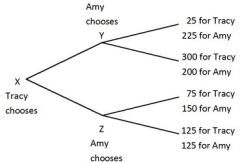 In the equilibrium of this game:
 (Multiple Choice)
4.7/5 (81)
(81) A ________ describes the possible moves in a game in sequence and lists the payoffs to each possible combination of moves.
(Multiple Choice)
4.9/5 (82)
(82) Miniville is an isolated town located on the southern shore of Lake Condescending, a very large lake. The western edge of Miniville is adjacent to impassable mountains and there are no towns or businesses for many miles to the east. The 300 residents of Miniville are evenly distributed along 3 miles of shoreline on the lake, east of the mountains. Lake Shore Drive, the only street in town, provides access to Miniville's homes and businesses. All residents live between the lake and the street; businesses locate on the other side of the street. Lake Shore Drive is 3 miles long, and the points labeled A, B, and C are 1, 2, and 3 miles from the western end of Lake Shore Drive, respectively. All residents of Miniville shop at the store located closest to their homes. 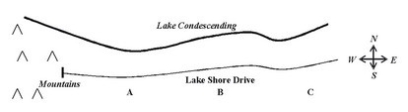 If one store is located at A and the other store is located at B:
 (Multiple Choice)
4.9/5 (88)
(88) The market for bagels contains two firms: BagelWorld (BW)and Bagels'R'Us (BRU). The owners of the two firms decide to fix the price of bagels. The table below shows how each firm's profit (in dollars)depends on whether they abide by the agreement or cheat on the agreement.
 For Bagels'R'Us, ________ is a ________.
 (Multiple Choice)
4.9/5 (70)
(70) P-TV and QRS-TV are trying to decide whether to air a sitcom or a reality show in a given time slot. Viewers like both sitcoms and reality shows, but sitcoms are more expensive to produce than reality shows since real actors need to be hired. QRS-TV makes its decision first, and then P-TV observes that choice before making its decision. Both stations know all of the information in the decision tree below. 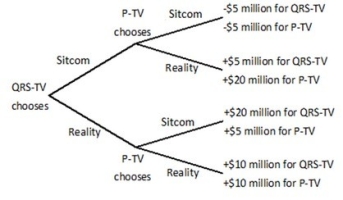 Suppose QRS-TV enters into an agreement with P-TV that gives QRS-TV the exclusive right to air a reality show during this time slot. QRS-TV would have to pay P-TV ________ in order to persuade P-TV to enter into this agreement.
 (Multiple Choice)
4.9/5 (79)
(79) A coalition of firms who agree to restrict output for the purpose of earning an economic profit is called a(n):
(Multiple Choice)
4.9/5 (85)
(85) Before it became illegal, cigarette manufacturers once relied heavily on TV advertising. According to the textbook, when the government banned TV advertising, the cigarette manufacturers:
(Multiple Choice)
4.8/5 (95)
(95) Joe is the owner of the 7-11 Mini Mart, Sam is the owner of the SuperAmerica Mini Mart, and together they are the only two gas stations in town. Currently, they both charge $3 per gallon, and each earns a profit of $1,000. If Joe cuts his price to $2.90 and Sam continues to charge $3, then Joe's profit will be $1,350, and Sam's profit will be $500. Similarly, if Sam cuts his price to $2.90 and Joe continues to charge $3, then Sam's profit will be $1,350, and Joe's profit will be $500. If Sam and Joe both cut their price to $2.90, then they will each earn a profit of $900. If both players choose their dominated strategy they will each earn ________, and if both players choose their dominant strategy they will each earn ________.
(Multiple Choice)
4.8/5 (75)
(75) P-TV and QRS-TV are trying to decide whether to air a sitcom or a reality show in a given time slot. Viewers like both sitcoms and reality shows, but sitcoms are more expensive to produce than reality shows since real actors need to be hired. QRS-TV makes its decision first, and then P-TV observes that choice before making its decision. Both stations know all of the information in the decision tree below. 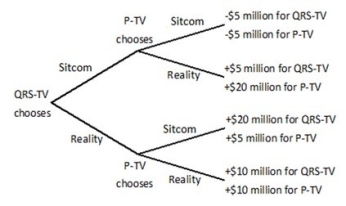 In the equilibrium of this game:
 (Multiple Choice)
4.8/5 (74)
(74) Suppose Acme and Mega produce and sell identical products and face zero marginal and average cost. Below is the market demand curve for their product.  For a monopolist facing this demand curve, the profit-maximizing quantity is ________ and the profit-maximizing price is ________.
 (Multiple Choice)
4.7/5 (81)
(81) Refer to the figure below. In this game, how many dominant strategies does Player B have?. 
(Multiple Choice)
4.8/5 (76)
(76) Suppose two companies, Macrosoft and Apricot, are considering whether to develop a new product, a touch-screen t-shirt. The payoffs to each of developing a touch-screen t-shirt depend upon the actions of the other, as shown in the payoff matrix below (the payoffs are given in millions of dollars).
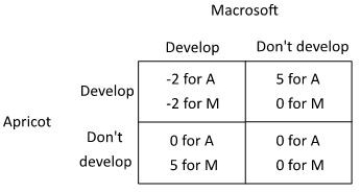 Suppose Apricot makes its decision first, and then Macrosoft makes its decision after seeing Apricot's choice. What will happen if, before Apricot chooses, Macrosoft announces that it is going to develop a touch-screen t-shirt no matter what Apricot does?
 (Multiple Choice)
4.9/5 (70)
(70) Mexico and the members of OPEC produce crude oil. Realizing that it would be in their best interests to form an agreement on production goals, a meeting is arranged and an informal, verbal agreement is reached. If both Mexico and OPEC abide by the agreement, then OPEC's profit will be $200 million and Mexico's profit will be $100 million. If both Mexico and OPEC cheat on the agreement, then OPEC's profit will be $175 million and Mexico's profit will be $80 million. If only OPEC cheats, then OPEC's profit will be $185 million, and Mexico's profit will be $60 million. If only Mexico cheats, then Mexico's profit will be $110 million, and OPEC's profit will be $150 million. Which of the following statements is correct?
(Multiple Choice)
4.7/5 (87)
(87) Mexico and the members of OPEC produce crude oil. Realizing that it would be in their best interests to form an agreement on production goals, a meeting is arranged and an informal, verbal agreement is reached. If both Mexico and OPEC abide by the agreement, then OPEC's profit will be $200 million and Mexico's profit will be $100 million. If both Mexico and OPEC cheat on the agreement, then OPEC's profit will be $175 million and Mexico's profit will be $80 million. If only OPEC cheats, then OPEC's profit will be $185 million, and Mexico's profit will be $60 million. If only Mexico cheats, then Mexico's profit will be $110 million, and OPEC's profit will be $150 million. Suppose Mexico chooses first, and then OPEC, after seeing Mexico's choice, chooses second. Before Mexico chooses, OPEC tells Mexico that if Mexico cheats on the agreement, then OPEC will also cheat, and if Mexico abides by the agreement, then OPEC will also abide. This is an example of a ________, and the outcome is that ________.
(Multiple Choice)
4.8/5 (76)
(76) 
Filters
- Essay(0)
- Multiple Choice(0)
- Short Answer(0)
- True False(0)
- Matching(0)