



 Chat with AI
Exam 9: Games and Strategic Behavior

Exam 1: Thinking Like an Economist142 Questions
Exam 2: Comparative Advantage163 Questions
Exam 3: Supply and Demand181 Questions
Exam 4: Elasticity154 Questions
Exam 5: Demand144 Questions
Exam 6: Perfectly Competitive Supply159 Questions
Exam 7: Efficiency, Exchange, and the Invisible Hand in Action159 Questions
Exam 8: Monopoly, Oligopoly, and Monopolistic Competition147 Questions
Exam 9: Games and Strategic Behavior150 Questions
Exam 10: An Introduction to Behavioral Economics111 Questions
Exam 11: Externalities, Property Rights, and the Environment184 Questions
Exam 12: The Economics of Information127 Questions
Exam 13: Labor Markets, Poverty, and Income Distribution138 Questions
Exam 14: Public Goods and Tax Policy142 Questions
Exam 15: International Trade and Trade Policy164 Questions
Exam 16: Macroeconomics: The Birds Eye View of the Economy154 Questions
Exam 17: Measuring Economic Activity: GDP and Unemployment210 Questions
Exam 18: Measuring the Price Level and Inflation160 Questions
Exam 19: Economic Growth, Productivity, and Living Standards158 Questions
Exam 20: The Labor Market: Workers, Wages, and Unemployment121 Questions
Exam 21: Saving and Capital Formation144 Questions
Exam 22: Money Prices and the Federal Reserve107 Questions
Exam 23: Financial Markets and International Capital Flows104 Questions
Exam 24: Short-Term Economic Fluctuations: An Introduction124 Questions
Exam 25: Spending and Output in the Short Run146 Questions
Exam 26: Stabilizing the Economy: The Role of the Fed162 Questions
Exam 27: Aggregate Demand, Aggregate Supply, and Inflation159 Questions
Exam 28: Exchange Rates and the Open Economy157 Questions
Select questions type


Consider the accompanying payoff matrix.  When Row Resorts and Column Cruises both play their dominant strategy:
 (Multiple Choice)
4.8/5  (74)
(74) One thousand adults live in Milltown. Every day, they all leave work at 4:30 p.m., arrive home at exactly 5:00 p.m., and go to bed at 9:00 p.m. Three fundraisers, Alpha, Beta, and Charlie, have targeted Milltown's population. To get a donation, they must call Milltown's residents after they get home from work but before they go to bed. Because the charities raising the funds are identical, the first to call a willing donor will get the donation. Calls made by the fundraisers will tend to be:
(Multiple Choice)
4.9/5 (77)
(77) Lee and Cody are playing a game in which Lee has the first move at A in the decision tree shown below. Once Lee has chosen either aggression or cooperation, Cody, who can see what Lee has chosen, must choose either aggression or cooperation at B or C. Both players know the payoffs at the end of each branch. 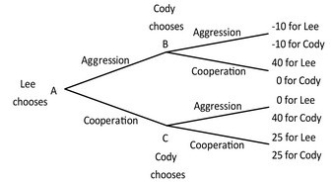 Suppose Cody tells Lee that if Lee chooses aggression, then Cody will also choose aggression, and if Lee chooses cooperation, then Cody will also choose cooperation. Cody's statement is:
 (Multiple Choice)
4.9/5 (70)
(70) Game theory is not useful in understanding perfect competition because in a perfectly competitive market:
(Multiple Choice)
4.9/5 (76)
(76) The market for bagels contains two firms: BagelWorld (BW)and Bagels'R'Us (BRU). The owners of the two firms decide to fix the price of bagels. The table below shows how each firm's profit (in dollars)depends on whether they abide by the agreement or cheat on the agreement.  In the Nash equilibrium of this game:
 (Multiple Choice)
4.7/5 (93)
(93) Suppose two companies, Macrosoft and Apricot, are considering whether to develop a new product, a touch-screen t-shirt. The payoffs to each of developing a touch-screen t-shirt depend upon the actions of the other, as shown in the payoff matrix below (the payoffs are given in millions of dollars).
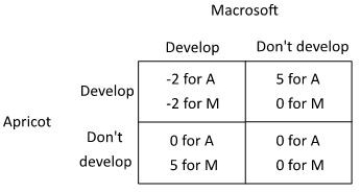 Suppose Apricot makes its decision first, and then Macrosoft makes its decision after seeing Apricot's choice. What will be the equilibrium outcome of this game?
 (Multiple Choice)
4.9/5 (85)
(85) Suppose two companies, Macrosoft and Apricot, are considering whether to develop a new product, a touch-screen t-shirt. The payoffs to each of developing a touch-screen t-shirt depend upon the actions of the other, as shown in the payoff matrix below (the payoffs are given in millions of dollars).
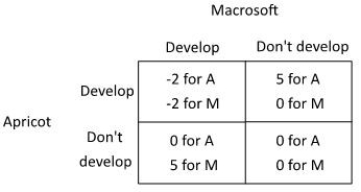 Which of the following statements is correct?
 (Multiple Choice)
4.9/5 (74)
(74) Consider to the accompanying payoff matrix.
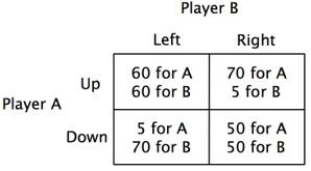 If player A makes his or her choice before player B, then what will be the equilibrium outcome of this game?
 (Multiple Choice)
4.7/5 (90)
(90) Mexico and the members of OPEC produce crude oil. Realizing that it would be in their best interests to form an agreement on production goals, a meeting is arranged and an informal, verbal agreement is reached. If both Mexico and OPEC abide by the agreement, then OPEC's profit will be $200 million and Mexico's profit will be $100 million. If both Mexico and OPEC cheat on the agreement, then OPEC's profit will be $175 million and Mexico's profit will be $80 million. If only OPEC cheats, then OPEC's profit will be $185 million, and Mexico's profit will be $60 million. If only Mexico cheats, then Mexico's profit will be $110 million, and OPEC's profit will be $150 million. To OPEC, the payoff to abiding by the agreement is either:
(Multiple Choice)
4.8/5 (83)
(83) P-TV and QRS-TV are trying to decide whether to air a sitcom or a reality show in a given time slot. Viewers like both sitcoms and reality shows, but sitcoms are more expensive to produce than reality shows since real actors need to be hired. QRS-TV makes its decision first, and then P-TV observes that choice before making its decision. Both stations know all of the information in the decision tree below. 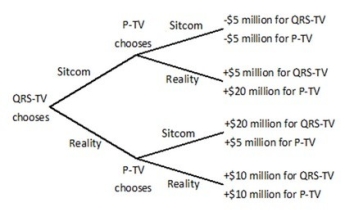 P-TV will air a sitcom:
 (Multiple Choice)
5.0/5 (89)
(89) The market for bagels contains two firms: BagelWorld (BW)and Bagels'R'Us (BRU). The owners of the two firms decide to fix the price of bagels. The table below shows how each firm's profit (in dollars)depends on whether they abide by the agreement or cheat on the agreement.
 Suppose the game above is repeated every day, and both firms adopt the following strategy: cooperate on the first day, then if the other firm cheats, cheat the next day, and if the other firm abides, abide the next day. This type of strategy is known as:
 (Multiple Choice)
5.0/5 (76)
(76) Player 1 and Player 2 are playing a game in which Player 1 has the first move at A in the decision tree shown below. Once Player 1 has chosen either Up or Down, Player 2, who can see what Player 1 has chosen, must choose Up or Down at B or C. Both players know the payoffs at the end of each branch. 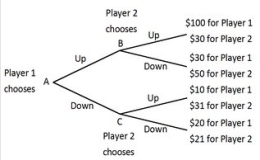 Suppose Player 1 and Player 2 enter into a binding agreement in which Player 1 agrees to pay Player 2 a fixed amount of money to get Player 2 to play Up when it is Player 2's turn. How much will Player 1 have to pay Player 2 to get Player 2 to play Up?
 (Multiple Choice)
4.8/5 (92)
(92) Quick Buck and Pushy Sales produce and sell identical products and face zero marginal and average cost. Below is the market demand curve for their product.  Suppose Quick Buck and Pushy Sales decide to collude and work together as a monopolist with each firm producing half the quantity demanded by the market at the monopoly price. If Quick Buck cheats by reducing its price to $1 while Pushy Sales continues to comply with the collusive agreement, then Quick Buck will sell ________ units and Pushy Sales will sell ________ units.
 (Multiple Choice)
4.8/5 (75)
(75) Consider the accompanying payoff matrix.  The dominant strategy for Row Resorts is to ________ , and the dominant strategy for Column Cruises is to ________ .
 (Multiple Choice)
4.9/5 (80)
(80) The use of psychological incentives to solve commitment problems would be least effective in games played:
(Multiple Choice)
4.8/5 (81)
(81) Consider the accompanying payoff matrix.  If Row Resorts offers reduced rates, then Column Cruises would receive the highest payoff if it:
 (Multiple Choice)
4.9/5 (89)
(89) Joe is the owner of the 7-11 Mini Mart, Sam is the owner of the SuperAmerica Mini Mart, and together they are the only two gas stations in town. Currently, they both charge $3 per gallon, and each earns a profit of $1,000. If Joe cuts his price to $2.90 and Sam continues to charge $3, then Joe's profit will be $1,350, and Sam's profit will be $500. Similarly, if Sam cuts his price to $2.90 and Joe continues to charge $3, then Sam's profit will be $1,350, and Joe's profit will be $500. If Sam and Joe both cut their price to $2.90, then they will each earn a profit of $900. For Joe, keeping his price at $3 per gallon is a:
(Multiple Choice)
4.7/5 (88)
(88) 
Filters
- Essay(0)
- Multiple Choice(0)
- Short Answer(0)
- True False(0)
- Matching(0)