



 Chat with AI
Exam 9: Games and Strategic Behavior

Exam 1: Thinking Like an Economist142 Questions
Exam 2: Comparative Advantage163 Questions
Exam 3: Supply and Demand181 Questions
Exam 4: Elasticity154 Questions
Exam 5: Demand144 Questions
Exam 6: Perfectly Competitive Supply159 Questions
Exam 7: Efficiency, Exchange, and the Invisible Hand in Action159 Questions
Exam 8: Monopoly, Oligopoly, and Monopolistic Competition147 Questions
Exam 9: Games and Strategic Behavior150 Questions
Exam 10: An Introduction to Behavioral Economics111 Questions
Exam 11: Externalities, Property Rights, and the Environment184 Questions
Exam 12: The Economics of Information127 Questions
Exam 13: Labor Markets, Poverty, and Income Distribution138 Questions
Exam 14: Public Goods and Tax Policy142 Questions
Exam 15: International Trade and Trade Policy164 Questions
Exam 16: Macroeconomics: The Birds Eye View of the Economy154 Questions
Exam 17: Measuring Economic Activity: GDP and Unemployment210 Questions
Exam 18: Measuring the Price Level and Inflation160 Questions
Exam 19: Economic Growth, Productivity, and Living Standards158 Questions
Exam 20: The Labor Market: Workers, Wages, and Unemployment121 Questions
Exam 21: Saving and Capital Formation144 Questions
Exam 22: Money Prices and the Federal Reserve107 Questions
Exam 23: Financial Markets and International Capital Flows104 Questions
Exam 24: Short-Term Economic Fluctuations: An Introduction124 Questions
Exam 25: Spending and Output in the Short Run146 Questions
Exam 26: Stabilizing the Economy: The Role of the Fed162 Questions
Exam 27: Aggregate Demand, Aggregate Supply, and Inflation159 Questions
Exam 28: Exchange Rates and the Open Economy157 Questions
Select questions type


Suppose that you have noticed that almost all of the car dealers in your city are located along a three-block stretch of the same street. A likely reason for this clustering of car dealers is that:
(Multiple Choice)
4.9/5  (87)
(87) The table below shows how the payoffs to two political candidates depend on whether the candidates run a positive or negative campaign. The payoffs are given in terms of the percentage change in the number of votes received.
 In the Nash equilibrium of this game:
 (Multiple Choice)
4.9/5 (72)
(72) A strategy that limits defection in a repeated prisoner's dilemma game is:
(Multiple Choice)
4.9/5 (76)
(76) Suppose Acme and Mega produce and sell identical products and face zero marginal and average cost. Below is the market demand curve for their product.  Suppose Acme and Mega decide to collude and work together as a monopolist with each firm producing half the quantity demanded by the market at the monopoly price. If Mega cheats on the agreement by reducing its price to $1 and Acme matches the price cut, then if consumers are evenly split between the two firms, Acme's economic profit will be ________.
 (Multiple Choice)
4.9/5 (85)
(85) The market for bagels contains two firms: BagelWorld (BW)and Bagels'R'Us (BRU). The owners of the two firms decide to fix the price of bagels. The table below shows how each firm's profit (in dollars)depends on whether they abide by the agreement or cheat on the agreement.
 For Bagel World, ________ is a ________.
 (Multiple Choice)
4.8/5 (66)
(66) Refer to the figure below. Player A can infer that Player B will: 
(Multiple Choice)
5.0/5 (75)
(75) Suppose Jordan and Lee are trying to decide what to do on a Friday. Jordan would prefer to see a comedy while Lee would prefer to see a documentary. One documentary and one comedy are showing at the local cinema. The payoffs they receive from seeing the films either together or separately are shown in the payoff matrix below. Both Jordan and Lee know the information contained in the payoff matrix. They purchase their tickets simultaneously, ignorant of the other's choice.
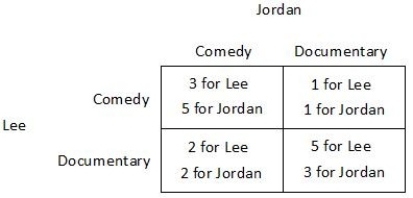 Which of the following statements is true?
 (Multiple Choice)
4.8/5 (96)
(96) The market for bagels contains two firms: BagelWorld (BW)and Bagels'R'Us (BRU). The owners of the two firms decide to fix the price of bagels. The table below shows how each firm's profit (in dollars)depends on whether they abide by the agreement or cheat on the agreement.
 Is this game a prisoner's dilemma?
 (Multiple Choice)
4.7/5 (78)
(78) Suppose Acme and Mega produce and sell identical products and face zero marginal and average cost. Below is the market demand curve for their product.  If Acme and Mega decide to collude and work together as a monopolist with each firm producing half the quantity demanded by the market at the monopoly price, then what will be Mega's economic profit?
 (Multiple Choice)
4.8/5 (84)
(84) Miniville is an isolated town located on the southern shore of Lake Condescending, a very large lake. The western edge of Miniville is adjacent to impassable mountains and there are no towns or businesses for many miles to the east. The 300 residents of Miniville are evenly distributed along 3 miles of shoreline on the lake, east of the mountains. Lake Shore Drive, the only street in town, provides access to Miniville's homes and businesses. All residents live between the lake and the street; businesses locate on the other side of the street. Lake Shore Drive is 3 miles long, and the points labeled A, B, and C are 1, 2, and 3 miles from the western end of Lake Shore Drive, respectively. All residents of Miniville shop at the store located closest to their homes. 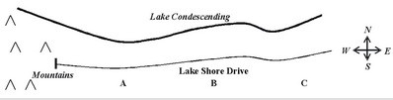 Because all residents of Miniville shop at the store located closest to their homes, the optimal location for the first store to open in Miniville is:
 (Multiple Choice)
4.9/5 (79)
(79) Suppose there are two small island countries: Avarice, which is populated by people who are completely self-interested, and Altruism, which is populated by people who have adopted social norms of generosity and cooperation. Suppose residents of each island often play prisoner's dilemma games, always matched with a person from the same island, but not a person who they know or will play with again. If the same number of games is played on each island, you would expect:
(Multiple Choice)
4.9/5 (83)
(83) Tracy and Amy are playing a game in which Tracy has the first move at X in the decision tree shown below. Once Tracy has chosen either the top or bottom branch at X, Amy, who can see what Tracy has chosen, must choose the top or bottom branch at Y or Z. Both players know the payoffs at the end of each branch. 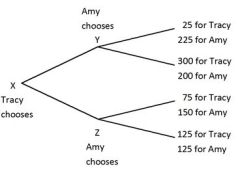 In the equilibrium this game, Tracy chooses the ________ branch, and then Amy chooses the ________ branch.
 (Multiple Choice)
4.7/5 (74)
(74) Player 1 and Player 2 are playing a game in which Player 1 has the first move at A in the decision tree shown below. Once Player 1 has chosen either Up or Down, Player 2, who can see what Player 1 has chosen, must choose Up or Down at B or C. Both players know the payoffs at the end of each branch. 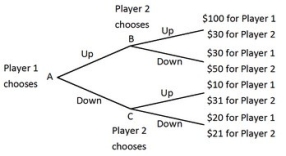 What is the equilibrium outcome of this game?
 (Multiple Choice)
4.8/5 (81)
(81) Hotelling's model has been used to describe differentiation in the political "market." Suppose that 100 voters are evenly distributed between the extreme left and the extreme right on the political spectrum, and that all voters vote, and they always vote for the candidate closest to them on this spectrum. The numbers on this spectrum represent the number of voters lying to the left of the number. So, at the midpoint, fifty voters lie to the left and fifty to the right.  If Candidate X is running against Candidate Z, by moving to the right Candidate X would:
 (Multiple Choice)
4.9/5 (91)
(91) The table below shows how the payoffs to two political candidates depend on whether the candidates run a positive or negative campaign. The payoffs are given in terms of the percentage change in the number of votes received.
 Suppose that the Republican candidate tells the Democratic candidate that he intends to run a positive campaign. The likely result is that:
 (Multiple Choice)
4.9/5 (85)
(85) Player 1 and Player 2 are playing a game in which Player 1 has the first move at A in the decision tree shown below. Once Player 1 has chosen either Up or Down, Player 2, who can see what Player 1 has chosen, must choose Up or Down at B or C. Both players know the payoffs at the end of each branch. 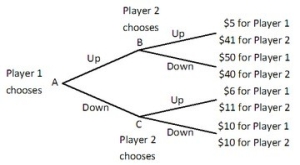 What is the equilibrium outcome of this game?
 (Multiple Choice)
4.8/5 (78)
(78) According to the text, everyone shouts at a party in order to be heard. If instead everyone spoke at a normal volume people would still be heard, but people continue to shout because:
(Multiple Choice)
4.8/5 (68)
(68) 
Filters
- Essay(0)
- Multiple Choice(0)
- Short Answer(0)
- True False(0)
- Matching(0)