



 Chat with AI
Exam 9: Games and Strategic Behavior

Exam 1: Thinking Like an Economist142 Questions
Exam 2: Comparative Advantage163 Questions
Exam 3: Supply and Demand181 Questions
Exam 4: Elasticity154 Questions
Exam 5: Demand144 Questions
Exam 6: Perfectly Competitive Supply159 Questions
Exam 7: Efficiency, Exchange, and the Invisible Hand in Action159 Questions
Exam 8: Monopoly, Oligopoly, and Monopolistic Competition147 Questions
Exam 9: Games and Strategic Behavior150 Questions
Exam 10: An Introduction to Behavioral Economics111 Questions
Exam 11: Externalities, Property Rights, and the Environment184 Questions
Exam 12: The Economics of Information127 Questions
Exam 13: Labor Markets, Poverty, and Income Distribution138 Questions
Exam 14: Public Goods and Tax Policy142 Questions
Exam 15: International Trade and Trade Policy164 Questions
Exam 16: Macroeconomics: The Birds Eye View of the Economy154 Questions
Exam 17: Measuring Economic Activity: GDP and Unemployment210 Questions
Exam 18: Measuring the Price Level and Inflation160 Questions
Exam 19: Economic Growth, Productivity, and Living Standards158 Questions
Exam 20: The Labor Market: Workers, Wages, and Unemployment121 Questions
Exam 21: Saving and Capital Formation144 Questions
Exam 22: Money Prices and the Federal Reserve107 Questions
Exam 23: Financial Markets and International Capital Flows104 Questions
Exam 24: Short-Term Economic Fluctuations: An Introduction124 Questions
Exam 25: Spending and Output in the Short Run146 Questions
Exam 26: Stabilizing the Economy: The Role of the Fed162 Questions
Exam 27: Aggregate Demand, Aggregate Supply, and Inflation159 Questions
Exam 28: Exchange Rates and the Open Economy157 Questions
Select questions type


Consider the accompanying payoff matrix.
 Suppose both players make their choices simultaneously and independently. What is the Nash equilibrium of this game?
 (Multiple Choice)
4.9/5  (80)
(80) Something that changes incentives so as to make otherwise empty threats or promises credible is called a:
(Multiple Choice)
4.8/5 (66)
(66) Consider the accompanying payoff matrix.  If Row Resorts keeps its rates high, then Column Cruises would receive the highest payoff if it:
 (Multiple Choice)
4.7/5 (88)
(88) Tracy and Amy are playing a game in which Tracy has the first move at X in the decision tree shown below. Once Tracy has chosen either the top or bottom branch at X, Amy, who can see what Tracy has chosen, must choose the top or bottom branch at Y or Z. Both players know the payoffs at the end of each branch. 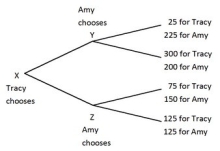 The equilibrium to the game results in ________ for Amy and Tracy relative to what they could get if they could solve their ________.
 (Multiple Choice)
4.8/5 (79)
(79) Refer to the figure below. In this game, how many dominant strategies does Player A have? 
(Multiple Choice)
4.9/5 (64)
(64) Suppose the market for bottled water is served by two oligopolists. If they reach an agreement to restrict production and charge a price above marginal cost, then:
(Multiple Choice)
4.8/5 (70)
(70) Refer to the figure below. What is the Nash equilibrium of this game? 
(Multiple Choice)
4.7/5 (79)
(79) Suppose Grandis and Immanis are the only two companies that sell the product whose market demand curve is shown in the accompanying figure. For both companies, both average total cost and marginal cost are constant and equal to $2 (ATC = MC = $2).  Suppose Grandis and Immanis agree to collude by both charging the price a monopolist would charge and each producing half of the monopolist's profit-maximizing level of output. Grandis, however, decides to cheat on the collusive agreement. If Grandis charges $1 less than the monopoly price while Immanis continues to charge the monopoly price, then Grandis will earn a profit of ________ per day.
 (Multiple Choice)
4.7/5 (80)
(80) Quick Buck and Pushy Sales produce and sell identical products and face zero marginal and average cost. Below is the market demand curve for their product.  Suppose Quick Buck and Pushy Sales decide to collude and work together as a monopolist with each firm producing half the quantity demanded by the market at the monopoly price. If Quick Buck cheats by reducing its price to $1 and Pushy Sales matches the price cut, then if consumers are evenly split between the two firms, what will be Quick Buck's economic profit?
 (Multiple Choice)
4.8/5 (66)
(66) 
Filters
- Essay(0)
- Multiple Choice(0)
- Short Answer(0)
- True False(0)
- Matching(0)